VPN Gateway and ADC Vulnerabilities: The Hidden Risks in Network Perimeters
Misconfigured application delivery controllers often expose internal services directly to the internet, bypassing firewall rules that assume traffic is already authenticated.
VPN gateways and application delivery controllers introduce complex attack surfaces through protocol handling and configuration errors. These systems often fail to validate input at the network edge, allowing attackers to exploit buffer overflows or session fixation. Proper hardening requires strict input validation and regular penetration testing to identify misconfigurations before they become breaches.
What makes VPN gateways vulnerable to remote code execution?
VPN gateways are vulnerable to remote code execution because they process untrusted network packets from the internet and translate them into internal traffic. This translation process often involves complex protocol parsing that can trigger buffer overflows if input validation is insufficient. Attackers send malformed packets that crash the service or execute arbitrary code. The risk increases when vendors release firmware updates that patch known issues but introduce new parsing errors. You must assume the gateway software contains bugs until proven otherwise.
Why do application delivery controllers expose internal services?
Application delivery controllers expose internal services when they are configured to reverse proxy traffic without strict access controls. These devices sit between the internet and your servers, often terminating SSL connections to inspect content. If the controller trusts all traffic passing through it, an attacker can craft requests that bypass security filters. This creates a path to internal applications that should remain hidden. You need to verify that the controller enforces least privilege for every backend service it connects to.
How does SSL termination create security risks?
SSL termination creates security risks because the application delivery controller decrypts traffic before forwarding it to backend servers. This means the internal network sees unencrypted data, which can be intercepted if network segmentation fails. If the controller is compromised, the attacker gains access to all decrypted traffic. This setup also requires careful management of private keys stored on the controller. You should treat the controller as a high-value target that requires the same protection as your database servers.
What role do security misconfigurations play in breaches?
Security misconfigurations play a central role in breaches by leaving default settings active that were never intended for production use. Many administrators deploy devices with default credentials, open management interfaces, or permissive firewall rules. These errors allow attackers to gain administrative access without exploiting software vulnerabilities. You can reduce this risk by implementing automated configuration checks that compare current settings against a hardened baseline. See our guide on security misconfigurations for detailed hardening steps.
How can developers prevent injection attacks in gateway plugins?
Developers prevent injection attacks in gateway plugins by using parameterized queries and strict output encoding for all user-supplied data. Plugins often handle authentication or logging, which makes them targets for SQL injection or command injection. If the plugin writes data to a database or log file without validation, an attacker can manipulate the input to execute malicious commands. You must validate input at the earliest possible point in the processing chain. Refer to the guides on parameterized queries and output encoding for implementation details.
See also: Port Scan Response: Containment, Recovery, and Prevention Steps · Difference Between ARP Spoofing and ARP Poisoning Explained
Why is fuzz testing critical for custom gateway logic?
Fuzz testing is critical for custom gateway logic because it discovers memory corruption bugs that static analysis tools miss. Custom plugins or scripts often handle edge cases in network protocols that standard libraries do not cover. By sending random or malformed data to these components, you can identify crashes that indicate buffer overflows or use-after-free errors. This proactive approach helps you patch vulnerabilities before attackers discover them. You should integrate fuzz testing into your continuous integration pipeline for any code that processes network traffic.
How do session management flaws compromise VPN access?
Session management flaws compromise VPN access by allowing attackers to hijack or forge valid user sessions. If the gateway generates predictable session tokens or fails to invalidate them properly, an attacker can reuse captured tokens to gain access. This is especially dangerous when combined with cross-site request forgery (CSRF) attacks that trick authenticated users into performing actions. You must ensure that session tokens are cryptographically random and bound to specific client identifiers. Check our guide on cross-site request forgery (CSRF) for mitigation strategies.
What is the impact of insecure direct object references in ADCs?
Insecure direct object references in application delivery controllers allow attackers to access resources they should not see by manipulating request parameters. If the controller uses predictable IDs for backend resources, an attacker can guess valid IDs and retrieve sensitive data. This flaw often exists when the controller fails to verify that the authenticated user has permission to access the requested resource. You must implement server-side access checks for every request that references an internal object. See the guide on insecure direct object references (IDOR) for prevention techniques.
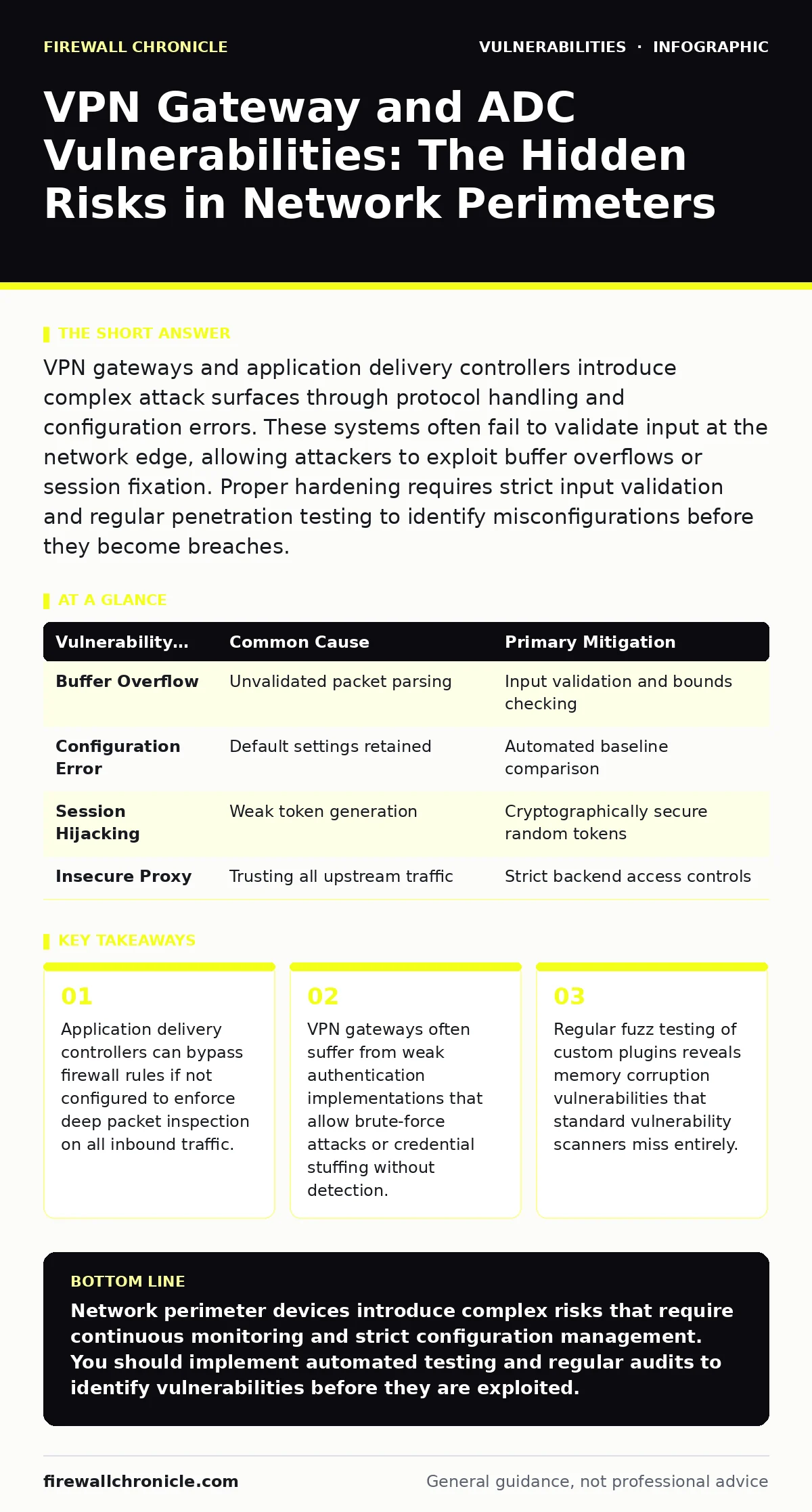
| Vulnerability Type | Common Cause | Primary Mitigation |
|---|---|---|
| Buffer Overflow | Unvalidated packet parsing | Input validation and bounds checking |
| Configuration Error | Default settings retained | Automated baseline comparison |
| Session Hijacking | Weak token generation | Cryptographically secure random tokens |
| Insecure Proxy | Trusting all upstream traffic | Strict backend access controls |
How do DLL hijacking risks affect gateway stability?
DLL hijacking risks affect gateway stability when the software loads libraries from insecure directories. If the gateway searches for required libraries in user-writable paths, an attacker can place a malicious library there. When the service restarts, it loads the malicious code with elevated privileges. This allows the attacker to take full control of the gateway. You must ensure that all libraries are loaded from secure, system-protected directories. Consult the guide on DLL hijacking for secure loading practices.
Key takeaways
- Application delivery controllers can bypass firewall rules if not configured to enforce deep packet inspection on all inbound traffic.
- VPN gateways often suffer from weak authentication implementations that allow brute-force attacks or credential stuffing without detection.
- Regular fuzz testing of custom plugins reveals memory corruption vulnerabilities that standard vulnerability scanners miss entirely.
Network perimeter devices introduce complex risks that require continuous monitoring and strict configuration management. You should implement automated testing and regular audits to identify vulnerabilities before they are exploited.
Frequently asked questions
Can a VPN gateway protect against all types of attacks?
No, a VPN gateway only secures the connection tunnel. It does not protect against application-level vulnerabilities or compromised endpoints inside the network.
How often should I update my application delivery controller firmware?
You should update firmware as soon as critical security patches are released. Delaying updates leaves known vulnerabilities open to exploitation.
What is the difference between a VPN and an ADC?
A VPN encrypts traffic for remote access, while an ADC manages and optimizes application traffic delivery. Both handle traffic but serve different primary functions.
Do I need a separate firewall if I have an ADC?
Yes, an ADC focuses on application performance and delivery. It does not replace the deep packet inspection and threat prevention features of a dedicated firewall.
How this guide was produced: written by the Firewall Chronicle editorial team with AI assistance, checked against the public references listed below, and reviewed when the facts change. See our editorial policy or report an error.