Difference Between ARP Spoofing and ARP Poisoning Explained
These terms describe the same attack mechanism where an attacker corrupts local address tables to intercept or block network traffic without leaving the subnet.
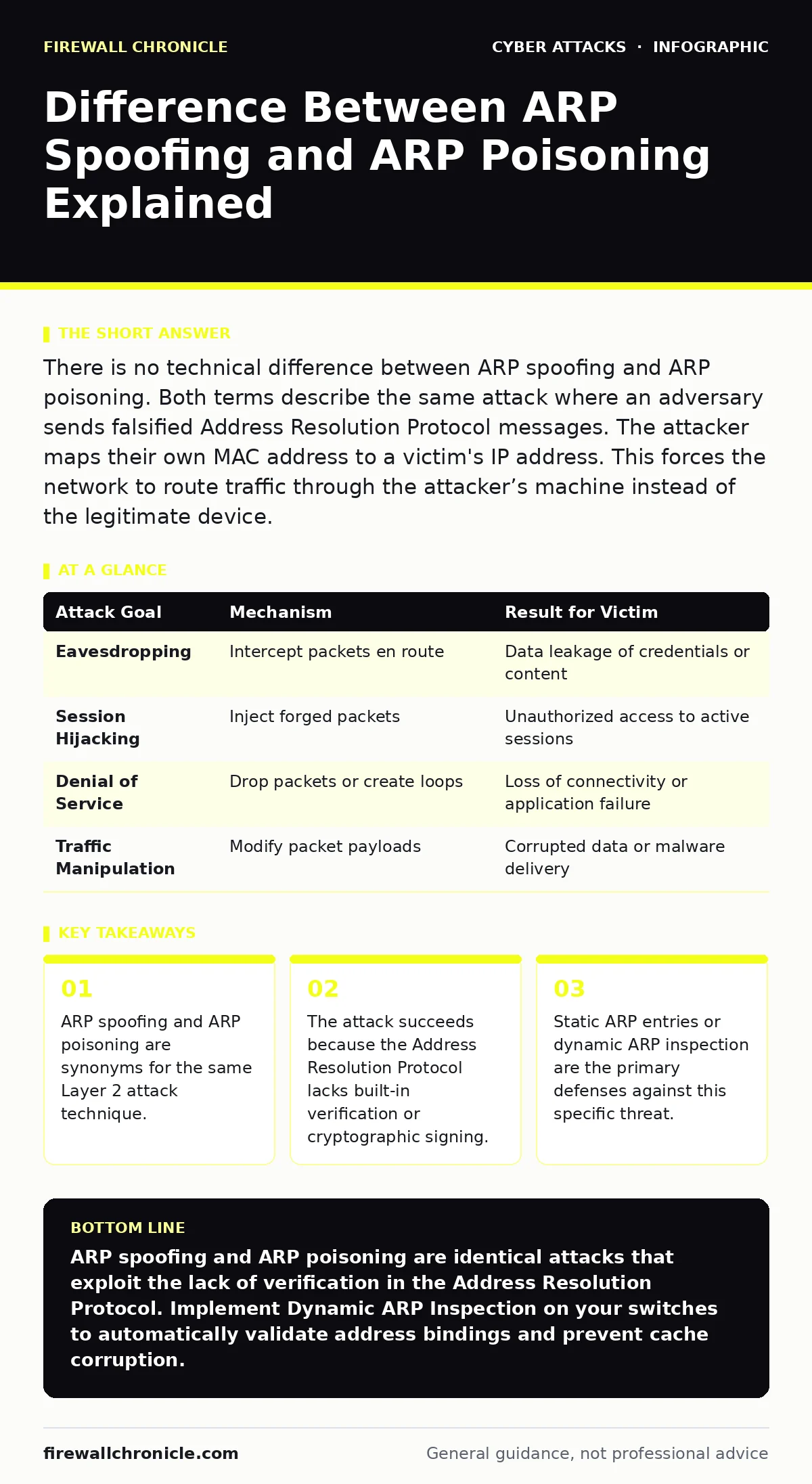
There is no technical difference between ARP spoofing and ARP poisoning. Both terms describe the same attack where an adversary sends falsified Address Resolution Protocol messages. The attacker maps their own MAC address to a victim's IP address. This forces the network to route traffic through the attacker’s machine instead of the legitimate device.
What is the actual difference between ARP spoofing and ARP poisoning?
The difference between ARP spoofing and ARP poisoning is purely semantic, not technical. Both terms refer to the exact same exploit against the Address Resolution Protocol. You use one word or the other based on habit, not because the underlying mechanism changes. The attacker sends gratuitous ARP replies or unsolicited ARP responses to the local network segment. These packets claim a false association between an IP address and a MAC address. The victim device updates its ARP cache with this incorrect information. Traffic intended for the legitimate IP address is then sent to the attacker’s hardware address.
Why does the Address Resolution Protocol allow this attack?
The Address Resolution Protocol was designed for speed and simplicity, not security. It operates at the data link layer of the OSI model. When a device needs to send data to an IP address on the local network, it broadcasts an ARP request. Any device can respond to this request. The protocol assumes that the first response received is the correct one.
There is no handshake to verify the sender’s identity. There is no cryptographic signature to prove the MAC address belongs to the claimed IP address. This trust model creates a fundamental vulnerability in flat network segments. An attacker does not need to crack a password or bypass a firewall. They simply need to be on the same switch or wireless access point.
How does the attack manipulate network traffic flow?
Imagine a local network with a web server, a database server, and a compromised workstation. The attacker runs a script that continuously sends forged ARP replies. One reply tells the web server that the database server’s IP address is now associated with the attacker’s MAC address. Another reply tells the database server that the web server’s IP address is associated with the attacker’s MAC address. The attacker’s machine becomes a man-in-the-middle. All traffic between the two servers passes through the attacker. The attacker can read, modify, or drop packets. If the attacker enables IP forwarding on their machine, the traffic reaches its destination, making the attack harder to detect.
What are the immediate consequences for the victim?
The primary consequence is a loss of confidentiality and integrity. The attacker can inspect unencrypted traffic passing through the network segment. This includes cleartext protocols like HTTP, FTP, or Telnet. Even if the application uses encryption, the attacker can perform session hijacking if they capture the initial handshake.
The attacker can also cause a denial of service. By mapping the gateway’s IP address to a non-existent MAC address, the victim loses internet connectivity. By mapping all IPs to a single MAC address, the attacker can create a bottleneck or crash the network switch. The victim often sees slow performance or intermittent connectivity before realizing the network is compromised.
| Attack Goal | Mechanism | Result for Victim |
|---|---|---|
| Eavesdropping | Intercept packets en route | Data leakage of credentials or content |
| Session Hijacking | Inject forged packets | Unauthorized access to active sessions |
| Denial of Service | Drop packets or create loops | Loss of connectivity or application failure |
| Traffic Manipulation | Modify packet payloads | Corrupted data or malware delivery |
How do developers detect this activity in their tools?
Standard application logs rarely show ARP spoofing because the attack happens below the transport layer. You must look at network-level data. Packet captures are the most reliable source. Tools like Wireshark allow you to filter for ARP traffic. Look for multiple ARP replies for the same IP address within a short timeframe. A legitimate switch or router usually responds once.
An attacker floods the network with updates. You can also monitor for duplicate MAC addresses. If two different ports on a switch report the same MAC address, an attack is likely in progress. Network flow data can also reveal unexpected traffic patterns, such as a workstation suddenly communicating with a server it never contacted before.
See also: Port Scan Response: Containment, Recovery, and Prevention Steps · VPN Gateway and ADC Vulnerabilities: The Hidden Risks in Network Perimeters
What are the effective defenses against this threat?
The most effective defense is Dynamic ARP Inspection. This feature is available on managed network switches. It validates ARP packets against a trusted database of IP-to-MAC bindings. Packets that do not match the database are dropped. This requires proper network configuration and switch support. If you cannot control the network hardware, use static ARP entries on critical servers. You manually map the IP address of the gateway and critical peers to their correct MAC addresses. This prevents the cache from being overwritten. However, static entries are difficult to manage in dynamic environments. Another option is ARP monitoring tools that watch for cache changes and alert administrators.
Why do static ARP entries fail in cloud environments?
Static ARP entries assume a stable physical or virtual topology. In cloud environments, virtual machines are frequently moved, resized, or replaced. The MAC address of a virtual machine may change when it is restarted or migrated. If you hardcode a MAC address, the connection breaks when the cloud provider changes the underlying hardware.
This makes static ARP entries a poor choice for cloud-based infrastructure. In these cases, you must rely on software-defined networking features. Many cloud providers offer virtual private clouds with built-in protections against ARP spoofing. These protections are often enabled by default. You should verify that these controls are active and cannot be disabled by users.
How does this relate to other network security concepts?
ARP spoofing is a prerequisite for many other attacks. It allows an attacker to position themselves to perform more complex exploits. For example, an attacker can use the intercepted traffic to launch dictionary attacks against weak credentials. They can also inject malicious scripts to perform formjacking on web applications. Understanding ARP spoofing helps you see the broader picture of network security. It is not just about protecting the network layer. It is about preventing the attacker from gaining the vantage point needed for higher-level attacks. Combining network controls with application-level security reduces the overall risk.
What steps should you take if you suspect an attack?
If you suspect ARP spoofing, isolate the compromised segment immediately. Disconnect the suspected attacker’s device from the network. Check the ARP tables on critical servers for incorrect mappings. Reset the ARP cache on affected devices to clear the poisoned entries. Investigate the source of the forged packets. Look for processes running on local machines that generate network traffic. Check for unauthorized software that might be performing the attack. Review network switch logs for port security violations. Implement Dynamic ARP Inspection or static ARP entries to prevent recurrence. Monitor the network for similar patterns in the future.
Key takeaways
- ARP spoofing and ARP poisoning are synonyms for the same Layer 2 attack technique.
- The attack succeeds because the Address Resolution Protocol lacks built-in verification or cryptographic signing.
- Static ARP entries or dynamic ARP inspection are the primary defenses against this specific threat.
ARP spoofing and ARP poisoning are identical attacks that exploit the lack of verification in the Address Resolution Protocol. Implement Dynamic ARP Inspection on your switches to automatically validate address bindings and prevent cache corruption.
Frequently asked questions
Can ARP spoofing work across different subnets?
No, ARP is a local broadcast protocol. It does not route across subnet boundaries. An attacker must be on the same Layer 2 segment as the victim to successfully spoof an address.
Does using a VPN prevent ARP spoofing?
A VPN encrypts traffic between the endpoint and the VPN server. It does not protect the local network traffic between the endpoint and the gateway. ARP spoofing can still occur on the local link.
How long does an ARP cache entry last?
The timeout varies by operating system, typically ranging from a few minutes to an hour. An attacker must continuously send forged packets to maintain the hijack before the cache expires.
Are wireless networks more vulnerable to ARP spoofing?
Wireless networks are equally vulnerable. In fact, they may be easier to attack because an attacker does not need physical access to the switch. They only need to connect to the same Wi-Fi network.
How this guide was produced: written by the Firewall Chronicle editorial team with AI assistance, checked against the public references listed below, and reviewed when the facts change. See our editorial policy or report an error.