
Network Segmentation: Stop Lateral Movement Before It Starts
Compartmentalizing your infrastructure limits blast radius, ensuring a single compromised host cannot access sensitive data stores.
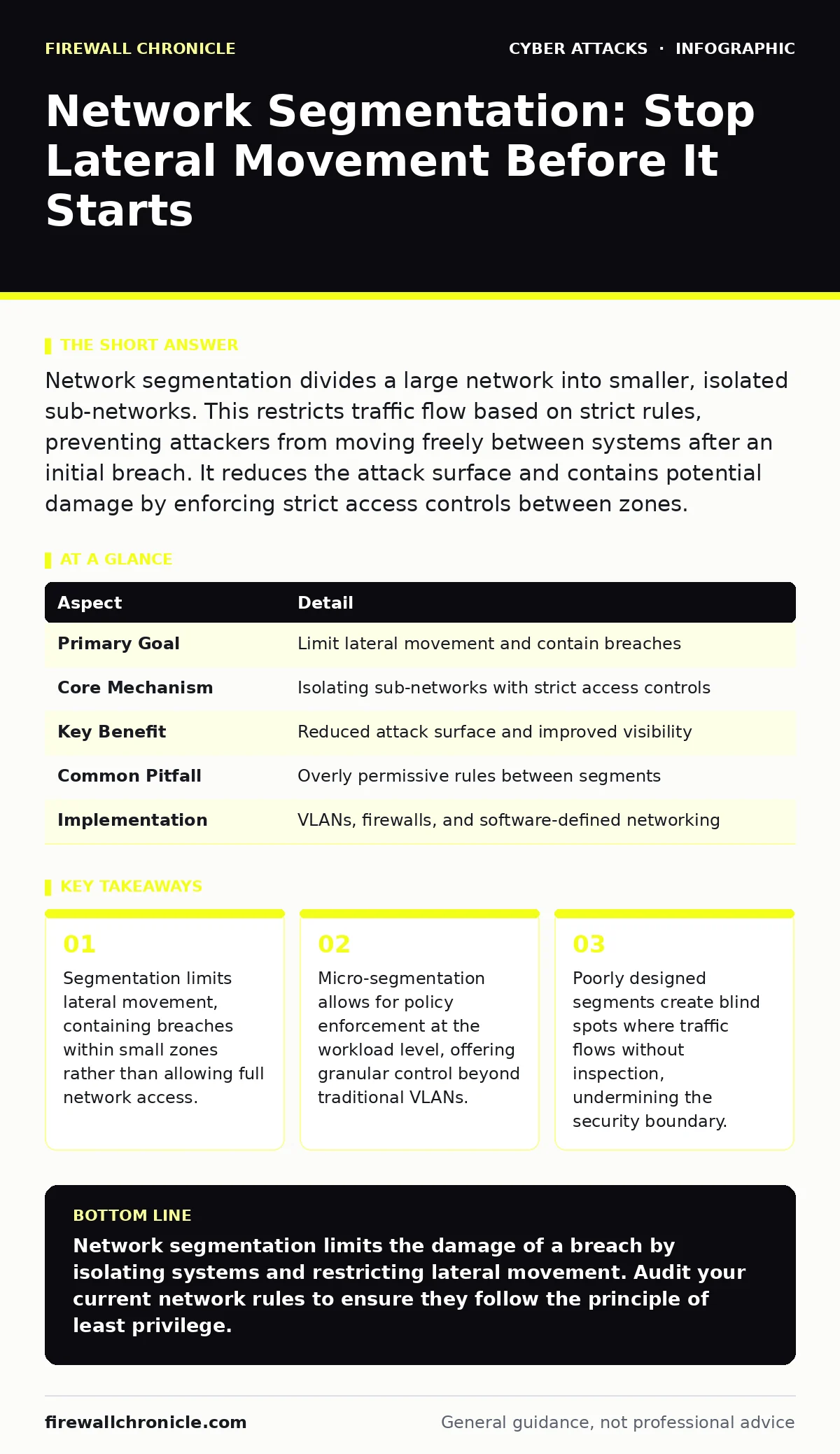
Network segmentation divides a large network into smaller, isolated sub-networks. This restricts traffic flow based on strict rules, preventing attackers from moving freely between systems after an initial breach. It reduces the attack surface and contains potential damage by enforcing strict access controls between zones.
The Walled Garden Analogy
Imagine a corporate campus where every office shares a single, open courtyard. If an intruder enters through one window, they can walk freely to the executive suite, the server room, and the break room. Now imagine that same campus divided by secure gates, with each building requiring a separate badge to enter. Even if the intruder breaches the perimeter, they remain trapped in the initial zone. Network segmentation operates on this exact principle. It transforms a flat, open network into a series of isolated compartments.
Defining the Boundary
Network segmentation is the practice of dividing a computer network into smaller, distinct sub-networks. Each segment operates with its own set of security policies and access controls. Traffic between these segments is filtered and inspected, ensuring that only authorized data flows across the boundaries. This approach contrasts with a flat network, where any device can communicate with any other device without restriction. In a flat network, the failure of one security control exposes every asset. Segmentation adds layers of defense, forcing an attacker to overcome multiple barriers to reach valuable data.
The Problem of Flat Networks
Most organizations start with a simple network topology for ease of management. Devices connect to a central switch, and firewalls sit only at the perimeter. This creates a single point of failure. If an attacker gains access to one workstation, they have a direct path to every other system. This is particularly dangerous for lateral movement, the technique where attackers move from one compromised system to another. Without segmentation, the entire network becomes a single blast zone. A single vulnerability can lead to total compromise.
| Aspect | Detail |
|---|---|
| Primary Goal | Limit lateral movement and contain breaches |
| Core Mechanism | Isolating sub-networks with strict access controls |
| Key Benefit | Reduced attack surface and improved visibility |
| Common Pitfall | Overly permissive rules between segments |
| Implementation | VLANs, firewalls, and software-defined networking |
The Anatomy of Segmentation
Effective segmentation relies on three main components. First, you need logical or physical separation. Logical separation uses Virtual Local Area Networks (VLANs) to group devices logically, even if they share the same physical switch. Physical separation uses distinct hardware, which is more secure but costlier. Second, you need enforcement points. These are firewalls or access control lists that inspect traffic between segments. They decide what is allowed and what is blocked. Third, you need a clear policy. This defines who can talk to whom and over which protocols. Without a policy, the technical controls are meaningless.
Micro-Segmentation for Modern Infrastructure
Traditional segmentation works at the network layer, grouping devices by location or function. Micro-segmentation takes this further by isolating individual workloads or applications. This is critical in virtualized and cloud environments where servers spin up and down dynamically. With micro-segmentation, security policies follow the workload, regardless of its location.
This prevents east-west traffic, which is traffic between servers within the data center, from flowing unchecked. It ensures that even if an attacker is inside the network, they cannot move laterally to other applications. This level of granularity provides defense in depth, adding security at the application layer rather than just the network edge.
See also: Remote Access Trojan Prevention Checklist for Secure Systems · Web Filtering Checklist: Configure Categories, Logs, and Exceptions
Integration with Other Defences
Segmentation does not replace other security measures; it enhances them. It works in tandem with identity management to ensure that users and services are who they claim to be. It complements endpoint protection by limiting the damage if an endpoint is breached. Consider the threat of social engineering, where attackers trick users into revealing credentials. Even if an attacker obtains valid credentials through such means, segmentation restricts what those credentials can access. Similarly, if you deploy hardware security keys for strong authentication, segmentation ensures that a stolen key cannot grant access to the entire infrastructure. It acts as a safety net when other controls fail.
Common Implementation Errors
Many organizations implement segmentation but fail to enforce it strictly. A common mistake is creating "hairpin" routes, where traffic leaves a segment to reach another segment and then returns, bypassing security controls. Another error is overly permissive rules between segments. Administrators often allow all traffic between certain zones to avoid breaking applications, effectively creating a flat network within the segmented structure. This undermines the purpose of segmentation. You must regularly audit rules to ensure they align with business needs. Remove any rule that is not explicitly required.
The Hidden Cost of Complexity
Segmentation introduces complexity that can hinder operations. Troubleshooting network issues becomes harder when traffic must pass through multiple inspection points. Latency may increase if every packet is deeply inspected. Furthermore, managing the policies requires specialized skills. If the segmentation design is flawed, it can create blind spots.
For instance, if you segment based on IP addresses but do not account for dynamic IP assignment, devices may end up in the wrong segment. This is where the advice to "just segment everything" fails. You must balance security with usability. Over-segmentation can break legitimate business processes, leading to shadow IT or bypassed controls.
Final Considerations
Network segmentation is not a one-time project but a continuous process. As your infrastructure grows, you must adjust your segments and policies. Regular testing is essential to ensure that controls are working as intended. This includes penetration testing and red team exercises to simulate attacks. By validating your segmentation, you can identify gaps before attackers do. Remember that segmentation is about limiting damage, not preventing initial entry. It is a critical layer in a layered security strategy.
Key takeaways
- Segmentation limits lateral movement, containing breaches within small zones rather than allowing full network access.
- Micro-segmentation allows for policy enforcement at the workload level, offering granular control beyond traditional VLANs.
- Poorly designed segments create blind spots where traffic flows without inspection, undermining the security boundary.
Network segmentation limits the damage of a breach by isolating systems and restricting lateral movement. Audit your current network rules to ensure they follow the principle of least privilege.
Frequently asked questions
Does segmentation prevent all types of cyber attacks?
No, segmentation does not prevent initial breaches but limits their impact by restricting movement within the network.
How does segmentation differ from a VPN?
A VPN encrypts traffic over public networks, while segmentation isolates internal network zones to control traffic flow.
Can segmentation slow down network performance?
Yes, additional inspection points can introduce latency, but modern hardware and optimized policies minimize this impact.
Is micro-segmentation necessary for small businesses?
It depends on your risk profile; traditional segmentation may suffice for smaller, less complex environments.
How this guide was produced: written by the Firewall Chronicle editorial team with AI assistance, checked against the public references listed below, and reviewed when the facts change. See our editorial policy or report an error.