Insecure Direct Object References: How Hidden IDs Leak Data
Insecure direct object references expose data when applications trust user-supplied identifiers without verifying ownership or access rights.
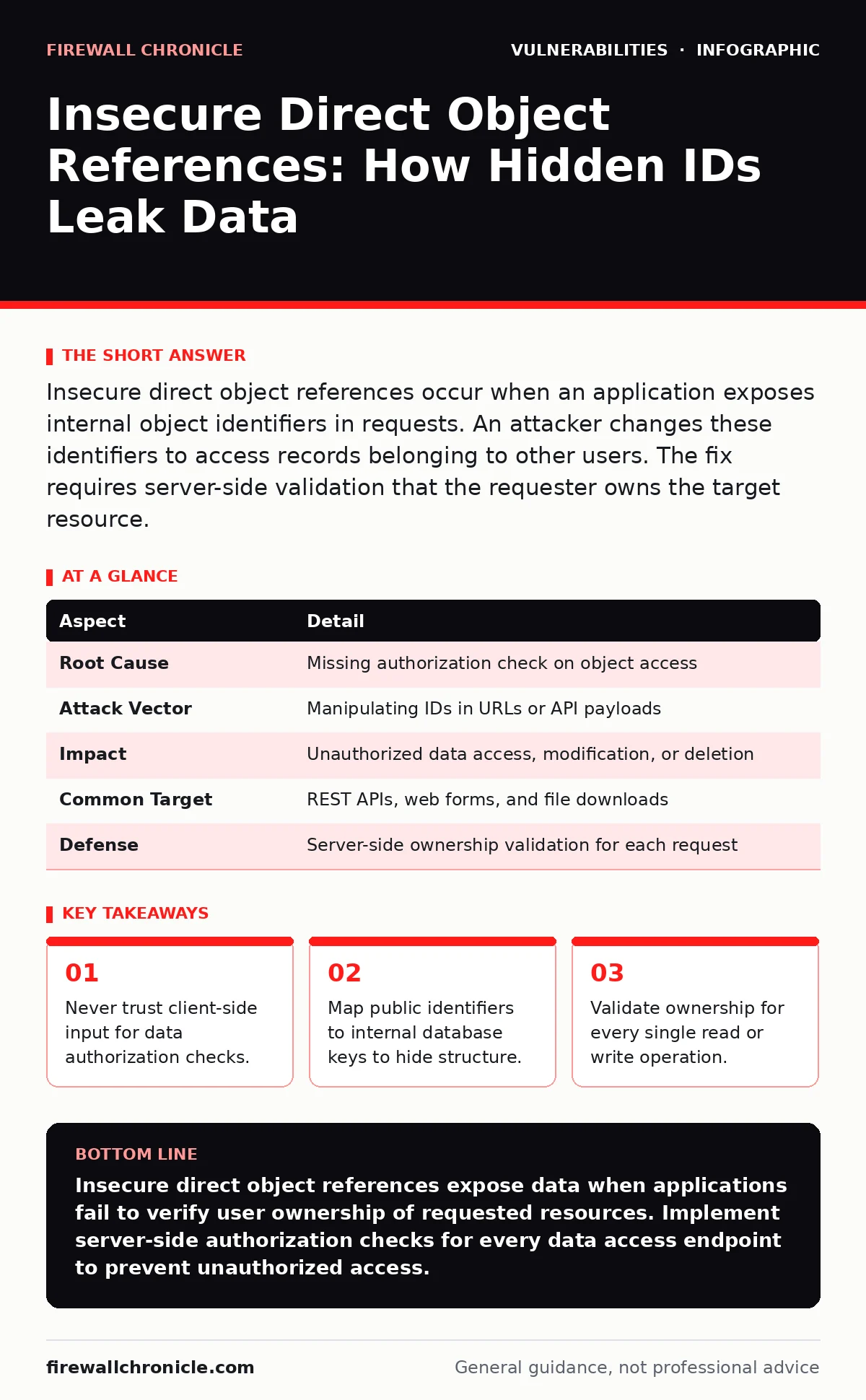
Insecure direct object references occur when an application exposes internal object identifiers in requests. An attacker changes these identifiers to access records belonging to other users. The fix requires server-side validation that the requester owns the target resource.
Insecure Direct Object References Explained
Imagine you work at a bank with numbered safety deposit boxes. The teller hands you a card with box number 101. You can open it because you presented the card. Now imagine you hand the teller a card for box 102. If the teller opens it without checking if box 102 belongs to you, the bank has a security flaw. This is exactly how insecure direct object references work in software.
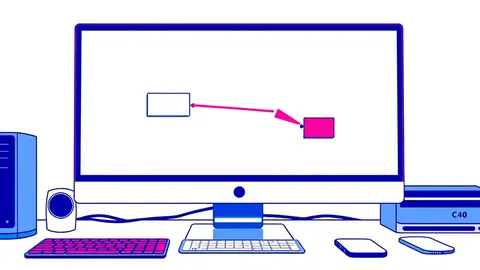
Insecure direct object references happen when an application uses a user-supplied value to access a data object directly. The application fails to verify that the user has permission to access that specific object. This creates a path for attackers to traverse data boundaries simply by changing a number or string in a request.
| Aspect | Detail |
|---|---|
| Root Cause | Missing authorization check on object access |
| Attack Vector | Manipulating IDs in URLs or API payloads |
| Impact | Unauthorized data access, modification, or deletion |
| Common Target | REST APIs, web forms, and file downloads |
| Defense | Server-side ownership validation for each request |
How Insecure Direct Object References Work
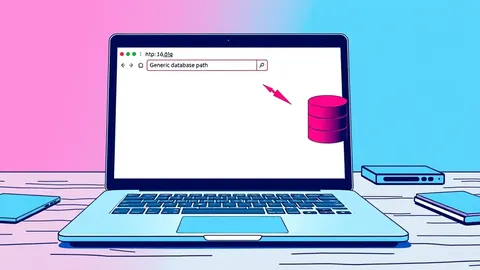
The mechanism relies on the application exposing an internal identifier. This identifier often appears in a URL path, a query parameter, or a JSON body. The application accepts this identifier and passes it directly to the database or file system. It assumes that because the user reached this page, they are allowed to see this data.
Consider a profile page. The URL might be example.com/profile?user_id=500. The application retrieves the user with ID 500 from the database. It does not check if the current session belongs to user 500. An attacker changes the URL to user_id=501. The application returns the data for user 501. This is a direct object reference vulnerability. The application trusts the input too much.
Who Is Affected by Insecure Direct Object References
Any application that allows users to access specific resources is at risk. This includes e-commerce sites, banking platforms, healthcare portals, and internal enterprise tools. The vulnerability affects anyone who can interact with the application. It does not require complex exploits or zero-day flaws.
Developers often assume that authentication solves this problem. Authentication proves who you are. Authorization proves what you can do. Insecure direct object references are an authorization failure. You are logged in, but you are accessing someone else's data. This distinction matters because many teams focus heavily on login security while neglecting data access controls.
What People Usually Get Wrong
A common mistake is relying on session variables for authorization. Developers store the user ID in a server-side session. They then compare this session variable to the requested ID. This seems safe until an attacker finds a way to manipulate the session or until the application logic changes. The comparison must happen at the data access layer, not just at the input layer.
Another error is hiding the vulnerability behind obfuscation. Developers use UUIDs or hash values instead of sequential integers. This makes guessing harder but does not stop an attacker who can view one valid ID. If the system does not check ownership, any valid ID becomes a target. Obfuscation is not a security control. It is merely a deterrent that slows down casual scanning.
Server-Side Validation Strategies
The primary defense is to enforce authorization on every request. The server must verify that the authenticated user has the right to access the requested object. This check must happen before the data is retrieved or modified. It cannot be skipped for performance reasons.
Use a consistent pattern for these checks. Create a helper function that takes the current user and the target object. This function returns true only if the user owns the object or has administrative privileges. Apply this function to every endpoint that serves specific data. This reduces the chance of missing a check in complex code paths.
See also: Cross-Site Request Forgery (CSRF): Mechanisms, Mitigations, and Edge Cases
Hiding Internal Identifiers
You can reduce the attack surface by not exposing internal database keys. Map internal IDs to public tokens. When a user requests data, they provide the public token. The server translates this token to the internal ID. The server then performs the ownership check.
This approach has two benefits. First, it prevents attackers from enumerating records by incrementing numbers. Second, it allows you to revoke access by invalidating the token without changing the database. However, this adds complexity to your data layer. You must maintain the mapping table and ensure it stays in sync with the primary data.
Integration with Threat Modeling
Insecure direct object references are often missed during initial development. They appear as logical flaws rather than code errors. Including this vulnerability in your threat modeling process helps catch it early. Map out data flows and identify where user input influences data access.
Ask specific questions during threat modeling. Who owns this data? How does the application verify ownership? What happens if the ID is changed? Document the expected behavior for unauthorized access. This creates a checklist for code reviews. It ensures that every new feature includes proper authorization checks.
Beyond Basic Authorization
Authorization is not just about ownership. Some systems require role-based access. A manager might view all team tickets. A regular user views only their own. The authorization logic must handle these complex rules. Simple ownership checks are insufficient for hierarchical data.
Consider the interaction with cross-site scripting (XSS). If an attacker can inject script into your page, they might steal the public tokens or IDs. While this is a separate vulnerability, it compounds the risk. Secure your inputs and outputs to prevent script injection. This limits the attacker's ability to harvest valid identifiers.
Testing for Insecure Direct Object References
Manual testing is effective for finding these flaws. Review the API documentation and identify endpoints that accept IDs. Try changing the IDs to values you do not own. Observe the server response. A successful response indicates a vulnerability.
Automated tools can help scan for common patterns. They send modified requests and look for consistent data structures in the responses. However, tools often miss logical flaws that require context. Combine automated scanning with manual review. This ensures you catch both obvious and subtle authorization failures.
Summary of Defenses
Preventing insecure direct object references requires a disciplined approach. You must validate ownership on the server for every data access request. You must hide internal identifiers to prevent enumeration. You must test your authorization logic thoroughly. These steps protect your data from unauthorized access.
The effort required is modest compared to the cost of a data breach. Implementing these checks early saves time and resources. It also builds trust with your users. They know their data is safe from prying eyes. Security is not an afterthought. It is a core part of application design.
Key takeaways
- Never trust client-side input for data authorization checks.
- Map public identifiers to internal database keys to hide structure.
- Validate ownership for every single read or write operation.
Insecure direct object references expose data when applications fail to verify user ownership of requested resources. Implement server-side authorization checks for every data access endpoint to prevent unauthorized access.
Frequently asked questions
How do I detect insecure direct object references in my code?
Review endpoints that accept user-supplied IDs. Check if the code verifies that the current user owns the requested resource before returning data.
Can HTTPS prevent insecure direct object references?
No, HTTPS encrypts data in transit but does not enforce access controls. The server must still validate permissions for each request.
Is using UUIDs enough to stop IDOR?
No, UUIDs make guessing harder but do not prevent access if the application lacks authorization checks. An attacker with one valid UUID can still access data.
How does this differ from broken access control?
Insecure direct object references are a specific type of broken access control. They focus on direct manipulation of object identifiers to access data.
How this guide was produced: written by the Firewall Chronicle editorial team with AI assistance, checked against the public references listed below, and reviewed when the facts change. See our editorial policy or report an error.