Fuzz Testing Limits: What It Finds and What It Misses
Fuzzing excels at breaking parsers but fails to find logic errors, creating a false sense of security if used as the sole validation method.
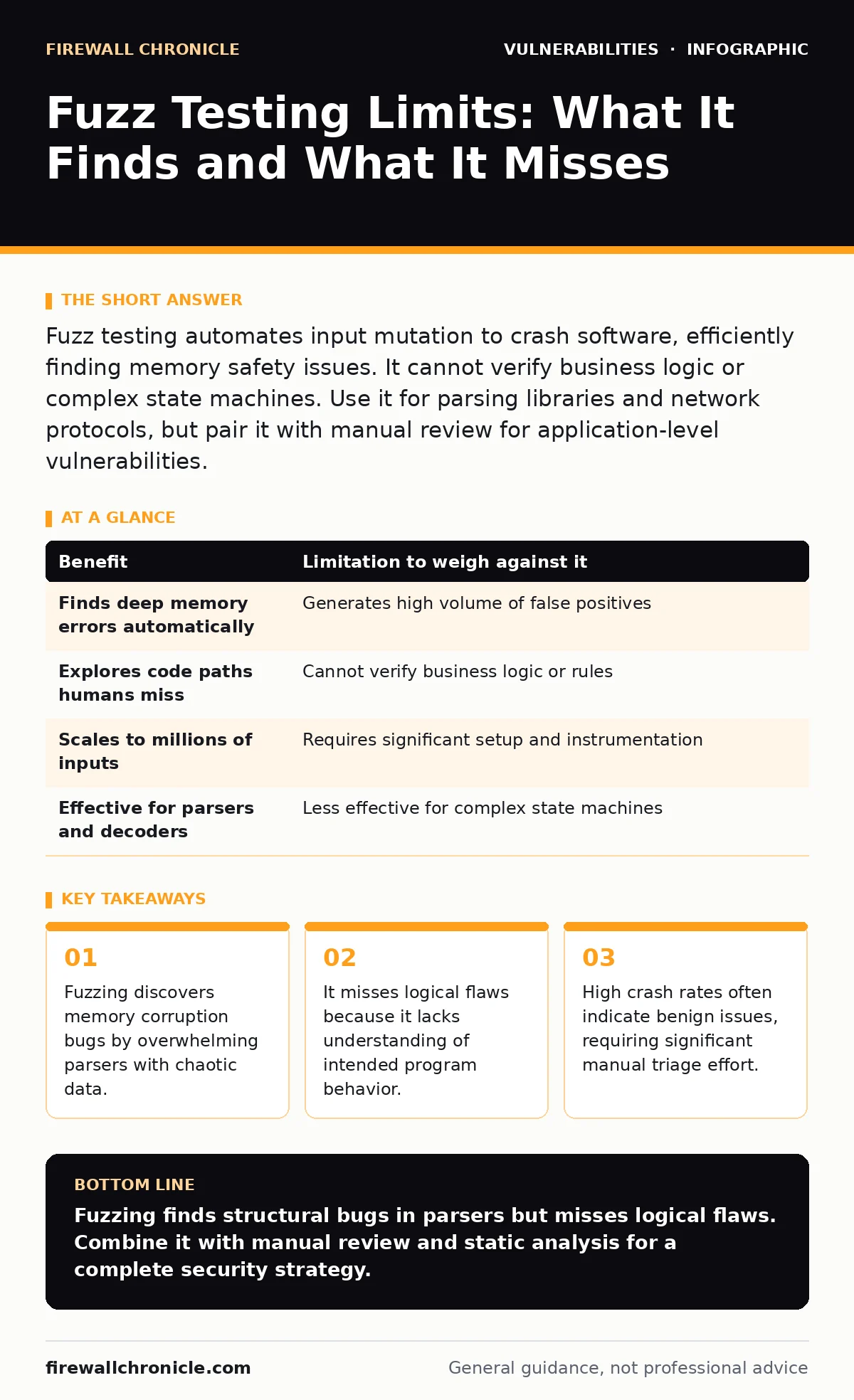
Fuzz testing automates input mutation to crash software, efficiently finding memory safety issues. It cannot verify business logic or complex state machines. Use it for parsing libraries and network protocols, but pair it with manual review for application-level vulnerabilities.
The Mechanics of Automated Chaos
Fuzz testing, or fuzzing, is an automated software testing technique that provides invalid, unexpected, or random data as inputs to a computer program. The program is then monitored for exceptions such as crashes, failing built-in code assertions, or potential memory leaks. You do not need to write specific test cases for every input scenario. Instead, you feed the target application a steady stream of mutated data and watch for failures.
The core mechanism relies on the assumption that if a program cannot handle random garbage, it likely has deeper structural weaknesses. Modern fuzzers use feedback to guide their mutations. They observe which inputs cause new code paths to execute and prioritize those branches. This approach is known as coverage-guided fuzzing. It ensures the tool explores the application’s logic tree rather than blindly repeating similar errors.
Concrete Benefits for Developers
The primary benefit of fuzzing is its ability to find obscure edge cases that human testers overlook. Humans tend to test happy paths and obvious error conditions. A fuzzer does not care about intent. It generates inputs that violate assumptions about length, format, or encoding. This often triggers memory corruption bugs, where data overwrites adjacent memory regions. These bugs are particularly dangerous because they can lead to remote code execution.
Fuzzing also scales indefinitely. Once you set up the environment, the tool runs continuously. It can test millions of inputs per hour without fatigue. This volume is impossible to achieve manually. You gain confidence that your parser handles malformed data gracefully. For libraries that process external data, this is a powerful safety net. It catches issues before they reach production environments where attackers might exploit them.
Honest Limitations and Blind Spots
Fuzzing has significant blind spots. It cannot understand the meaning of the data it generates. If your application requires a valid JSON object with specific nested fields, a fuzzer might generate syntactically correct but semantically invalid data. It will not trigger logic errors that depend on business rules. For example, it might not catch a scenario where a user transfers money to themselves, bypassing a fee, because the fuzzer does not understand the concept of a fee.
Another limitation is the noise-to-signal ratio. Fuzzers often generate thousands of crashes, many of which are harmless. A buffer overflow in a temporary buffer that is immediately discarded is less critical than one in a global structure. You must filter and triage these reports. This process consumes developer time. If you do not have the resources to analyze crashes, fuzzing becomes a burden rather than a benefit.
Weighing Benefits Against Limitations
To decide if fuzzing fits your workflow, you must weigh its strengths against its weaknesses. The table below compares key aspects of fuzzing with their corresponding trade-offs.
| Benefit | Limitation to weigh against it |
|---|---|
| Finds deep memory errors automatically | Generates high volume of false positives |
| Explores code paths humans miss | Cannot verify business logic or rules |
| Scales to millions of inputs | Requires significant setup and instrumentation |
| Effective for parsers and decoders | Less effective for complex state machines |
Imagine you are building a PDF parser. Fuzzing is highly effective here because the format is complex and strict. Now imagine you are building a shopping cart calculator. Fuzzing will struggle because the logic depends on valid product IDs and prices. The table helps you see where the tool shines and where it falters.
When It Is Worth It
Fuzzing is worth the investment when you process untrusted external data. This includes network protocols, file parsers, and image decoders. These components are often the first line of defense against attackers. They are also the most complex, with many edge cases defined by standards bodies. A single mistake in a parser can lead to a severe vulnerability.
It is also valuable for open-source libraries that many other projects depend on. If your library is widely used, the attack surface is large. Fuzzing helps you maintain trust by demonstrating that your code handles malicious input gracefully. You should also consider fuzzing for security-critical components where the cost of a breach is high. The upfront effort pays off by preventing catastrophic failures later.
When It Is Not Worth It
Fuzzing is not worth it for simple, well-defined interfaces. If your application only accepts a small, fixed set of inputs, manual testing is faster and more effective. Fuzzing requires time to explore the input space. If the space is small, the tool will exhaust it quickly without finding new issues.
It is also not suitable for testing high-level business logic. If you need to verify that a discount code applies only to certain items, fuzzing will not help. You need formal verification or manual test cases for this. Fuzzing does not understand context. Using it for logic checks is like using a sledgehammer to thread a needle. It creates more damage than value.
Integrating with Other Techniques
Fuzzing works best when combined with other testing methods. It complements static analysis, which checks code without running it. Static analysis can find potential issues, while fuzzing confirms if they are exploitable. You should also pair fuzzing with dynamic analysis tools that monitor memory usage. This helps you distinguish between serious memory corruption bugs and minor issues.
Consider using parameterized queries to prevent SQL injection, as fuzzing may not generate the specific payloads needed to trigger this vulnerability. Similarly, output encoding is necessary to prevent server-side template injection, which fuzzing might miss due to its lack of semantic understanding. Fuzzing is a tool in your arsenal, not the entire arsenal. It finds structural weaknesses, but you must address logical ones separately.
Managing the Triage Process
The value of fuzzing depends on your ability to triage results. Set up a pipeline that automatically filters known issues. Use crash signatures to group similar crashes. This reduces the noise and allows you to focus on unique failures. Document each crash and its root cause. Over time, you will see patterns emerge.
You should also integrate fuzzing into your continuous integration pipeline. This ensures that new code does not introduce regressions. If a new commit causes a crash, the build fails. This enforces quality standards and keeps the codebase clean. However, be prepared for occasional false positives. Not every crash is a vulnerability. Some may be benign errors that need to be handled gracefully.
Key takeaways
- Fuzzing discovers memory corruption bugs by overwhelming parsers with chaotic data.
- It misses logical flaws because it lacks understanding of intended program behavior.
- High crash rates often indicate benign issues, requiring significant manual triage effort.
Fuzzing finds structural bugs in parsers but misses logical flaws. Combine it with manual review and static analysis for a complete security strategy.
Frequently asked questions
Does fuzzing replace manual security testing?
No, fuzzing automates input mutation but cannot understand business logic or complex attack scenarios that require human insight.
How long should I run a fuzzer?
Run it continuously in your CI pipeline and periodically for longer durations to explore deeper code paths.
Can fuzzing find race condition vulnerabilities?
It can find some race conditions, but specialized tools designed for concurrency testing are more effective for this purpose.
Is fuzzing effective for web applications?
It is less effective for high-level web logic but useful for testing underlying libraries and parsers used by the application.
How this guide was produced: written by the Firewall Chronicle editorial team with AI assistance, checked against the public references listed below, and reviewed when the facts change. See our editorial policy or report an error.