Output Encoding: The Hidden Trade-offs in Web Security
Output encoding neutralizes injection risks at the render layer but fails to address logic flaws or data integrity issues, making it a necessary but insufficient defense.
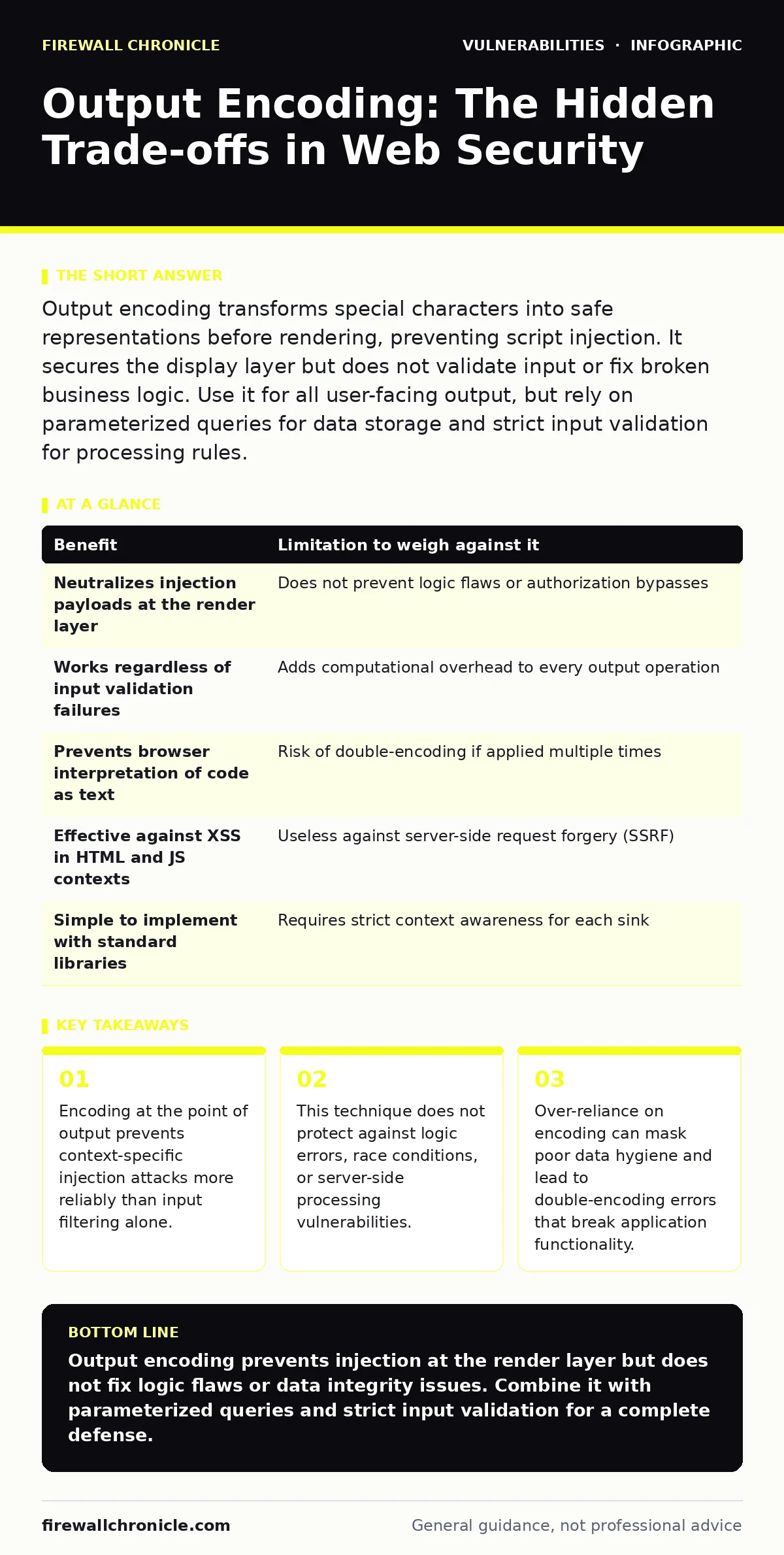
Output encoding transforms special characters into safe representations before rendering, preventing script injection. It secures the display layer but does not validate input or fix broken business logic. Use it for all user-facing output, but rely on parameterized queries for data storage and strict input validation for processing rules.
The Contextual Nature of Encoding
Output encoding is the process of converting data into a format that the target context interprets as literal text rather than executable code. You must encode data based on where it will appear, not just because it came from a user. HTML, JavaScript, CSS, and URL contexts each have their own set of reserved characters. Treating all contexts the same leaves gaps. For example, encoding a character for HTML might leave it dangerous if that same string is later injected into a JavaScript variable.
Imagine you store a user’s name in a database and display it on a profile page. If you encode it for HTML, you convert < to <. This prevents the browser from reading angle brackets as tags. However, if you later use that same name in a URL parameter without URL-encoding it, the space or special characters could break the request structure or allow injection. Context awareness is the core mechanism. You must identify the sink—the point where data leaves your application—and apply the correct encoding scheme for that specific environment.
The Primary Defense Against Injection
The main benefit of output encoding is that it neutralizes payloads at the last possible moment. Input validation often fails because attackers find ways to bypass regex filters or use unexpected character sets. By encoding at output, you assume all input is hostile and render it harmless before the interpreter sees it. This approach aligns with the principle of least privilege at the rendering layer. The browser or client receives data that it cannot mistake for instructions.
This method is particularly effective against cross-site scripting (XSS) attacks. These attacks rely on the browser executing malicious scripts embedded in page content. Proper encoding breaks the script syntax, causing the browser to display the code as plain text. It also mitigates HTML injection, where attackers try to add unwanted elements to a page. By forcing the data into a literal representation, you remove the ability to alter the page structure or behavior through injected markup.
The Illusion of Complete Safety
Output encoding does not fix broken logic. If your application allows a user to change their email address by submitting a form, encoding the output on the confirmation page does not stop the email from changing. It only ensures the confirmation message looks correct. Logic vulnerabilities exist in the business rules, not the display layer. You cannot encode your way out of a flawed authorization check.
Suppose an attacker submits a request to transfer funds. The system processes the request and displays a success message. If the message contains the attacker’s username, encoding it prevents script injection in the message. It does nothing to stop the unauthorized transfer if the backend logic failed to verify permissions. Encoding is a presentation-layer control. It offers no protection for the data model, the database, or the server’s internal state. You must treat it as one layer in a deeper stack.
Hidden Costs and Implementation Risks
Implementing encoding introduces overhead. Every string that leaves the application must be inspected and transformed. This adds processing time and complexity to your codebase. In high-throughput systems, this latency can accumulate. More importantly, it creates a maintenance burden. Developers must remember to encode every output point. Missing one instance creates a vulnerability.
Double encoding is a common pitfall. If you encode data once and then encode it again, the result can become unreadable or break functionality. For instance, encoding & to & and then encoding that result again produces &amp;. This can confuse parsers or cause display errors. You must track the state of your data to avoid redundant transformations. Additionally, encoding can interfere with legitimate use cases, such as rendering Markdown or rich text. You must balance safety with the need for flexible content.
Benefits Versus Limitations
To weigh the value of output encoding, consider its specific strengths against its inherent weaknesses. The table below outlines the trade-offs you face when relying on this technique.
| Benefit | Limitation to weigh against it |
|---|---|
| Neutralizes injection payloads at the render layer | Does not prevent logic flaws or authorization bypasses |
| Works regardless of input validation failures | Adds computational overhead to every output operation |
| Prevents browser interpretation of code as text | Risk of double-encoding if applied multiple times |
| Effective against XSS in HTML and JS contexts | Useless against server-side request forgery (SSRF) |
| Simple to implement with standard libraries | Requires strict context awareness for each sink |
See also: Insecure Direct Object References: How Hidden IDs Leak Data · Formjacking Prevention Checklist for Secure Web Applications
When It Is Worth It
You should use output encoding for any data that originates from an untrusted source and appears in a user interface. This includes user comments, search results, and profile information. If the data will be interpreted by a browser, a mobile client, or an API consumer, encoding is mandatory. It is the final line of defense before the data becomes visible.
It is also worth it when you cannot control the input source. Third-party APIs, uploaded files, and external feeds often contain unpredictable data. Encoding ensures that your application remains stable and secure even when the input violates expectations. For developers, integrating encoding into your templating engine or framework can automate this process. This reduces the chance of human error. However, you must verify that the framework applies the correct encoding for each context.
When It Is Not Enough
Output encoding is not a substitute for secure data handling. You must use parameterized queries when interacting with databases. Encoding SQL statements manually is error-prone and often ineffective against advanced injection techniques. Parameterized queries separate code from data, ensuring the database treats input as values, not commands. This is a structural fix, not a cosmetic one.
It also does not address XML external entity (XXE) attacks. These attacks exploit the parser’s ability to load external resources. Encoding the output of an XML document does not prevent the parser from fetching malicious files during processing. You must disable external entity resolution at the parser level. Similarly, encoding does not help with race condition vulnerabilities. These occur when multiple requests interfere with each other. The timing of the race is unrelated to how the output is displayed. You need atomic operations and proper locking mechanisms to fix those issues.
Beyond the Display Layer
Security extends beyond what the user sees. Memory corruption bugs in server software can allow attackers to execute code regardless of how you encode output. These vulnerabilities exist in the underlying libraries and operating system. You must keep your dependencies updated and use memory-safe languages where possible.
Browser updates also play a role. Modern browsers include features like Content Security Policy (CSP) and strict mode that mitigate the impact of injection attacks. While encoding is your responsibility, these client-side defenses add a layer of resilience. However, they are not a replacement for proper encoding. They assume some level of server-side security.
Fuzz testing can help you find encoding errors. By injecting random or malformed data, you can identify cases where the application fails to encode correctly or crashes. This automated approach complements manual code reviews. It helps uncover edge cases that developers might miss.
Final Considerations
Output encoding is a fundamental practice, but it is not a silver bullet. It protects the presentation layer from injection attacks. It does not secure the logic, the data, or the infrastructure. You must combine it with other techniques to build a resilient system.
The goal is defense in depth. No single control stops all threats. By understanding the limits of encoding, you can allocate resources more effectively. Focus on securing the data flow from input to output. Ensure that each layer adds value rather than redundancy.
Key takeaways
- Encoding at the point of output prevents context-specific injection attacks more reliably than input filtering alone.
- This technique does not protect against logic errors, race conditions, or server-side processing vulnerabilities.
- Over-reliance on encoding can mask poor data hygiene and lead to double-encoding errors that break application functionality.
Output encoding prevents injection at the render layer but does not fix logic flaws or data integrity issues. Combine it with parameterized queries and strict input validation for a complete defense.
Frequently asked questions
Does output encoding prevent all types of injection attacks?
No. It primarily prevents cross-site scripting and HTML injection. It does not stop SQL injection, command injection, or logic-based attacks.
Can I use the same encoding for HTML and JavaScript?
No. Each context has different reserved characters. HTML encoding is insufficient for JavaScript contexts. You must use context-specific encoding schemes.
Is input validation enough if I also use output encoding?
Input validation is a first line of defense, but it is often bypassed. Output encoding is the final safeguard. You need both for a robust security posture.
How do I avoid double-encoding errors?
Track the state of your data. Encode only when outputting to a specific context. Avoid encoding data before storing it in the database unless required by the storage format.
How this guide was produced: written by the Firewall Chronicle editorial team with AI assistance, checked against the public references listed below, and reviewed when the facts change. See our editorial policy or report an error.