
Parameterized Queries Checklist for Secure Database Code
Binding data to query structure prevents the database engine from misinterpreting input as executable commands, stopping injection at the protocol level.
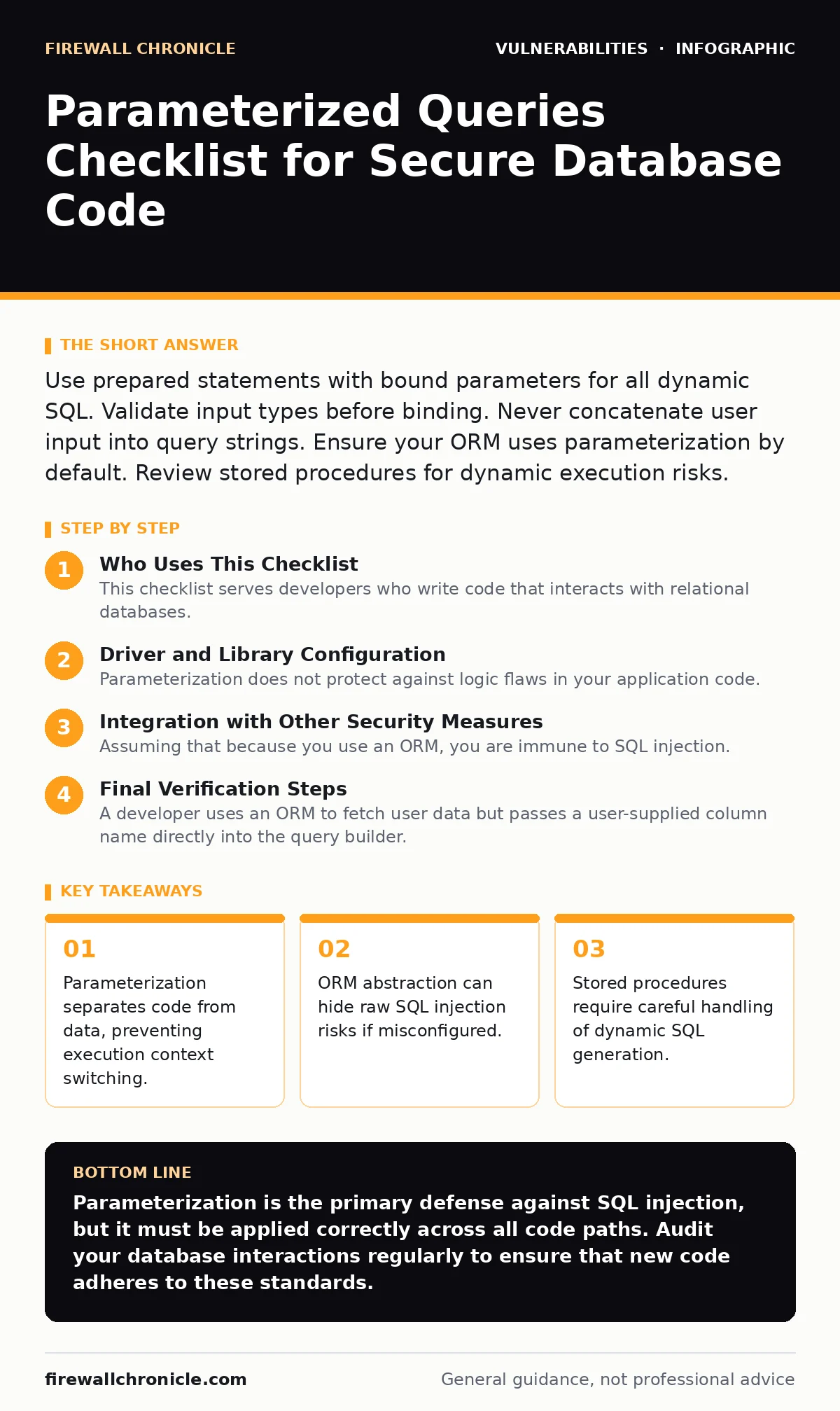
Use prepared statements with bound parameters for all dynamic SQL. Validate input types before binding. Never concatenate user input into query strings. Ensure your ORM uses parameterization by default. Review stored procedures for dynamic execution risks.
Who Uses This Checklist
This checklist serves developers who write code that interacts with relational databases. It applies to backend services, API handlers, and data migration scripts. You use it to verify that your application treats user input as data, not as part of the command structure.
Driver and Library Configuration
- Verify the database driver supports native parameter binding: Native binding occurs at the protocol level, ensuring the server never parses data as code.
- Disable automatic query string concatenation in ORMs: Object-Relational Mappers can bypass safety if they allow raw SQL injection through helper methods.
- Use strict type mapping for bound parameters: Explicit type definitions prevent the driver from guessing data types, which can lead to unexpected parsing.
- Ensure connection pooling does not cache prepared statements incorrectly: Cached plans must be bound to specific parameter sets to avoid cross-request confusion.
- Check that the library does not fall back to string interpolation: Some libraries switch to unsafe string building when complex queries exceed their abstraction limits.
Input Validation and Sanitization
- Validate input length before binding to parameters: Excessively long inputs can cause buffer overflows in older drivers or trigger denial of service.
- Enforce expected data types at the application layer: Type checking ensures that numeric inputs are actually numbers, preventing type-juggling attacks.
- Reject inputs containing special characters that break parsing rules: While parameterization handles most cases, malformed inputs can still cause query failures or errors.
- Use allowlists for enumerated string values: Mapping user input to known valid values reduces the attack surface compared to filtering bad characters.
- Normalize unicode characters before processing: Unicode normalization prevents bypasses where visually identical characters are treated differently by the database.
Dynamic SQL and Stored Procedures
- Avoid dynamic SQL construction for table or column names: Parameterization cannot protect identifiers, which must be validated against a strict allowlist.
- Use stored procedures with fixed parameter signatures: Fixed signatures prevent the procedure from accepting unexpected input patterns that could alter logic.
- Check for EXECUTE IMMEDIATE or equivalent commands in stored code: Dynamic execution within stored procedures reintroduces injection risks if input is concatenated.
- Ensure stored procedures do not return debug information: Detailed error messages can reveal database structure, aiding attackers in crafting further exploits.
- Review permissions assigned to the database user account: Least privilege limits the damage if an injection occurs, preventing administrative actions.
ORM and Framework Specifics
- Verify that ORM query builders use parameterized statements: Some ORMs generate raw SQL for complex joins, bypassing automatic safety mechanisms.
- Check for raw SQL injection points in ORM extensions: Custom extensions or plugins may introduce unsafe query construction methods.
- Ensure that eager loading does not trigger unsafe subqueries: Complex loading strategies can generate dynamic SQL that lacks parameterization.
- Validate that serialization of objects to SQL is safe: Converting complex objects to database rows can introduce unexpected string concatenation.
- Review migration scripts for hardcoded values: Migration scripts often run with elevated privileges and may contain unsafe dynamic SQL.
Edge Cases and Advanced Threats
- Test for second-order injection vulnerabilities: Stored data retrieved later and used in new queries can carry malicious payloads if not re-parameterized.
- Check for polyglot input that works across multiple contexts: Inputs designed to be valid in both application logic and SQL can bypass simple filters.
- Ensure that error handling does not expose query structure: Generic error messages prevent attackers from understanding why a query failed.
- Review logging mechanisms for sensitive data exposure: Logs that record full query strings may store malicious payloads or sensitive user data.
- Consider the impact of database collation settings: Collation differences can affect how characters are compared, potentially bypassing case-sensitive filters.
Integration with Other Security Measures
- Combine parameterization with output encoding for display contexts: Data retrieved from the database must be encoded when rendered in HTML to prevent cross-site scripting.
- Use fuzz testing to identify unexpected parsing behaviors: Automated input variation can reveal edge cases where parameterization fails or behaves unexpectedly.
- Monitor for anomalies in query execution times: Unusual delays can indicate blind injection attempts or complex queries being processed.
- Review CVSS score implications for identified vulnerabilities: Understanding severity helps prioritize fixes, though parameterization prevents most high-severity issues.
- Ensure that VPN appliance vulnerabilities are not exploited to bypass network-level protections: Network security complements application security but does not replace it.
Final Verification Steps
- Perform a manual review of all database interaction points: Automated tools may miss complex logic flows that lead to unsafe query construction.
- Document the parameterization strategy for your team: Clear documentation ensures that new developers understand the security requirements.
- Schedule regular audits of database access patterns: Regular reviews help identify new risks introduced by code changes or library updates.
- Verify that backup and restore processes do not introduce vulnerabilities: Data restoration can execute scripts or stored procedures that may be unsafe.
- Ensure that monitoring alerts are configured for failed login attempts: Brute force attacks on database credentials remain a significant risk.
Key takeaways
- Parameterization separates code from data, preventing execution context switching.
- ORM abstraction can hide raw SQL injection risks if misconfigured.
- Stored procedures require careful handling of dynamic SQL generation.
Parameterization is the primary defense against SQL injection, but it must be applied correctly across all code paths. Audit your database interactions regularly to ensure that new code adheres to these standards.
Frequently asked questions
Does parameterization protect against all types of SQL injection?
Parameterization protects against data-based injection but does not protect against identifier injection, such as table or column names, which must be validated separately.
Can ORMs introduce SQL injection vulnerabilities?
Yes, if developers use raw SQL methods or if the ORM generates unsafe queries for complex operations, injection risks remain present.
What is the difference between parameterization and escaping?
Parameterization sends data and code separately to the database, while escaping modifies data to be safe within a string, which can be bypassed.
How do I handle dynamic table names in SQL queries?
Use a strict allowlist of valid table names and validate the input against this list before constructing the query.
How this guide was produced: written by the Firewall Chronicle editorial team with AI assistance, checked against the public references listed below, and reviewed when the facts change. See our editorial policy or report an error.