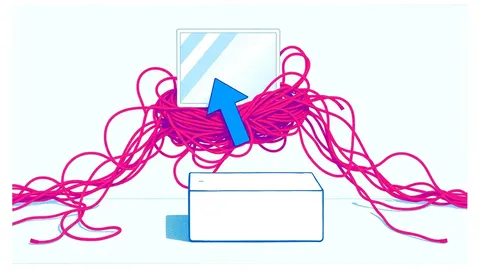
Cross-Site Request Forgery (CSRF): Mechanisms, Mitigations, and Edge Cases
Modern browsers block many CSRF vectors by default, yet state-changing requests without proper anti-forgery tokens remain exploitable through legacy protocols or same-site bypasses.
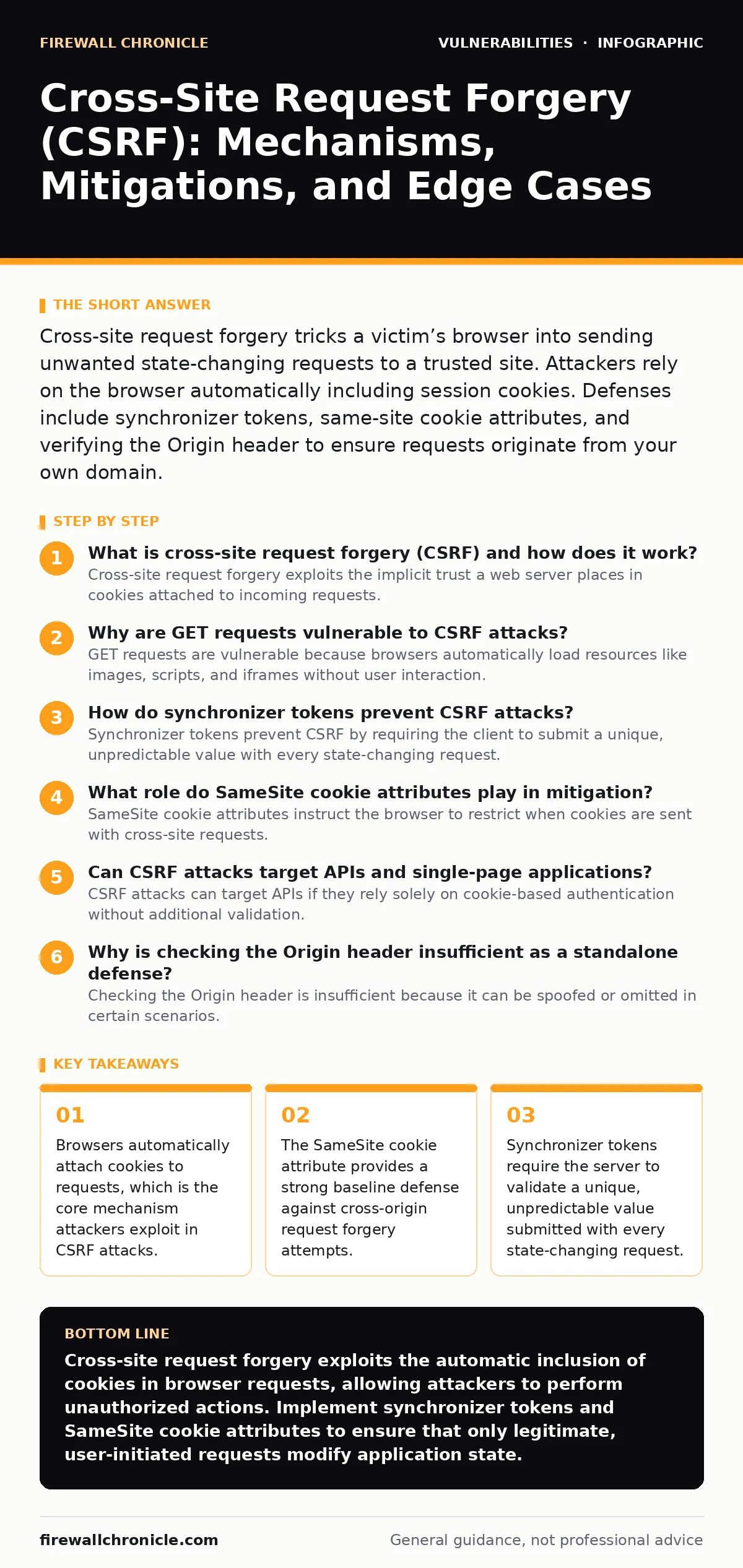
Cross-site request forgery tricks a victim’s browser into sending unwanted state-changing requests to a trusted site. Attackers rely on the browser automatically including session cookies. Defenses include synchronizer tokens, same-site cookie attributes, and verifying the Origin header to ensure requests originate from your own domain.
What is cross-site request forgery (CSRF) and how does it work?
Cross-site request forgery exploits the implicit trust a web server places in cookies attached to incoming requests. The browser automatically includes valid session cookies when navigating to a resource, regardless of the origin of the request. An attacker creates a malicious page that forces the victim’s browser to submit a request to a target application. The server processes this request as if it came from the authenticated user because the session cookie is present. This mechanism relies on the fact that browsers do not distinguish between user-initiated navigation and automated script-driven requests when cookies are involved.
Why are GET requests vulnerable to CSRF attacks?
GET requests are vulnerable because browsers automatically load resources like images, scripts, and iframes without user interaction. An attacker can embed a crafted URL in an image tag on a malicious site. When the victim visits that site, the browser fetches the image, sending the GET request along with session cookies. This allows the attacker to trigger actions that should require explicit user consent, such as changing a username or initiating a transfer, simply by loading a page. While modern frameworks often discourage state changes via GET, legacy systems may still expose these endpoints, leaving them open to exploitation.
How do synchronizer tokens prevent CSRF attacks?
Synchronizer tokens prevent CSRF by requiring the client to submit a unique, unpredictable value with every state-changing request. The server generates this token during the initial page load and stores it in the user’s session. When the user submits a form, the token is included as a hidden field. The server validates that the submitted token matches the one stored in the session before processing the action. If the token is missing or invalid, the server rejects the request. This ensures that only forms generated by the application itself can trigger state changes, as an attacker cannot predict or access the valid token from a different origin.
| Defense Mechanism | Effectiveness | Implementation Complexity | Browser Support |
|---|---|---|---|
| Synchronizer Tokens | High | Moderate | Universal |
| SameSite Cookies | High | Low | Modern Browsers |
| Origin Header Check | Moderate | Low | Universal |
| Custom Headers | High | High | Universal |
What role do SameSite cookie attributes play in mitigation?
SameSite cookie attributes instruct the browser to restrict when cookies are sent with cross-site requests. Setting a cookie to SameSite=Lax allows it to be sent with top-level navigations but blocks it on sub-resources like images or iframes. Setting it to SameSite=Strict prevents the cookie from being sent on any cross-site request, even top-level navigations. This attribute provides a strong baseline defense against CSRF by ensuring that the server does not receive authentication cookies from external sites. However, it does not protect against same-site attacks or legacy browsers that ignore the attribute.
Can CSRF attacks target APIs and single-page applications?
CSRF attacks can target APIs if they rely solely on cookie-based authentication without additional validation. Single-page applications often use JSON web tokens stored in local storage, which are not automatically sent by the browser. This storage method inherently mitigates CSRF because the attacker cannot force the browser to include the token in a cross-origin request. However, if an SPA uses cookies for session management, it remains vulnerable. Developers must ensure that API endpoints accepting state-changing requests validate the origin or include anti-forgery tokens, just as traditional server-rendered applications do.
See also: Formjacking Prevention Checklist for Secure Web Applications · Output Encoding: The Hidden Trade-offs in Web Security
Why is checking the Origin header insufficient as a standalone defense?
Checking the Origin header is insufficient because it can be spoofed or omitted in certain scenarios. An attacker can craft a request that includes a valid Origin header if they control the domain or use techniques to manipulate the header value. Additionally, some older browsers or specific configurations may not send the Origin header at all, causing the server to reject legitimate requests or fall back to less secure defaults. While verifying the Origin header adds a layer of security, it should always be combined with other measures like synchronizer tokens or SameSite attributes. Relying solely on header validation leaves the application exposed to edge cases and misconfigurations.
How do double-submit cookies work as a CSRF defense?
Double-submit cookies work by storing a random token in both a cookie and a request parameter. The server sets a cookie with a random value and requires the client to include the same value in a custom header or form field. Before processing the request, the server compares the value in the cookie with the value in the request. If they match, the request is considered valid. This method ensures that the request originates from the same domain, as the attacker cannot read the cookie due to same-origin policy restrictions. However, this approach requires careful implementation to avoid race conditions and ensure the token is updated regularly.
What are the limitations of modern browser protections against CSRF?
Modern browser protections like SameSite cookies and strict origin policies reduce the attack surface but do not eliminate CSRF risks entirely. Legacy browsers that do not support these attributes remain vulnerable. Additionally, same-site attacks, where the malicious code resides on the same domain as the target, bypass cross-origin restrictions. Applications that use iframe-based workflows or legacy authentication methods may also face challenges in implementing effective defenses. Developers must understand that browser features are aids, not complete solutions, and must implement server-side validation to ensure robust security.
How does CSRF differ from cross-site scripting (XSS)?
CSRF and cross-site scripting (XSS) differ in their attack vectors and goals. CSRF tricks the victim’s browser into performing unwanted actions using the victim’s own credentials, relying on the browser’s automatic cookie inclusion. XSS injects malicious scripts into a web page viewed by other users, allowing the attacker to steal data or hijack sessions directly. While CSRF requires the victim to be authenticated and the browser to send cookies, XSS can execute arbitrary code in the victim’s context, potentially bypassing same-origin policies. Understanding this distinction is critical for applying the correct mitigations, as defenses for one do not necessarily protect against the other.
What steps should developers take to audit for CSRF vulnerabilities?
Developers should audit for CSRF vulnerabilities by identifying all state-changing endpoints and verifying their authentication mechanisms. Check whether these endpoints require anti-forgery tokens or validate the Origin header. Review cookie configurations to ensure SameSite attributes are set appropriately. Test the application using automated tools that simulate cross-origin requests to detect missing validations. Additionally, examine third-party libraries and frameworks for known CSRF weaknesses. Regular code reviews and threat modeling help identify edge cases where standard defenses might fail, ensuring comprehensive protection against evolving attack techniques.
Key takeaways
- Browsers automatically attach cookies to requests, which is the core mechanism attackers exploit in CSRF attacks.
- The SameSite cookie attribute provides a strong baseline defense against cross-origin request forgery attempts.
- Synchronizer tokens require the server to validate a unique, unpredictable value submitted with every state-changing request.
Cross-site request forgery exploits the automatic inclusion of cookies in browser requests, allowing attackers to perform unauthorized actions. Implement synchronizer tokens and SameSite cookie attributes to ensure that only legitimate, user-initiated requests modify application state.
Frequently asked questions
Does HTTPS prevent CSRF attacks?
HTTPS encrypts data in transit but does not prevent CSRF. The browser still sends cookies automatically, allowing an attacker to forge requests over a secure connection. You must use additional defenses like tokens or SameSite attributes.
Can CSRF be used to read sensitive data?
CSRF typically cannot read sensitive data due to same-origin policy restrictions. It is designed to perform actions, not exfiltrate information. Attackers rely on the server’s response or side effects to confirm success, rather than reading the response content directly.
How do I fix CSRF in a legacy application?
Fix CSRF in a legacy application by adding synchronizer tokens to all state-changing forms. Set cookies to SameSite=Lax or Strict where possible. If tokens are not feasible, validate the Origin header for critical endpoints. Prioritize fixing high-risk actions like financial transactions or account settings first.
Is CSRF a concern for mobile applications?
CSRF is less common in native mobile applications because they do not use browser cookies in the same way. However, hybrid apps or web views may still be vulnerable. Ensure that any embedded web content uses proper authentication and that API calls include anti-forgery validation if they rely on cookie-based sessions.
How this guide was produced: written by the Firewall Chronicle editorial team with AI assistance, checked against the public references listed below, and reviewed when the facts change. See our editorial policy or report an error.