Payment Card Theft: Mechanics, Vectors, and Structural Defenses
Card theft rarely involves physical skimming anymore; most losses stem from data aggregation within insecure application layers and third-party vendor networks.
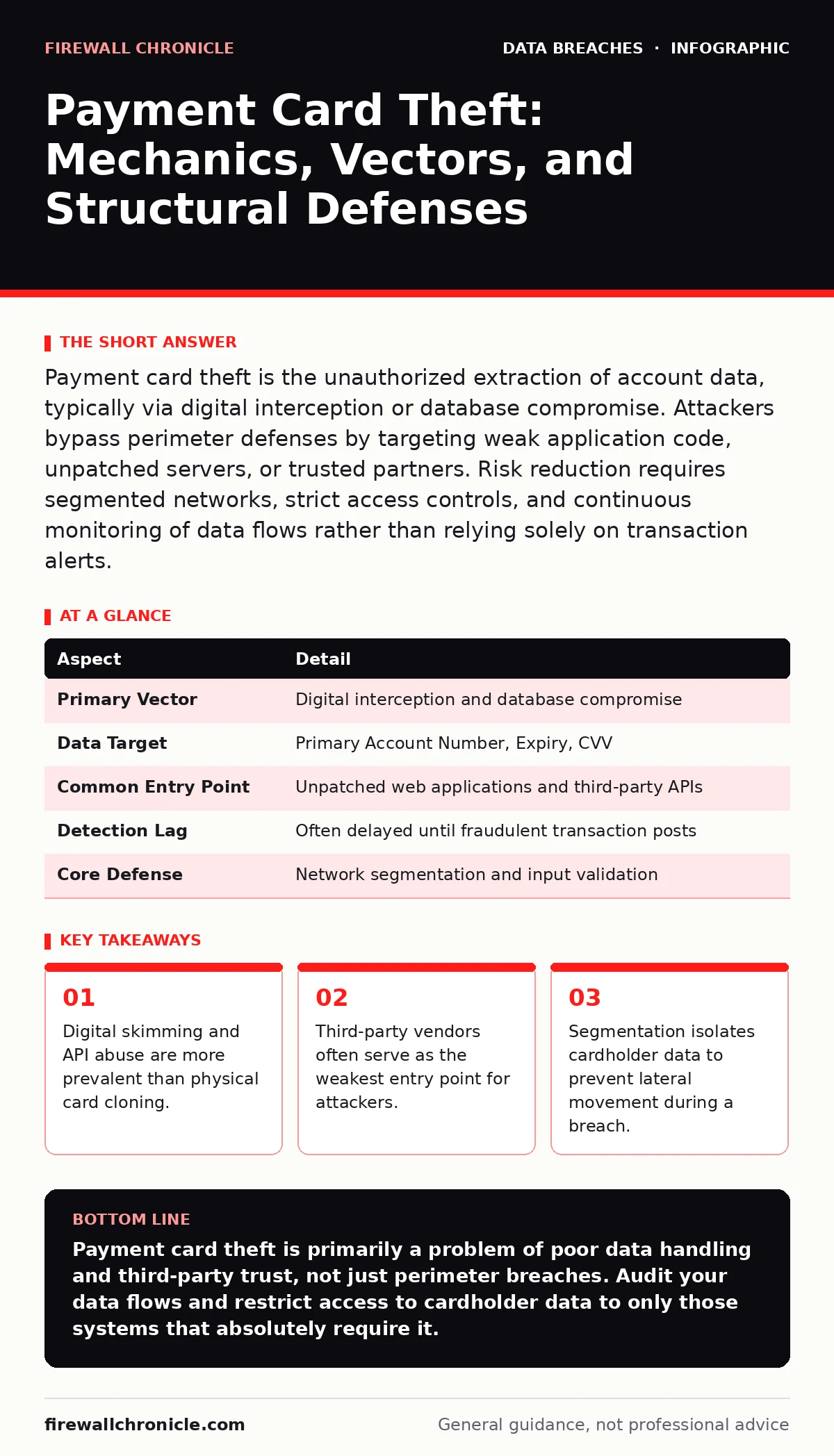
Payment card theft is the unauthorized extraction of account data, typically via digital interception or database compromise. Attackers bypass perimeter defenses by targeting weak application code, unpatched servers, or trusted partners. Risk reduction requires segmented networks, strict access controls, and continuous monitoring of data flows rather than relying solely on transaction alerts.
The Mechanism Behind Card Extraction
Think of a payment network as a high-speed rail system. The tracks are the communication protocols, and the trains are the data packets carrying sensitive information. Payment card theft occurs when an unauthorized actor intercepts, copies, or alters these packets before they reach their secure destination. This is not merely about stealing a plastic rectangle from a wallet. It is about capturing the magnetic stripe data, the chip cryptographic keys, or the tokenized identifiers that authorize transactions.
The attacker does not need to break into the bank’s vault. They only need to find a point in the journey where the data travels in plain text or where the authentication checks are lax. Once the primary account number and expiration date are captured, the thief can generate virtual cards or clone physical ones. The damage happens in milliseconds, often before the legitimate user notices a small test charge.
| Aspect | Detail |
|---|---|
| Primary Vector | Digital interception and database compromise |
| Data Target | Primary Account Number, Expiry, CVV |
| Common Entry Point | Unpatched web applications and third-party APIs |
| Detection Lag | Often delayed until fraudulent transaction posts |
| Core Defense | Network segmentation and input validation |
How Digital Skimming Bypasses Perimeters
Physical skimming devices at gas pumps are a visible threat, but they represent a small fraction of actual theft. Digital skimming, often called Magecart attacks, is far more insidious. Attackers inject malicious JavaScript into the checkout pages of e-commerce sites. This script runs in the victim’s browser, capturing card details as they are typed. The data is then exfiltrated to a server controlled by the attacker, bypassing the website’s own security measures entirely.
This method exploits the trust users place in legitimate storefronts. The website appears normal. The SSL certificate is valid. The HTTPS connection is encrypted. However, the encryption protects the data in transit between the browser and the server, not the code running inside the browser. If the script is malicious, it steals the data before it is ever encrypted for the final transmission.
The Third-Party Blind Spot
Most organizations assume their internal security posture determines their risk. This is a dangerous oversight. Modern supply chains are complex, with dozens of vendors having varying levels of access to internal systems. A payment processor, a shipping aggregator, or a marketing analytics tool may require access to cardholder data or the networks that house it. If any single vendor has weak security, the entire chain is exposed.
Attackers frequently perform reconnaissance on smaller vendors first. These targets often lack the resources for rigorous security audits. Once inside a vendor’s network, the attacker pivots to the larger organization that trusts them. This is why vendor risk management is a critical component of any defense strategy. You are only as secure as the least secure partner you integrate with.
Common Forms of Data Aggregation
Attackers rarely steal data for immediate use. They prefer to aggregate large volumes of card data to sell on underground markets. This creates a buffer between the theft and the fraud, making attribution difficult. Common forms of aggregation include:
- Database Dumping: SQL injection attacks that extract entire tables of customer records.
- API Abuse: Exploiting poorly secured application programming interfaces to scrape data in bulk.
- Insider Threats: Employees with excessive privileges copying data for financial gain or out of malice.
Each form relies on the failure of access controls. If a developer can query the production database directly, or if an API key is hardcoded in a public repository, the data is vulnerable. The volume of data stolen matters less than the speed of extraction and the lack of immediate detection.
What People Usually Get Wrong
Many believe that using a firewall is sufficient to prevent card theft. Firewalls filter traffic based on predefined rules, but they cannot inspect the content of encrypted application-layer requests effectively without deep packet inspection, which introduces latency. More importantly, firewalls do not protect against data that is already inside the network.
Another misconception is that tokenization eliminates risk. Tokenization replaces sensitive data with non-sensitive equivalents. While this protects the data at rest, it does not protect the point where the token is generated or the systems that manage the mapping between tokens and real card numbers. If the tokenization service is compromised, the attacker gains access to the real data.
See also: Encrypting Data at Rest for Small Teams: Practical Steps · Data Encryption in Transit: Protecting Moving Information
Structural Defenses for Developers
To reduce risk, you must shift from perimeter defense to zero-trust architecture. This means verifying every request, regardless of its origin. Implement role-based access control to ensure that only specific services and users can access cardholder data. The principle of least privilege dictates that no user or process should have more access than necessary to perform its function.
Input validation is equally critical. Every field that accepts user input must be sanitized and validated against strict schemas. This prevents injection attacks that could allow an attacker to execute arbitrary code or query the database directly. Use parameterized queries to separate code from data, ensuring that user input is never interpreted as executable commands.
Monitoring and Incident Response
Prevention is never perfect. You must assume that an attacker will eventually bypass your controls. Therefore, monitoring is vital. File integrity monitoring helps detect unauthorized changes to critical system files and configuration settings. If a script is injected into a checkout page, file integrity monitoring can alert you to the modification immediately.
When a breach is suspected, the response must be swift. Isolate affected systems to prevent lateral movement. Rotate credentials and API keys. Notify affected users through customer breach notification letters, providing clear guidance on protecting their accounts. Do not wait for regulatory deadlines to begin communication. Speed builds trust, even in bad news.
The Role of Data Minimization
The best defense is to not hold the data in the first place. Many businesses store card details for convenience, such as one-click purchasing. This creates a target. If you do not need to store the data, use a payment gateway that handles the storage and tokenization. This shifts the liability and the security burden to a specialist.
Data minimization reduces the attack surface. If you only store the last four digits of a card for reference, a database breach yields little value to an attacker. Combine this with the 3-2-1 backup rule for your own operational resilience, ensuring that your systems can recover from ransomware or accidental deletion without compromising customer data.
Key takeaways
- Digital skimming and API abuse are more prevalent than physical card cloning.
- Third-party vendors often serve as the weakest entry point for attackers.
- Segmentation isolates cardholder data to prevent lateral movement during a breach.
Payment card theft is primarily a problem of poor data handling and third-party trust, not just perimeter breaches. Audit your data flows and restrict access to cardholder data to only those systems that absolutely require it.
Frequently asked questions
Does using HTTPS prevent payment card theft?
HTTPS encrypts data in transit, but it does not protect against malicious scripts running in the browser or compromised servers that process the data after decryption.
What is the difference between tokenization and encryption?
Encryption transforms data using a key, allowing it to be reversed. Tokenization replaces data with a random value that has no mathematical relationship to the original, making it useless if stolen.
How do I know if my API is leaking card data?
Regularly audit API logs for unusual query patterns and ensure that API responses do not include full card numbers. Use automated tools to scan for exposed secrets in code repositories.
Should I store CVV codes for recurring billing?
No. Payment card industry standards strictly prohibit storing CVV codes after authorization. Use a token provided by the payment gateway to manage recurring transactions securely.
How this guide was produced: written by the Firewall Chronicle editorial team with AI assistance, checked against the public references listed below, and reviewed when the facts change. See our editorial policy or report an error.