Customer Breach Notification Letters: Small Business Compliance
Proper breach notification requires forensic clarity and legal precision, tasks that often exceed the capacity of small technical teams without external support.
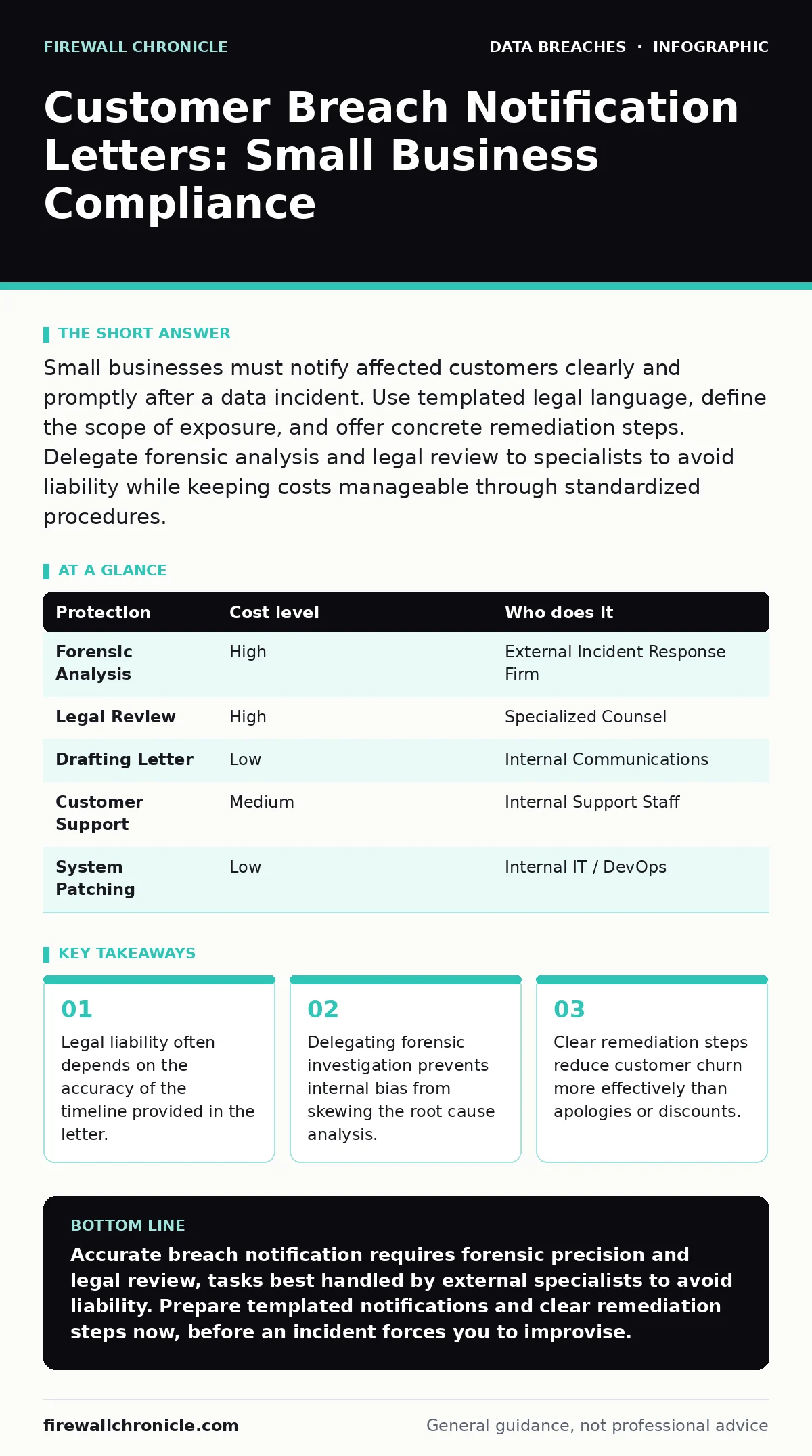
Small businesses must notify affected customers clearly and promptly after a data incident. Use templated legal language, define the scope of exposure, and offer concrete remediation steps. Delegate forensic analysis and legal review to specialists to avoid liability while keeping costs manageable through standardized procedures.
The Scale of the Problem
Small organizations often assume that breach notification is a large enterprise concern. This assumption is dangerous because regulatory frameworks rarely exempt companies based on employee count. The obligation to notify exists whenever personal data is compromised, regardless of whether you have ten employees or ten thousand.
The complexity lies not in the volume of data, but in the precision required. You must determine exactly what was accessed, when it was accessed, and what the attacker achieved. Guessing leads to legal exposure. If you understate the breach, you face penalties for deception. If you overstate it, you erode customer trust unnecessarily.
Defining the Scope Accurately
Before drafting any communication, you must isolate the incident. This process requires distinguishing between attempted access and successful exfiltration. Many teams panic when they see failed login attempts, but these do not constitute a breach of data confidentiality.
You need to verify if data left your secure environment. This verification often requires reviewing server logs, database query logs, and network flow data. If you lack the tools to correlate these logs, you cannot confidently state what was taken. This uncertainty forces you to notify users of a potential risk rather than a confirmed loss, which complicates the message.
Refer to the principles of file integrity monitoring to understand how you might have detected unauthorized changes to your database files in the first place.
Drafting the Notification Letter
The letter must be plain, direct, and free of technical jargon. Customers do not need to know the SQL injection vector used. They need to know if their credit card numbers, social security numbers, or health records were exposed.
Structure the letter with four components. First, state clearly that a security incident occurred. Second, describe the type of information involved. Third, explain what your company is doing to investigate and fix the problem. Fourth, provide specific steps the customer should take to protect themselves.
Avoid vague language like "security issue" or "data compromise." Use specific terms such as "unauthorized access to email addresses and passwords." Ambiguity breeds suspicion. Customers will assume the worst if you do not provide facts.
Managing the Remediation Offer
Apologies do not mitigate risk. Your notification must include actionable advice. If passwords were exposed, instruct users to change them immediately on your platform and any other sites where they reuse those credentials.
Consider offering credit monitoring services if financial data was involved. This is not a legal requirement in all jurisdictions, but it demonstrates good faith. Ensure the service provider you choose is reputable. A poor service can create a secondary data privacy issue.
Link this effort to broader identity theft prevention strategies. Your customers are likely already vigilant about phishing, so provide them with the specific indicators of fraud related to your industry.
What to Delegate Immediately
You should not attempt forensic analysis internally unless you have dedicated security engineers. Internal teams often lack the objectivity required for an unbiased investigation. They may also inadvertently alter evidence while trying to fix the problem.
Delegate the technical investigation to a third-party incident response firm. They can preserve logs, image drives, and identify the attack vector without disrupting your business operations. This separation of duties protects you legally and technically.
Legal review is another area for delegation. Have an attorney review the draft notification letter before it goes out. They will ensure the language complies with local regulations and does not admit liability prematurely.
See also: Data Encryption in Transit: Protecting Moving Information · Port Scan Response: Containment, Recovery, and Prevention Steps
Cost and Responsibility Matrix
Understanding the division of labor helps you budget for incident response. The following table outlines who should handle each aspect of the notification process.
| Protection | Cost level | Who does it |
|---|---|---|
| Forensic Analysis | High | External Incident Response Firm |
| Legal Review | High | Specialized Counsel |
| Drafting Letter | Low | Internal Communications |
| Customer Support | Medium | Internal Support Staff |
| System Patching | Low | Internal IT / DevOps |
Questions for IT Providers
If you rely on an IT provider for system maintenance, you must clarify their role in a breach. Many providers will secure the system but will not assist with the notification process. Ask these questions before an incident occurs.
- Does your contract include incident response services, or only maintenance?
- Will you preserve logs for forensic analysis, or do you overwrite them automatically?
- Can you provide a timeline of system changes prior to the incident?
- Do you carry cyber liability insurance that covers notification costs?
- Who is the single point of contact for urgent security events?
Refer to vendor risk management practices to ensure your provider has their own security controls in place. A breach at their end can expose your data just as easily as a direct attack on your servers.
Preventing Future Incidents
The notification process is reactive. Prevention is proactive. Implement strict access controls to limit who can view sensitive data. This reduces the blast radius if an account is compromised.
Use role-based access control to ensure employees only have access to the data necessary for their jobs. A marketing intern should not have read access to customer billing records. This segmentation limits the damage of insider threats and external breaches alike.
Ensure your backup strategy is resilient. If ransomware encrypts your data, a good backup allows you to restore operations without paying a ransom. Follow the 3-2-1 backup rule to keep copies offline and immutable.
The Human Element
Breach notifications are as much about psychology as they are about compliance. Your customers will be angry, scared, or indifferent. Your response must acknowledge their feelings without being defensive.
Empathy builds trust. Acknowledge the inconvenience and the risk. Do not blame the customer for weak passwords or falling for phishing. Take responsibility for the security of your platform.
Monitor social media and customer support channels after sending the letter. Be prepared to answer questions calmly and consistently. Inconsistent messages from different team members will amplify the crisis.
Final Preparation
Prepare templates in advance. Do not wait for a breach to draft your first notification. Have a legal-reviewed template ready for different scenarios, such as password leaks, financial data exposure, or email account compromise.
Review email encryption standards for your notification. If you are sending sensitive information about a breach, the notification itself should be secure. Consider using a secure portal rather than plain email for detailed reports.
By planning ahead, you reduce the stress of the incident. You can focus on containment and recovery rather than scrambling to write a letter under pressure.
Key takeaways
- Legal liability often depends on the accuracy of the timeline provided in the letter.
- Delegating forensic investigation prevents internal bias from skewing the root cause analysis.
- Clear remediation steps reduce customer churn more effectively than apologies or discounts.
Accurate breach notification requires forensic precision and legal review, tasks best handled by external specialists to avoid liability. Prepare templated notifications and clear remediation steps now, before an incident forces you to improvise.
Frequently asked questions
How long do I have to notify customers after a breach?
Timelines vary by jurisdiction and data type, often ranging from 30 to 90 days. Check local regulations immediately upon discovery to avoid penalties for late reporting.
Should I notify the media if I am a small business?
Only if required by law or if the breach affects a large number of customers. Publicity can amplify reputational damage. Focus on direct communication with affected individuals first.
Can I use a generic template for all breaches?
No. Each breach involves different data types and attack vectors. A generic template may omit critical details or include irrelevant information, leading to confusion and legal risk.
Does cyber insurance cover notification costs?
Many policies cover notification expenses, but exclusions apply. Review your policy details regarding forensic investigation, legal fees, and customer credit monitoring services before an incident occurs.
How this guide was produced: written by the Firewall Chronicle editorial team with AI assistance, checked against the public references listed below, and reviewed when the facts change. See our editorial policy or report an error.