
Data Encryption in Transit: Protecting Moving Information
Encryption in transit protects data only while it moves between systems, leaving it vulnerable the moment it stops at a server or database.
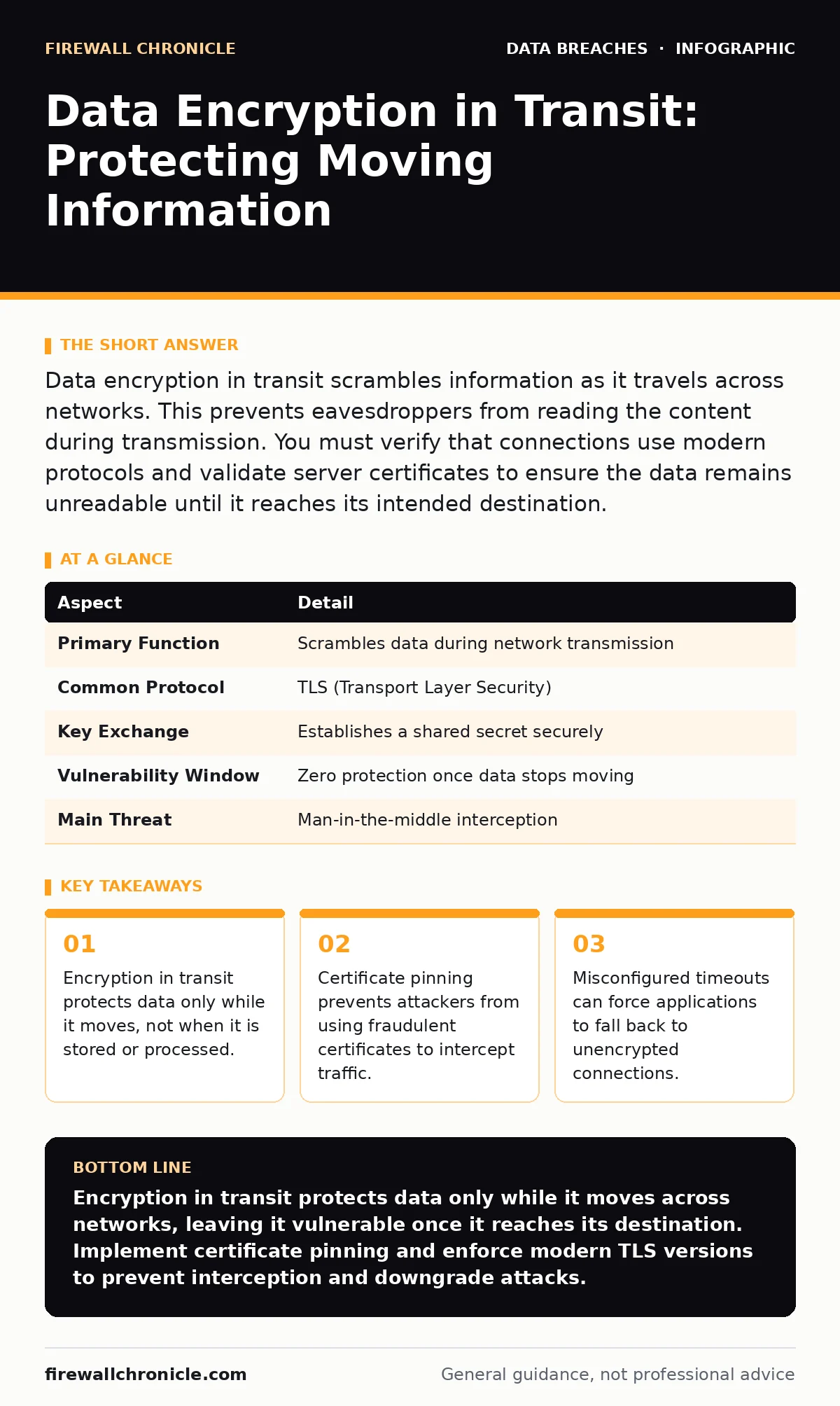
Data encryption in transit scrambles information as it travels across networks. This prevents eavesdroppers from reading the content during transmission. You must verify that connections use modern protocols and validate server certificates to ensure the data remains unreadable until it reaches its intended destination.
Everyday Analogy for Moving Data
Imagine sending a sealed steel briefcase through a public mail system. The briefcase represents your data. The mail truck represents the network. Encryption in transit is the lock on the briefcase. If a thief intercepts the truck, they cannot open the briefcase without the key. The lock protects the contents during the journey. Once the briefcase arrives at the office, the lock is removed. The data is now exposed inside the building. This analogy highlights that protection is temporary and location-specific.
At a Glance: Encryption Mechanics
| Aspect | Detail |
|---|---|
| Primary Function | Scrambles data during network transmission |
| Common Protocol | TLS (Transport Layer Security) |
| Key Exchange | Establishes a shared secret securely |
| Vulnerability Window | Zero protection once data stops moving |
| Main Threat | Man-in-the-middle interception |
How Data Encryption in Transit Works
Data encryption in transit uses cryptographic algorithms to transform readable data into ciphertext. This process occurs before the data leaves the source system. The sender and receiver agree on a shared secret, often called a session key. This key is generated during a handshake process. The handshake verifies the identity of the receiver. It ensures that the sender is talking to the correct server. The actual data is then encrypted using symmetric encryption. This method is fast and efficient for large volumes of information. The receiver uses the same session key to decrypt the data. Without this key, the data appears as random noise.
Who Is Affected by Transit Risks
Every application that sends data over a network is affected. This includes web browsers, mobile apps, and internal microservices. Developers must understand that the network is untrusted. Any node between the source and destination can potentially inspect the traffic. This includes internet service providers, public Wi-Fi networks, and corporate firewalls. If the encryption fails, attackers can steal credentials, session tokens, or personal information. This exposure leads to account takeovers and identity theft. The risk is not limited to external users. Internal systems sending data between servers are equally vulnerable if the network is compromised.
Common Mistakes in Implementation
Developers often assume that enabling HTTPS is enough. This assumption ignores configuration errors. One common mistake is using weak cipher suites. These suites use outdated algorithms that can be broken. Another error is failing to validate certificates. If an application accepts any certificate, an attacker can present a self-signed certificate. The application will trust the attacker. This is known as a man-in-the-middle attack. A third error is mixing encrypted and unencrypted traffic. If a form submits data over HTTP, the encryption is bypassed. The data is sent in plain text.
See also: Log Retention for Small Teams: Keep Evidence Without Breaking Budget · Incident Communication Plans: 9 FAQs on Strategy and Execution
Example Scenario: The Intercepted Login
Suppose you build a mobile banking application. Users log in by sending their username and password to your server. You enable TLS for the connection. However, you do not implement certificate pinning. An attacker sets up a rogue Wi-Fi network in a coffee shop. The attacker presents a fraudulent certificate to the user's device. Because your app does not pin the certificate, it accepts the fraudulent one. The attacker now sits between the user and the real server. The user sends their credentials to the attacker. The attacker forwards them to the real server to maintain the illusion. The user sees a successful login. The attacker now has the credentials.
What People Usually Get Wrong
Many teams believe that encryption in transit solves all security problems. This is a dangerous misconception. Encryption in transit does not protect data at rest. Once the data reaches the server, it must be stored securely. You must use encryption at rest for databases and file systems. Encryption in transit also does not protect data in use. While the application processes the data in memory, it is unencrypted. Attackers who compromise the server can read the data from memory. Furthermore, encryption does not prevent data leakage. If the server sends the wrong data to the wrong user, encryption ensures it arrives securely. It does not stop the leak.
Advanced Protection Strategies
To strengthen your defenses, consider certificate pinning. This technique hardcodes the expected certificate into the application. The application rejects any connection that does not present this specific certificate. This prevents attackers from using fraudulent certificates. Another strategy is to use mutual TLS. This requires both the client and the server to present certificates.
This ensures that only authorized clients can connect to the server. This is particularly useful for internal microservices. It prevents unauthorized services from accessing sensitive data. You must also monitor for protocol downgrades. Attackers may force older, weaker protocols. Your systems should reject these attempts immediately.
Integrating with Other Security Measures
Encryption in transit works best when combined with other controls. For example, if you handle credit card information, you must also address payment card theft risks. Even if the data is encrypted in transit, a breach at rest can expose it. You should also consider vendor risk management. Third-party services may handle your data.
If they fail to encrypt data in transit, your organization is exposed. Additionally, be aware of employee data breaches. Insiders may bypass encryption by accessing data directly from the server. Finally, remember that password hashing and salting protects stored passwords. This complements transit encryption by ensuring that stolen credentials are useless without the hash.
Checklist for Secure Transmission
- Enforce the latest TLS version on all endpoints.
- Disable support for weak cipher suites and protocols.
- Validate server certificates on all client applications.
- Implement certificate pinning for high-risk mobile apps.
- Monitor logs for failed handshake attempts.
- Ensure no mixed content (HTTP and HTTPS) is served.
Final Considerations for Developers
You must treat the network as hostile. Every packet of data is at risk. Encryption in transit is the primary defense against interception. However, it is not a silver bullet. You must configure it correctly. You must monitor it continuously. You must combine it with other security measures. The goal is to protect data everywhere it goes. This includes in transit, at rest, and in use. By understanding the limitations and strengths of encryption, you can build more secure applications. The effort required is small compared to the cost of a breach.
Key takeaways
- Encryption in transit protects data only while it moves, not when it is stored or processed.
- Certificate pinning prevents attackers from using fraudulent certificates to intercept traffic.
- Misconfigured timeouts can force applications to fall back to unencrypted connections.
Encryption in transit protects data only while it moves across networks, leaving it vulnerable once it reaches its destination. Implement certificate pinning and enforce modern TLS versions to prevent interception and downgrade attacks.
Frequently asked questions
Does encryption in transit protect my database?
No, encryption in transit only protects data while it is moving. You must use encryption at rest to protect data stored in your database.
Can attackers break modern TLS encryption?
Breaking modern TLS encryption is computationally infeasible. Attackers usually exploit configuration errors or use man-in-the-middle techniques instead.
Do I need encryption for internal network traffic?
Yes, internal networks are not immune to attacks. Lateral movement by attackers can intercept unencrypted internal traffic.
What is the difference between SSL and TLS?
SSL is the older, deprecated protocol. TLS is the modern, secure successor. You should always use TLS and avoid SSL.
How this guide was produced: written by the Firewall Chronicle editorial team with AI assistance, checked against the public references listed below, and reviewed when the facts change. See our editorial policy or report an error.