
Role-Based Access Control Checklist for Secure Systems
Most access failures stem from permission drift, where roles accumulate privileges that are no longer needed for the assigned job function.
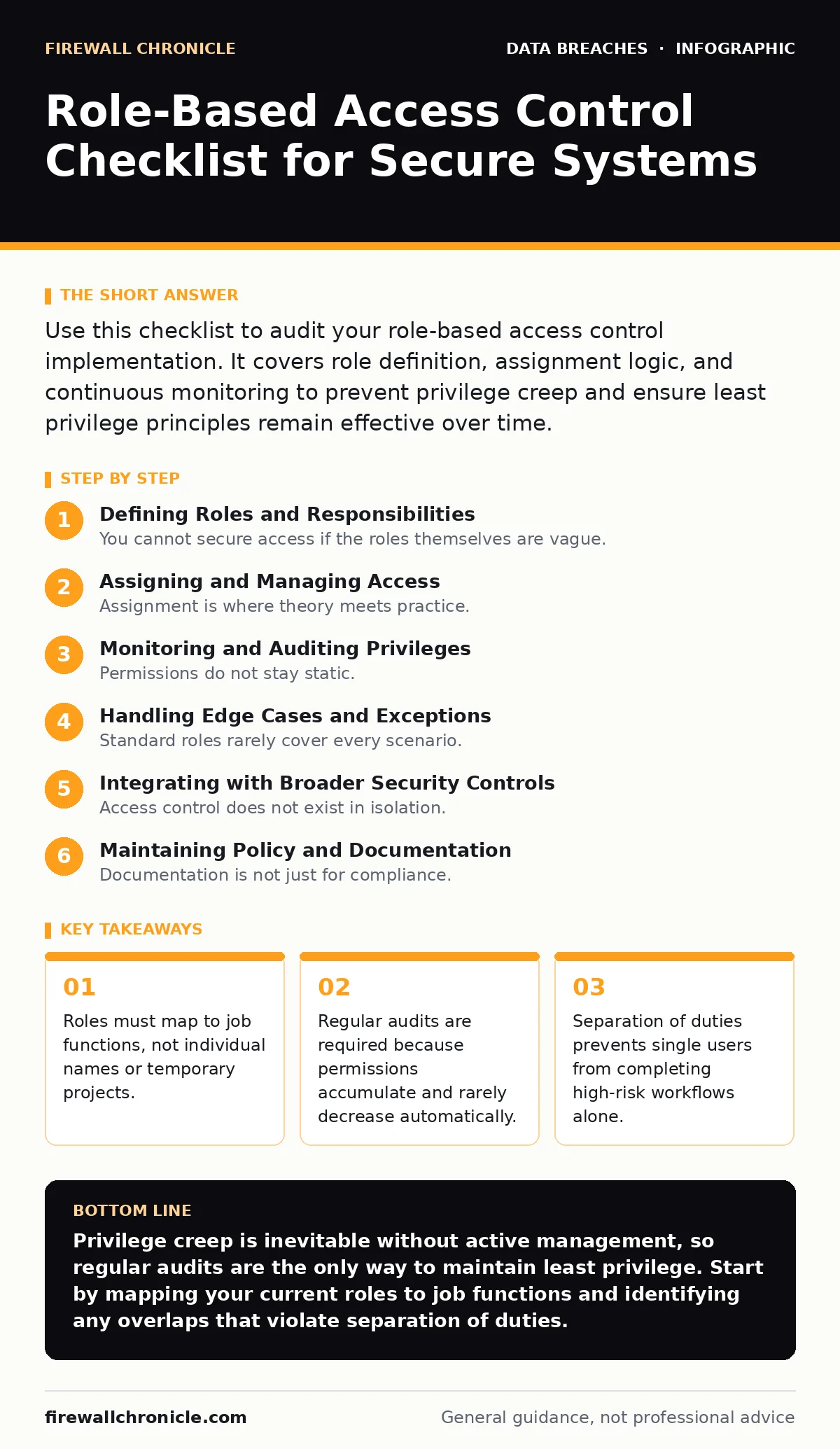
Use this checklist to audit your role-based access control implementation. It covers role definition, assignment logic, and continuous monitoring to prevent privilege creep and ensure least privilege principles remain effective over time.
Defining Roles and Responsibilities
You cannot secure access if the roles themselves are vague. This section ensures your foundational definitions are precise enough to enforce security policies without hindering productivity.
- Map each role to a specific job function: Vague titles lead to inconsistent permission sets and audit failures.
- Document the minimum permissions for each role: Explicit limits prevent accidental over-provisioning during onboarding.
- Define role hierarchies clearly: Inheritance rules must be explicit to avoid unintended privilege escalation.
- Identify roles requiring separation of duties: Critical tasks must be split to prevent fraud or error by a single actor.
Assigning and Managing Access
Assignment is where theory meets practice. Even well-defined roles fail if the mechanism for assigning them is flawed or manual.
- Automate role assignment based on HR data: Manual updates create gaps where users retain access after leaving or changing roles.
- Implement just-in-time access for elevated privileges: Temporary access reduces the window of opportunity for attackers.
- Require approval workflows for role changes: Human review catches anomalies that automated systems might miss.
- Remove access immediately upon role termination: Delayed revocation is a primary vector for unauthorized data exfiltration.
Monitoring and Auditing Privileges
Permissions do not stay static. Users accumulate rights over time, a phenomenon known as privilege creep, which expands the attack surface silently.
- Conduct quarterly access reviews: Regular audits identify dormant accounts and unnecessary permissions before they are exploited.
- Log all role assignment and modification events: Audit trails are necessary for forensic analysis and compliance verification.
- Monitor for anomalous role usage patterns: Unusual activity within a role may indicate compromised credentials or insider threats.
- Review service account permissions separately: Service accounts often have broad privileges and are targeted for lateral movement.
Handling Edge Cases and Exceptions
Standard roles rarely cover every scenario. How you handle exceptions often determines whether your security model holds under pressure.
- Define a process for emergency access: Break-glass procedures must be logged and reviewed to prevent abuse.
- Limit the duration of exception grants: Temporary overrides should expire automatically to prevent permanent privilege bloat.
- Document reasons for each exception: Context helps auditors distinguish between legitimate need and policy violation.
- Review shared accounts for role clarity: Shared credentials obscure individual accountability and hinder forensic investigation.
Integrating with Broader Security Controls
Access control does not exist in isolation. It must work alongside other security mechanisms to provide defense in depth.
- Align roles with data classification levels: Sensitive data requires stricter role constraints than public information.
- Ensure logging supports file integrity monitoring: Detecting unauthorized changes requires knowing who had the permission to make them.
- Coordinate with vendor risk management: Third-party access must follow the same rigorous role definitions as internal staff.
- Include access controls in incident response plans: Knowing who can do what speeds up containment during a breach.
See also: Exposed Storage Buckets: Why Your Cloud Data Is Open to the World · Employee Data Breach Myths: Why Insider Threat Models Fail
Maintaining Policy and Documentation
Documentation is not just for compliance. It serves as the source of truth for your security posture and aids in training new administrators.
- Keep role definitions updated with job changes: Outdated documentation leads to misconfigured systems and audit findings.
- Train administrators on role management procedures: Human error in assignment is a leading cause of access control failures.
- Archive historical role configurations: Historical data helps identify trends and long-term drift in permission structures.
- Review policy against industry standards regularly: Best practices evolve, and your policies should reflect current threat models.
Reviewing and Updating the Framework
Security is a continuous process. Your access control framework must evolve as your organization and its technology stack change.
- Schedule annual policy reviews: Regular updates ensure the framework remains relevant to current business needs.
- Test role configurations in non-production environments: Validation prevents breaking changes from affecting live systems.
- Gather feedback from role holders: Users can identify friction points that may indicate overly restrictive or poorly designed roles.
- Benchmark against peer organizations: Comparing practices helps identify gaps in your own implementation.
Key takeaways
- Roles must map to job functions, not individual names or temporary projects.
- Regular audits are required because permissions accumulate and rarely decrease automatically.
- Separation of duties prevents single users from completing high-risk workflows alone.
Privilege creep is inevitable without active management, so regular audits are the only way to maintain least privilege. Start by mapping your current roles to job functions and identifying any overlaps that violate separation of duties.
Frequently asked questions
How often should I review role-based access control settings?
Conduct formal reviews at least quarterly, with continuous monitoring for critical systems and high-privilege roles.
What is the difference between role-based and attribute-based access control?
Role-based access control uses predefined roles, while attribute-based access control uses dynamic attributes like location or device status for decisions.
Can role-based access control prevent insider threats?
It limits the damage an insider can do by enforcing least privilege, but it cannot stop a user from abusing their legitimate permissions.
How do I handle contractors in a role-based system?
Create specific roles for contractors with time-limited access and strict separation from internal employee roles.
How this guide was produced: written by the Firewall Chronicle editorial team with AI assistance, checked against the public references listed below, and reviewed when the facts change. See our editorial policy or report an error.