
Vendor Risk Management for Small Teams Without the Overhead
Small organizations face disproportionate risk from third-party connections because attackers bypass their defenses by targeting weaker suppliers.
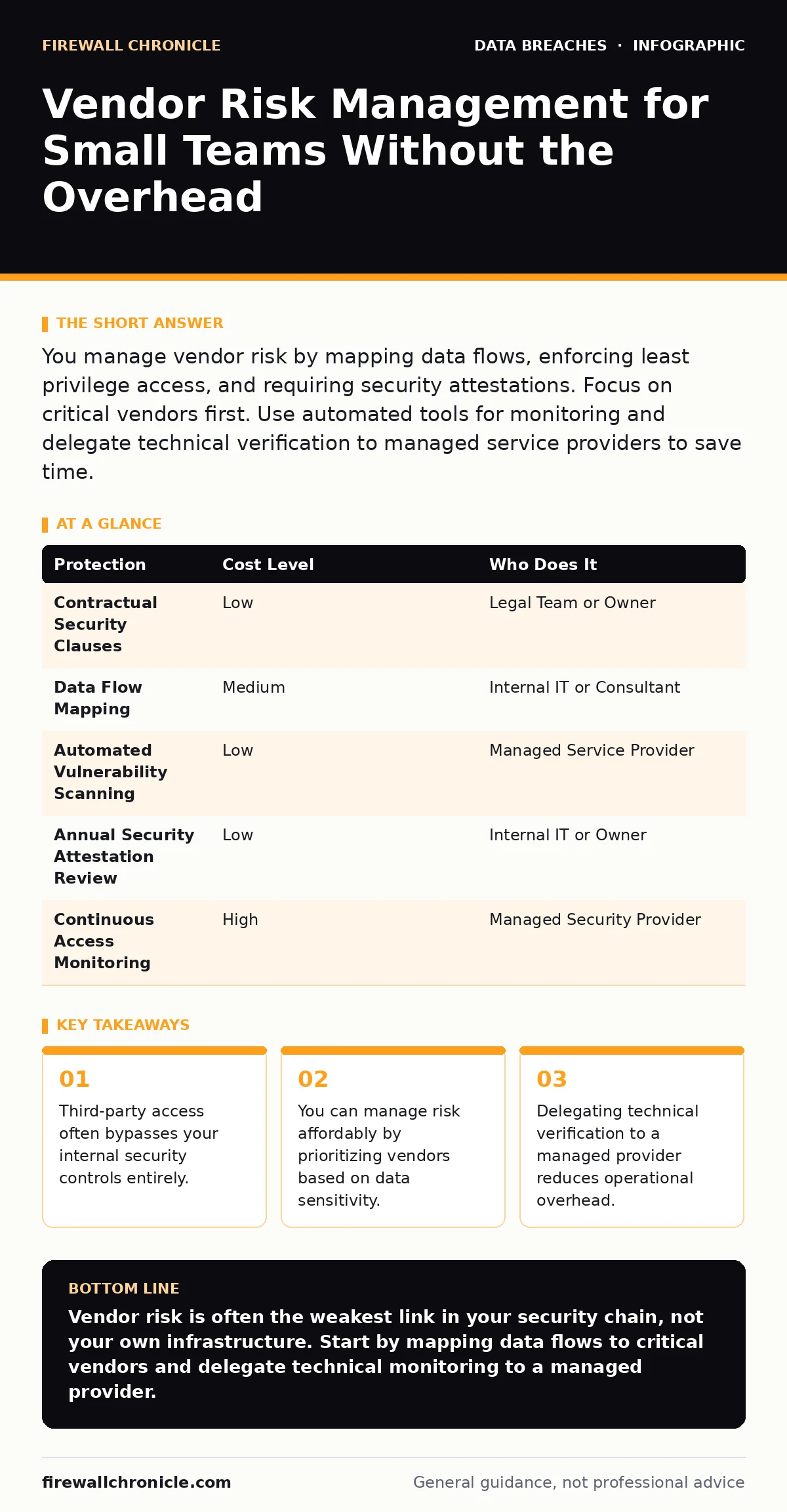
You manage vendor risk by mapping data flows, enforcing least privilege access, and requiring security attestations. Focus on critical vendors first. Use automated tools for monitoring and delegate technical verification to managed service providers to save time.
The Hidden Surface Area
Your security perimeter does not end at your network edge. It extends to every vendor that touches your data. When you grant a supplier access to your systems, you effectively hand them a key to your house. If that supplier has weaker security than you do, they become the easiest entry point for an attacker. This is known as third-party risk.
Small organizations often ignore this because they lack a dedicated security team. They assume that if their own locks are strong, they are safe. This assumption fails because attackers do not attack your locks. They attack the weakest link in your supply chain. A small logistics partner with poor password hygiene can compromise your entire customer database.
You must treat vendor access as a permanent expansion of your attack surface. Every API key, every shared account, and every file transfer channel is a potential breach vector. Understanding this shifts your mindset from protecting your servers to protecting your relationships.
Prioritizing By Data Sensitivity
You cannot audit every vendor with the same intensity. That would require resources you do not have. Instead, you must prioritize based on the sensitivity of the data the vendor accesses. This approach allows you to focus your limited energy where it matters most.
Start by mapping your data flows. Identify which vendors have access to personally identifiable information, financial records, or intellectual property. These are high-risk vendors. They require strict controls and regular review. Vendors that only access non-sensitive data, such as public marketing materials, pose a much lower risk.
This prioritization aligns with the principles of role-based access control. You grant access only to what is necessary for the job. If a vendor does not need access to your core database, they should not have it. Limiting their scope limits the damage they can cause if compromised.
Affordable Verification Methods
You do not need expensive consulting firms to verify vendor security. You can use affordable, standardized methods to assess risk. The goal is not to find every flaw, but to identify gross negligence.
Ask for a Security Assertion Markup Language (SAML) or similar attestation report. These documents summarize the vendor’s security controls. They are often available for free or at a low cost. Look for evidence of regular audits and incident response plans. Do not accept vague promises of "best practices."
For technical verification, you can use automated scanning tools. These tools check for common vulnerabilities in the vendor’s public-facing assets. They are inexpensive and can run continuously. This provides ongoing assurance without manual effort.
What To Delegate
You should not manage technical verification in-house if you lack the expertise. It is inefficient and prone to error. Instead, delegate this work to a managed security service provider (MSSP) or a qualified IT partner.
An MSSP can monitor vendor connections for anomalies. They can detect unusual login patterns or data exfiltration attempts. This shifts the burden of detection from you to a specialist. You retain oversight, but they handle the heavy lifting.
Consider how this relates to file integrity monitoring. You need to know if a vendor’s software changes unexpectedly. An MSSP can deploy agents that alert you to unauthorized modifications. This ensures that the tools you trust remain secure.
Structuring The Partnership
Your relationship with vendors must be contractual. You need clear terms that define security responsibilities. Without these terms, you have no recourse if a vendor fails to protect your data.
Include security clauses in every contract. Specify requirements for encryption, access controls, and incident notification. Require the vendor to notify you within a set timeframe if they experience a breach. This ensures you can respond quickly to protect your own systems.
You should also define the scope of access in the contract. Specify exactly which systems and data the vendor can access. This legal boundary supports your technical controls. It makes it easier to revoke access if needed.
See also: Threat Intelligence for Small Teams: Practical Application · Incident Communication Plans: 9 FAQs on Strategy and Execution
Ongoing Monitoring And Review
Vendor risk is not a one-time assessment. It is a continuous process. Vendors change their infrastructure, hire new staff, and update their software. These changes can introduce new risks.
Schedule regular reviews of your critical vendors. Re-evaluate their security posture annually or after significant changes. Check for new certifications or audit reports. Update your risk assessment based on the latest information.
This ongoing review complements your 3-2-1 backup rule. If a vendor compromise leads to data corruption, your backups ensure recovery. Regular reviews ensure that your backups are not compromised by the same attack.
Questions For Your IT Provider
If you delegate management to an IT provider, you must verify their capability. Ask specific questions to ensure they understand vendor risk.
- How do you monitor third-party access to our systems?
- What alerts do you generate for unusual vendor activity?
- How do you verify the security posture of our critical vendors?
- Can you provide reports on vendor risk trends over time?
These questions ensure that your provider is proactive, not reactive. They demonstrate that the provider understands the unique challenges of third-party risk.
| Protection | Cost Level | Who Does It |
|---|---|---|
| Contractual Security Clauses | Low | Legal Team or Owner |
| Data Flow Mapping | Medium | Internal IT or Consultant |
| Automated Vulnerability Scanning | Low | Managed Service Provider |
| Annual Security Attestation Review | Low | Internal IT or Owner |
| Continuous Access Monitoring | High | Managed Security Provider |
Integrating With Existing Controls
Vendor risk management must integrate with your existing security program. It cannot be a siloed activity. You must align it with your identity management, data protection, and incident response plans.
For example, if you use email encryption for sensitive communications, ensure that your vendors support the same standards. If they do not, you create a weak link in your communication chain. Similarly, if you have policies for printed document leaks, extend those policies to vendors who handle physical documents.
You should also consider the risk of payment card theft if your vendors process transactions. Ensure they meet the Payment Card Industry Data Security Standard (PCI DSS). This reduces the risk of financial fraud and regulatory penalties.
Finally, prepare for the possibility of a breach. Have a plan for customer breach notification letters ready. If a vendor compromise affects your customers, you must notify them promptly. Delays can damage your reputation and lead to legal consequences.
Key takeaways
- Third-party access often bypasses your internal security controls entirely.
- You can manage risk affordably by prioritizing vendors based on data sensitivity.
- Delegating technical verification to a managed provider reduces operational overhead.
Vendor risk is often the weakest link in your security chain, not your own infrastructure. Start by mapping data flows to critical vendors and delegate technical monitoring to a managed provider.
Frequently asked questions
Do I need to audit every vendor I work with?
No. Focus on vendors that have access to sensitive data or critical systems. Low-risk vendors require minimal oversight.
How often should I review vendor security?
Review critical vendors annually or after significant changes in their service or infrastructure.
What if a vendor refuses to sign a security contract?
Treat this as a high-risk factor. Consider finding an alternative vendor or limiting their access to non-sensitive data.
Can I use free tools to manage vendor risk?
You can use free tools for basic scanning and mapping, but continuous monitoring and expert analysis usually require paid services or delegation.
How this guide was produced: written by the Firewall Chronicle editorial team with AI assistance, checked against the public references listed below, and reviewed when the facts change. See our editorial policy or report an error.