
Attacker Reconnaissance: How Adversaries Map Your Digital Footprint
Reconnaissance often succeeds not through clever hacking tools, but by aggregating fragmented data that your own systems expose to the public internet.
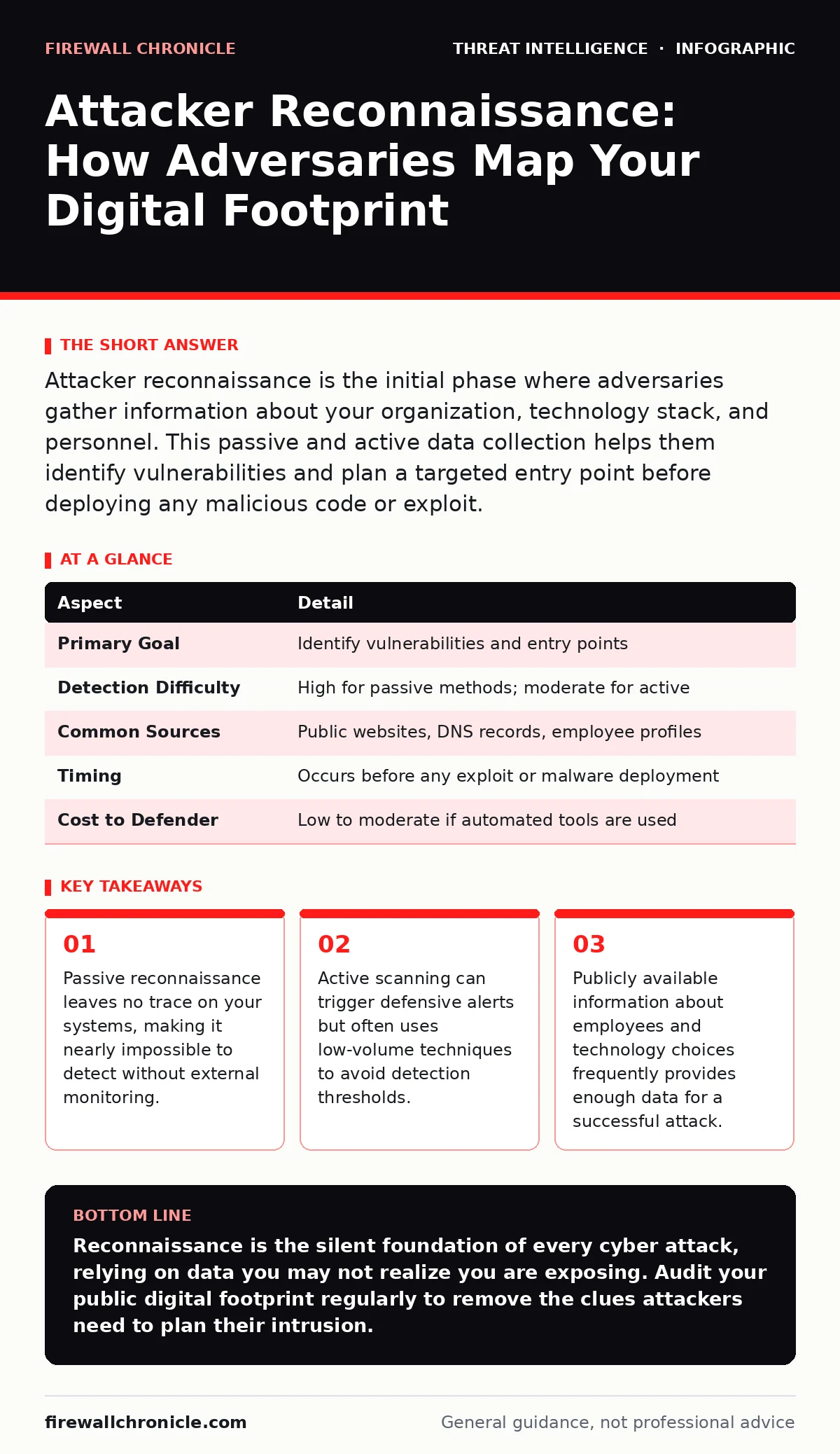
Attacker reconnaissance is the initial phase where adversaries gather information about your organization, technology stack, and personnel. This passive and active data collection helps them identify vulnerabilities and plan a targeted entry point before deploying any malicious code or exploit.
The Invisible Surveyor
Imagine a burglar who never touches your door. Instead, they study your trash, watch when you leave for work, and check if your windows open easily. They build a complete picture of your home’s weaknesses without ever stepping onto your property. Attacker reconnaissance works the same way. It is the process of gathering information to identify potential targets and vulnerabilities before any direct interaction occurs.
This phase is distinct from the actual attack. It is the planning stage. Adversaries use this time to reduce uncertainty. They want to know exactly what you are running, who works there, and how your network is structured. The goal is to find the path of least resistance.
| Aspect | Detail |
|---|---|
| Primary Goal | Identify vulnerabilities and entry points |
| Detection Difficulty | High for passive methods; moderate for active |
| Common Sources | Public websites, DNS records, employee profiles |
| Timing | Occurs before any exploit or malware deployment |
| Cost to Defender | Low to moderate if automated tools are used |
Passive vs Active Collection
Reconnaissance splits into two main categories: passive and active. Passive reconnaissance involves collecting information without interacting directly with the target system. The adversary looks at data that is already public. This might include reading job postings to identify software languages your team uses. It could involve searching for leaked credentials in public databases or reviewing DNS records to understand your domain structure.
Because passive reconnaissance does not touch your systems, it generates no logs. You cannot see it happening. It is silent. This makes it the most dangerous form of initial data gathering. An attacker can spend weeks mapping your organization’s digital footprint without triggering a single alert.
Active reconnaissance involves direct interaction with the target. The adversary sends packets to your servers to see how they respond. This might include pinging IP addresses to see which ones are alive or probing ports to identify running services. While this generates traffic, skilled attackers often throttle their requests. They send data slowly enough to look like normal background noise. This avoids triggering rate-limiting rules or intrusion detection systems.
The Human Element
Many defenders focus solely on technology, but people are a primary source of intelligence. Adversaries use osint, or open-source intelligence, to build profiles of your employees. They look for public social media posts, conference presentations, and professional networking profiles.
A software engineer might share a screenshot of their terminal in a blog post. That screenshot might reveal internal IP addresses or specific configuration tools. A marketing manager might post about a new cloud migration project. This tells an attacker which cloud provider you use and what migration tools might be vulnerable.
This human-centric approach is often more effective than technical scanning. It provides context. It helps the attacker understand not just what you have, but how you use it. They can tailor their social engineering attacks with high precision. They know who has access to sensitive systems and what those systems are.
Technical Footprinting
Beyond people, attackers map your technology stack. They identify the operating systems, web servers, and applications you run. This process is often called network enumeration. It involves systematically discovering hosts and services on your network.
Adversaries use automated tools to scan for common misconfigurations. They look for default credentials on IoT devices. They check for outdated software versions that have known vulnerabilities. They also look for exposed administrative interfaces. An unprotected login page is an open door.
This technical footprinting helps the attacker prioritize. They will not waste time on a hardened server if they find an unpatched web application nearby. They follow the path of least resistance. The goal is to find one weak point that gives them access to the broader network.
Common Misconceptions
There are several myths about reconnaissance that lead to poor defense strategies. One common mistake is assuming that if you do not see scanning traffic, you are safe. As noted, passive reconnaissance leaves no trace. An attacker can know everything about your system without sending a single packet to it.
Another error is believing that blocking all external scanning prevents reconnaissance. Attackers use proxy servers and compromised devices to mask their origin. The traffic appears to come from legitimate residential IPs or cloud providers. Blocking these sources is often impractical and may block legitimate business traffic.
Finally, many teams think reconnaissance ends once the attacker finds a vulnerability. In reality, reconnaissance is continuous. Even after gaining initial access, attackers continue to gather information. They map the internal network to find higher-value targets. This ongoing process is part of blue team operations that must be monitored constantly.
See also: SIEM Misconceptions: Fixing 6 Common Security Logic Errors · How Disinformation Bot Networks Operate: Mechanics and Mitigation
Reducing the Attack Surface
You cannot stop passive reconnaissance entirely. The internet is full of public data. However, you can minimize the amount of useful information available. Start by auditing your public presence. Search for your company name and see what appears. Look for exposed repositories, leaked credentials, or detailed employee profiles.
Restrict access to sensitive information. Use least privilege principles for public-facing systems. Do not expose internal IP addresses in public documents. Train employees to avoid sharing technical details on social media. A small change in behavior can remove a key piece of the puzzle for an attacker.
For active reconnaissance, implement strict network segmentation. Limit which systems are visible from the outside. Use firewalls to block unnecessary ports. Employ log management systems to capture and analyze all inbound traffic. Look for patterns that suggest probing, even if they are slow.
Integrating Intelligence into Defense
Reconnaissance data is valuable for your own security teams. By understanding how attackers view your organization, you can prioritize your defenses. This is the core of threat intelligence reports. These reports provide context about the tactics and techniques adversaries use against your industry.
Use this intelligence to simulate attacks. Breach and attack simulation allows you to test your defenses against known reconnaissance techniques. You can see if your systems reveal too much information during a scan. You can verify that your alerts trigger when expected.
Regularly update your security metrics to track progress. Measure how much of your attack surface is visible. Track the time it takes to detect and respond to scanning activity. These metrics help you demonstrate the effectiveness of your security program.
Continuous Vigilance
Reconnaissance is not a one-time event. It is a continuous process. Adversaries are always looking for new information. Your digital footprint changes as you deploy new services, hire new staff, and update software.
You must treat reconnaissance as an ongoing threat. Monitor your external presence regularly. Update your defenses as your environment changes. Stay aware of new techniques and tools. By understanding how attackers map your organization, you can make it harder for them to find a way in.
Key takeaways
- Passive reconnaissance leaves no trace on your systems, making it nearly impossible to detect without external monitoring.
- Active scanning can trigger defensive alerts but often uses low-volume techniques to avoid detection thresholds.
- Publicly available information about employees and technology choices frequently provides enough data for a successful attack.
Reconnaissance is the silent foundation of every cyber attack, relying on data you may not realize you are exposing. Audit your public digital footprint regularly to remove the clues attackers need to plan their intrusion.
Frequently asked questions
Can I completely prevent an attacker from learning about my company?
No, passive reconnaissance uses public data that you cannot fully control, but you can minimize the amount of sensitive information available.
How do I know if someone is scanning my network?
Look for unusual patterns in your firewall logs, such as many connection attempts from a single IP or repeated probes on unused ports.
What is the difference between OSINT and active scanning?
OSINT gathers public information without touching your systems, while active scanning involves sending data to your servers to elicit responses.
Should I block all external IP addresses that probe my network?
Blocking all probing IPs is often impractical and may block legitimate traffic; instead, focus on hardening your systems and monitoring for suspicious patterns.
How this guide was produced: written by the Firewall Chronicle editorial team with AI assistance, checked against the public references listed below, and reviewed when the facts change. See our editorial policy or report an error.