
Dark Web Monitoring Services: How They Work and What They Miss
Dark web monitoring services scan hidden networks for leaked credentials and proprietary code, but they cannot prevent the initial compromise that generates the data in the first place.
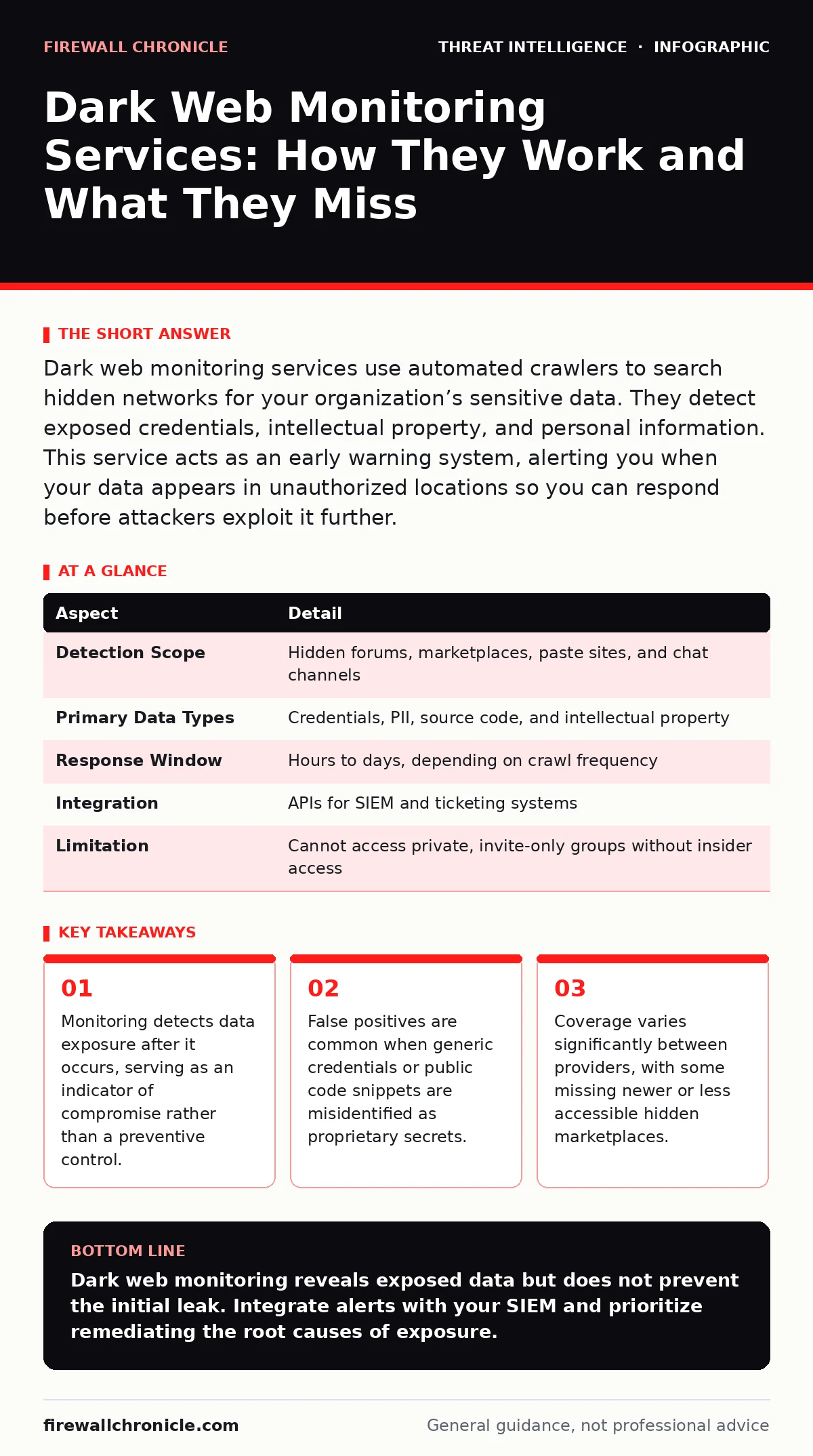
Dark web monitoring services use automated crawlers to search hidden networks for your organization’s sensitive data. They detect exposed credentials, intellectual property, and personal information. This service acts as an early warning system, alerting you when your data appears in unauthorized locations so you can respond before attackers exploit it further.
The Digital Detective Analogy
Imagine a library where books are not arranged by title but are instead scattered randomly in a vast, unlit warehouse. You cannot see the books unless you have a specific map and the right flashlight. Dark web monitoring services act as automated librarians who possess these maps and flashlights. They do not prevent books from being stolen or misplaced. Instead, they constantly search the warehouse for your specific titles. When they find a book with your name on it, they alert you. This analogy clarifies the fundamental limitation of the service: it is a detection mechanism, not a prevention mechanism. You cannot stop the theft by hiring a librarian. You stop it by locking the front door.
How Monitoring Mechanisms Operate
Dark web monitoring services rely on a combination of indexing, credential stuffing checks, and community intelligence. The process begins with crawlers that navigate hidden services using protocols like Tor. These crawlers map directories and forums where stolen data is often traded or discussed.
The service then matches the collected data against your organization’s known indicators, such as email domains, IP ranges, or proprietary code hashes. This matching process is not instantaneous. It requires constant updates to the crawler’s access lists and matching algorithms. The service aggregates this data into a dashboard, allowing security teams to see what has been exposed and when. This visibility is the primary value proposition.
| Aspect | Detail |
|---|---|
| Detection Scope | Hidden forums, marketplaces, paste sites, and chat channels |
| Primary Data Types | Credentials, PII, source code, and intellectual property |
| Response Window | Hours to days, depending on crawl frequency |
| Integration | APIs for SIEM and ticketing systems |
| Limitation | Cannot access private, invite-only groups without insider access |
Who Is Affected by Exposure
The impact of dark web exposure varies by the type of data found. For individual users, exposed credentials lead to account takeovers and identity theft. For organizations, the stakes are higher. Exposed source code can reveal proprietary algorithms or security vulnerabilities. Exposed customer data triggers regulatory compliance issues and reputational damage.
Developers are particularly vulnerable when their personal GitHub accounts or private repositories are compromised. Attackers often target developers specifically because they hold access to production environments and build pipelines. A compromised developer credential can serve as a beachhead for lateral movement within the corporate network.
Common Forms of Detected Data
Most dark web monitoring alerts fall into three categories. The first is credential dumps. These are lists of usernames and passwords, often hashed, sold in bulk. The second is personally identifiable information. This includes names, addresses, and financial details, often used for social engineering. The third is intellectual property. This includes source code, design documents, and internal communications. Developers should pay close attention to code snippets. If a snippet of your private code appears on a paste site, it may indicate a developer accidentally committed secrets to a public repository. This is a common vector for initial compromise.
What People Usually Get Wrong
Many organizations believe that dark web monitoring provides complete visibility. This is incorrect. Hidden networks are fragmented and ephemeral. Forums shut down, migrate, or become invite-only. Monitoring services cannot access every corner of the dark web. They rely on open directories and shared intelligence feeds. Another common misconception is that an alert means a breach has occurred. Often, it means old data from a third-party breach has been resold. The data may be years old and no longer valid. Context is required to determine the severity. Without context, teams may waste resources investigating false positives.
See also: How Disinformation Bot Networks Operate: Mechanics and Mitigation · What ISACs Are: Sector-Specific Threat Sharing Explained
Integrating with Security Operations
Dark web monitoring is most effective when integrated into broader security operations. Alerts should feed into your SIEM for correlation with other events. If a credential is found on the dark web and a login attempt fails from an unusual location, the correlation increases the confidence of a real attack. This integration supports blue team operations by providing actionable intelligence. It also aids in breach and attack simulation by validating whether detected vulnerabilities are being exploited in the wild. Teams should establish clear playbooks for responding to different types of alerts. Not all alerts require the same urgency.
Reducing the Underlying Risk
Monitoring does not fix the root cause of data exposure. To reduce risk, you must strengthen your security posture. Implement multi-factor authentication to render stolen passwords useless. Use secret management tools to prevent credentials from being hardcoded in applications. Conduct regular code reviews to catch accidental commits of sensitive data. Monitor your external attack surface for misconfigurations. Educate developers on secure coding practices. These measures prevent the data from leaving your environment in the first place. Monitoring is the safety net, not the floor.
The Role of Standards and Metrics
To manage the volume of alerts, organizations should adopt standard frameworks. STIX and TAXII allow for the sharing of threat intelligence in a standardized format. This enables different tools to communicate and share context about observed threats. Security metrics help quantify the effectiveness of your monitoring program. Track the time to detect and the time to respond. Measure the ratio of false positives to true positives. Use these metrics to refine your matching algorithms and reduce noise. Effective monitoring is not just about finding data; it is about finding the right data quickly.
Key takeaways
- Monitoring detects data exposure after it occurs, serving as an indicator of compromise rather than a preventive control.
- False positives are common when generic credentials or public code snippets are misidentified as proprietary secrets.
- Coverage varies significantly between providers, with some missing newer or less accessible hidden marketplaces.
- Integration with security metrics allows teams to measure the velocity of data leakage and prioritize remediation efforts.
Dark web monitoring reveals exposed data but does not prevent the initial leak. Integrate alerts with your SIEM and prioritize remediating the root causes of exposure.
Frequently asked questions
Can dark web monitoring detect real-time attacks?
No, it detects historical data exposure. It cannot see live hacking attempts or active intrusions on your network.
How often should I review monitoring alerts?
Review them daily. Stale alerts lose their value. Immediate action is required for high-severity findings like exposed credentials.
Does monitoring cover all hidden networks?
No, it covers accessible public directories and forums. Private, invite-only groups are generally invisible to automated crawlers.
Is dark web monitoring a replacement for a firewall?
No, it is a complementary tool. Firewalls block traffic; monitoring detects data that has already left your control.
How this guide was produced: written by the Firewall Chronicle editorial team with AI assistance, checked against the public references listed below, and reviewed when the facts change. See our editorial policy or report an error.