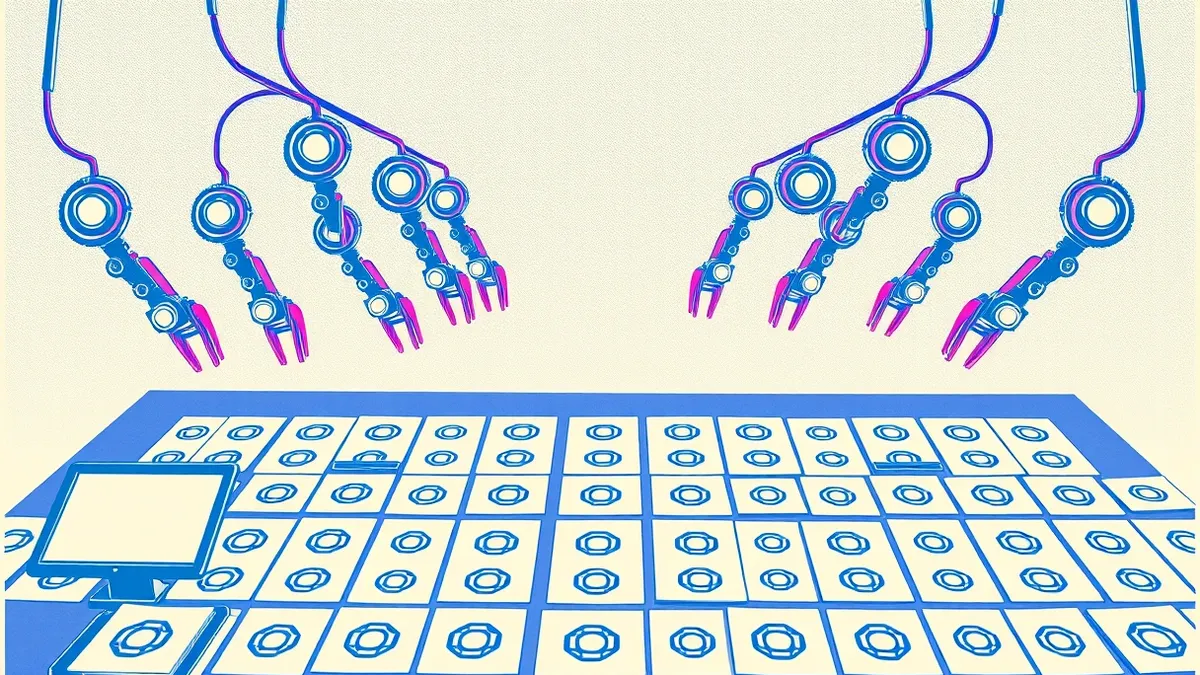
How Disinformation Bot Networks Operate: Mechanics and Mitigation
Bot networks succeed by mimicking human social proof patterns rather than through technical sophistication, requiring behavioral analysis over simple signature detection.
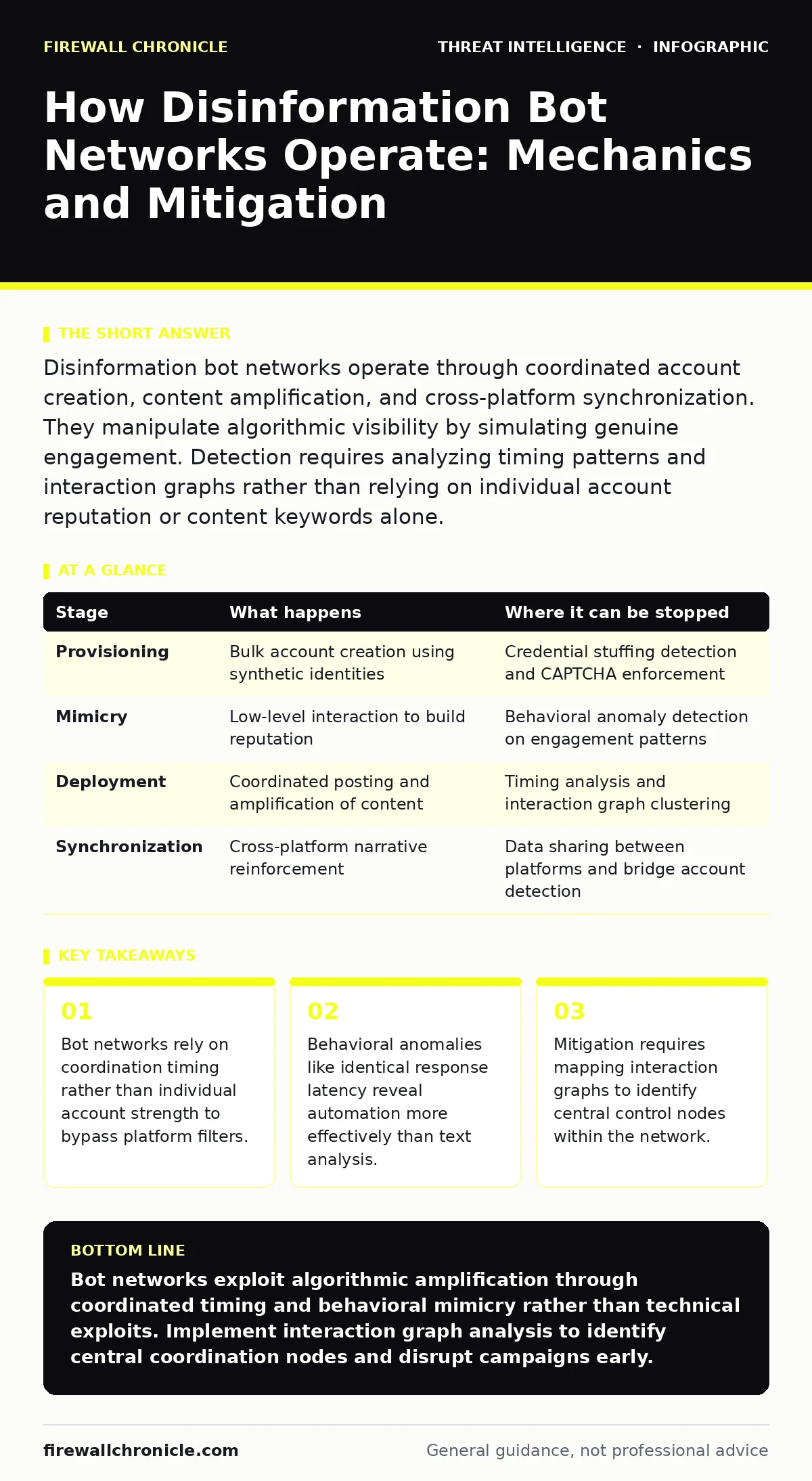
Disinformation bot networks operate through coordinated account creation, content amplification, and cross-platform synchronization. They manipulate algorithmic visibility by simulating genuine engagement. Detection requires analyzing timing patterns and interaction graphs rather than relying on individual account reputation or content keywords alone.
The Anatomy of Coordinated Inauthentic Behavior
Disinformation bot networks function as distributed systems designed to manipulate public perception. They do not rely on a single super-user but on hundreds of low-privilege accounts acting in concert. This structure provides resilience against individual account takedowns. The network operates by simulating organic interest in specific narratives. You must understand that these systems exploit the same mechanisms that platforms use to promote popular content. The goal is not to convince every user but to trigger algorithmic amplification. This creates a feedback loop where the platform promotes the content because it appears to have high engagement.
Stage 1: Infrastructure Provisioning and Account Seeding
The first phase involves acquiring the digital identity infrastructure. Operators obtain bulk email addresses and phone numbers through compromised databases or synthetic identity generation services. These credentials are used to register accounts on target platforms. The accounts remain dormant or perform minimal activity to avoid immediate detection. This seeding period allows the accounts to build a small amount of reputation. They may follow legitimate users or post benign content. This step is critical because platforms often trust accounts with longer histories or higher follower counts. The cost here is time and computational resources for maintaining the initial pool.
Stage 2: Behavioral Mimicry and Warm-up
Once registered, the accounts must appear human to evade heuristic filters. This stage focuses on establishing a baseline of normal behavior. The bots post content at irregular intervals to mimic human posting habits. They interact with popular, non-controversial content to build social capital. This warm-up phase can last weeks or months. The operators adjust the behavior based on platform updates. If a new detection rule targets rapid following, the bots slow down their follow rate. This adaptability makes static rule-based detection ineffective. The network learns the boundaries of acceptable behavior through trial and error.
Stage 3: Narrative Deployment and Amplification
The network activates when a target narrative is selected. Accounts begin posting the disinformation content in a coordinated manner. They use slight variations of the same message to avoid duplicate content filters. The goal is to create the illusion of widespread agreement. Bots like, comment, and share the content to boost its visibility. They also engage with each other to create dense interaction clusters. This cluster appears as a community of interested users to the platform's algorithm. The algorithm then recommends the content to real users. This stage relies on speed and volume to outpace manual moderation.
Stage 4: Cross-Platform Synchronization and Persistence
Advanced networks operate across multiple platforms simultaneously. They synchronize their actions to create a consistent narrative footprint. If a story breaks on one platform, bots on other platforms amplify it within minutes. This cross-platform presence reinforces the credibility of the information. Operators use bridge accounts that are active on multiple services to link the campaigns. If one platform bans the network, the operators can pivot to another service. They maintain their audience by directing traffic through encrypted messaging apps. This persistence ensures the narrative survives individual platform interventions.
| Stage | What happens | Where it can be stopped |
|---|---|---|
| Provisioning | Bulk account creation using synthetic identities | Credential stuffing detection and CAPTCHA enforcement |
| Mimicry | Low-level interaction to build reputation | Behavioral anomaly detection on engagement patterns |
| Deployment | Coordinated posting and amplification of content | Timing analysis and interaction graph clustering |
| Synchronization | Cross-platform narrative reinforcement | Data sharing between platforms and bridge account detection |
See also: SIEM Misconceptions: Fixing 6 Common Security Logic Errors · What ISACs Are: Sector-Specific Threat Sharing Explained
Reading the Signals: Behavioral Anomalies
Detecting these networks requires looking beyond the content itself. You must analyze the metadata and interaction patterns. Timing is a primary indicator. Humans do not post at identical millisecond intervals across different time zones. Bots often exhibit synchronized behavior that defies geographic logic. Another signal is the lack of reciprocal relationships. Real users tend to follow back or engage with their followers. Bots often follow thousands but receive little engagement in return. You should also look for low entropy in content. Even with slight variations, the underlying structure of bot posts remains rigid. This rigidity allows for statistical detection.
Applying Network Graph Analysis
To map a bot network, you construct a graph of interactions. Nodes represent accounts, and edges represent interactions like likes or replies. In a genuine community, the graph appears decentralized with many weak connections. In a bot network, the graph shows dense clusters with high internal connectivity. You can identify the central nodes that coordinate the activity. These nodes often have higher privileges or older account ages. By removing these central nodes, you can disrupt the network's ability to coordinate. This approach requires access to large datasets of interaction logs. It is computationally intensive but highly effective.
Integration with Defensive Operations
Integrating bot detection into your security operations requires collaboration. You must share indicators of compromise with other organizations. This sharing helps identify cross-platform campaigns. Your SIEM system can ingest data from social media APIs to detect anomalies. You can correlate these events with internal network activity. For instance, if a bot campaign targets your organization, you may see increased traffic to your website. This allows you to prepare for potential phishing attempts. Blue team operations should include monitoring for social engineering campaigns linked to these bot networks. The insights from bot analysis can inform broader threat intelligence efforts.
Limitations of Technical Mitigation
No technical control can fully stop disinformation bot networks. Platforms constantly update their detection algorithms, and operators adapt. The arms race ensures that new techniques emerge. Over-aggressive blocking can lead to false positives, silencing legitimate users. This creates a trade-off between security and free expression. You must balance automated detection with human review. Manual investigation is necessary to confirm malicious intent. The cost of maintaining these defenses is significant. Organizations must invest in both technology and trained analysts. The goal is not elimination but resilience against manipulation.
The effectiveness of your defenses depends on continuous adaptation. You must regularly update your detection models. Incorporate feedback from manual reviews to improve accuracy. Share findings with industry groups to enhance collective defense. This collaborative approach reduces the overall impact of bot networks. It also helps identify new tactics before they become widespread. Your organization must remain vigilant against evolving threats. The nature of these networks will continue to change. Your strategies must evolve accordingly.
Key takeaways
- Bot networks rely on coordination timing rather than individual account strength to bypass platform filters.
- Behavioral anomalies like identical response latency reveal automation more effectively than text analysis.
- Mitigation requires mapping interaction graphs to identify central control nodes within the network.
Bot networks exploit algorithmic amplification through coordinated timing and behavioral mimicry rather than technical exploits. Implement interaction graph analysis to identify central coordination nodes and disrupt campaigns early.
Frequently asked questions
How can I distinguish between a bot and a real user?
Analyze posting timing, reciprocal engagement, and account age. Bots often post at identical intervals and lack reciprocal relationships.
Do bot networks use AI to generate content?
Yes, they use natural language processing to create unique text that bypasses keyword filters while maintaining a consistent narrative.
Can I stop bot attacks on my own website?
You can mitigate impact by implementing CAPTCHAs and rate limiting, but you cannot stop the generation of content on external platforms.
How often should I update my bot detection rules?
Update rules continuously as operators adapt to new detection methods. Static rules become ineffective within weeks.
How this guide was produced: written by the Firewall Chronicle editorial team with AI assistance, checked against the public references listed below, and reviewed when the facts change. See our editorial policy or report an error.