
SIEM Misconceptions: Fixing 6 Common Security Logic Errors
Most organizations treat SIEM as a detection engine, but it functions primarily as a correlation and retention layer for noisy telemetry.
A SIEM does not automatically detect threats. It aggregates logs, normalizes formats, and applies rules you write. Misusing it as a magic bullet creates alert fatigue. You must define clear use cases, tune noise, and integrate with threat intelligence feeds to make the data actionable for your team.
Misreading: SIEM Automatically Detects Threats
Correct reading: A SIEM (Security Information and Event Management) system is a passive aggregation and correlation engine. It collects logs from servers, firewalls, and applications. It does not inherently know what constitutes an attack. You must write detection rules that define malicious behavior. Without these rules, the system simply stores data. Imagine a library with no index cards.
The books exist, but finding a specific fact requires manual searching. The SIEM provides the shelf space and the search index, not the knowledge of what is dangerous. This distinction matters because relying on default rules leaves gaps in your defense. Default rules often cover basic brute-force attempts but miss sophisticated lateral movement techniques. You must map your specific risk model to the data available.
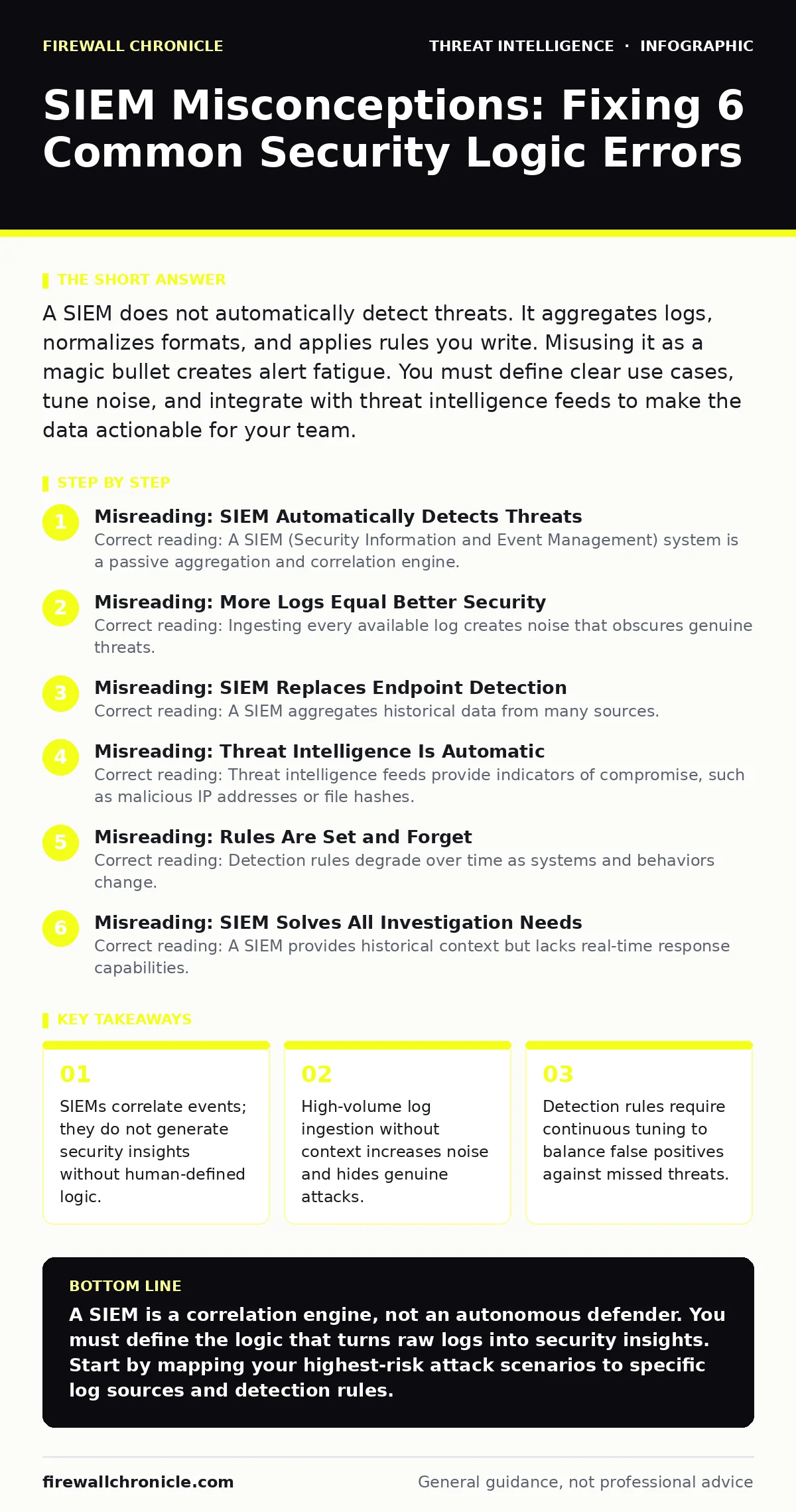
Misreading: More Logs Equal Better Security
Correct reading: Ingesting every available log creates noise that obscures genuine threats. High-volume data increases storage costs and processing latency. It also overwhelms analysts with low-value alerts. The goal is signal-to-noise ratio, not volume. You should ingest logs that support specific detection use cases. For example, monitoring authentication events is valuable for tracking unauthorized access.
Monitoring routine web server 200 OK responses is rarely useful for security. Consider the principle of least privilege applied to data. Only collect what you need to answer specific security questions. This approach aligns with effective Windows event log monitoring strategies, where selecting specific event IDs reduces clutter. Over-collection leads to alert fatigue, where analysts ignore notifications because most are false positives.
Misreading: SIEM Replaces Endpoint Detection
Correct reading: A SIEM aggregates historical data from many sources. Endpoint Detection and Response (EDR) tools monitor real-time behavior on individual devices. These technologies complement each other. The SIEM provides context across the entire network. The EDR provides deep visibility into process execution and file changes on a single host. You cannot see lateral movement across the network using only EDR data.
You cannot see specific malware behavior on a host using only SIEM logs. Imagine trying to understand a conversation by only reading the transcript of one person’s words. You miss the context of the other speaker. Integrating EDR telemetry into your SIEM allows you to correlate host-level anomalies with network-wide patterns. This combined view is necessary for detecting complex attacks.
Misreading: Threat Intelligence Is Automatic
Correct reading: Threat intelligence feeds provide indicators of compromise, such as malicious IP addresses or file hashes. A SIEM does not automatically interpret these indicators. You must configure the SIEM to ingest these feeds and match them against your logs. This process requires mapping the intelligence to your data schema. For instance, an external IP address in a threat feed must match the source IP field in your firewall logs.
Without this mapping, the intelligence is useless. Using standards like STIX and TAXII helps normalize this data exchange. However, the logic for alerting remains your responsibility. You decide whether a match triggers a low-priority log or a high-priority alert. Automated ingestion without proper tuning results in missed detections or excessive noise.
Misreading: Rules Are Set and Forget
Correct reading: Detection rules degrade over time as systems and behaviors change. A rule that worked last year may trigger false positives today due to software updates or new business processes. You must regularly review and tune rules. This involves analyzing false positives and adjusting thresholds or conditions. For example, a rule alerting on 10 failed logins might need adjustment if a new application causes repeated authentication errors.
Regular tuning reduces alert fatigue and improves detection accuracy. This process is similar to maintaining security metrics, where you track the effectiveness of your controls. Static rules become blind spots. Dynamic tuning ensures your detection logic evolves with your environment. Neglecting this maintenance leads to a false sense of security.
See also: How Disinformation Bot Networks Operate: Mechanics and Mitigation · What ISACs Are: Sector-Specific Threat Sharing Explained
Misreading: SIEM Solves All Investigation Needs
Correct reading: A SIEM provides historical context but lacks real-time response capabilities. It helps you understand what happened, not what is happening now. You need additional tools for active investigation and containment. Breach and attack simulation tools can test your detection rules by generating realistic attack traffic. This validates whether your SIEM rules trigger as expected.
The SIEM shows the aftermath of an attack. Other tools help you stop it. Imagine finding footprints in the snow. The SIEM shows where the attacker walked. It does not stop them from continuing. You must integrate your SIEM with incident response platforms. This integration allows you to take action based on SIEM alerts. Relying solely on SIEM for response delays containment and increases damage.
Key takeaways
- SIEMs correlate events; they do not generate security insights without human-defined logic.
- High-volume log ingestion without context increases noise and hides genuine attacks.
- Detection rules require continuous tuning to balance false positives against missed threats.
- Integrating external threat intelligence transforms raw logs into actionable security signals.
A SIEM is a correlation engine, not an autonomous defender. You must define the logic that turns raw logs into security insights. Start by mapping your highest-risk attack scenarios to specific log sources and detection rules.
Frequently asked questions
How do I reduce SIEM alert fatigue?
Focus on high-fidelity use cases. Tune rules to reduce false positives by adjusting thresholds and adding context. Remove rules that generate no value.
What is the difference between SIEM and SOAR?
SIEM aggregates and correlates logs. SOAR (Security Orchestration, Automation, and Response) automates response actions based on SIEM alerts.
Do I need a SIEM for small networks?
It depends on your compliance requirements and risk profile. Small networks may benefit from lightweight log management solutions before adopting full SIEM capabilities.
How often should I update detection rules?
Review rules quarterly or after significant system changes. Update rules to reflect new threats and reduce false positives.
How this guide was produced: written by the Firewall Chronicle editorial team with AI assistance, checked against the public references listed below, and reviewed when the facts change. See our editorial policy or report an error.