
Open-Source Intelligence Benefits and Trade-Offs
Public data exposes defender infrastructure faster than internal monitoring while simultaneously drowning analysis teams in untrusted noise.
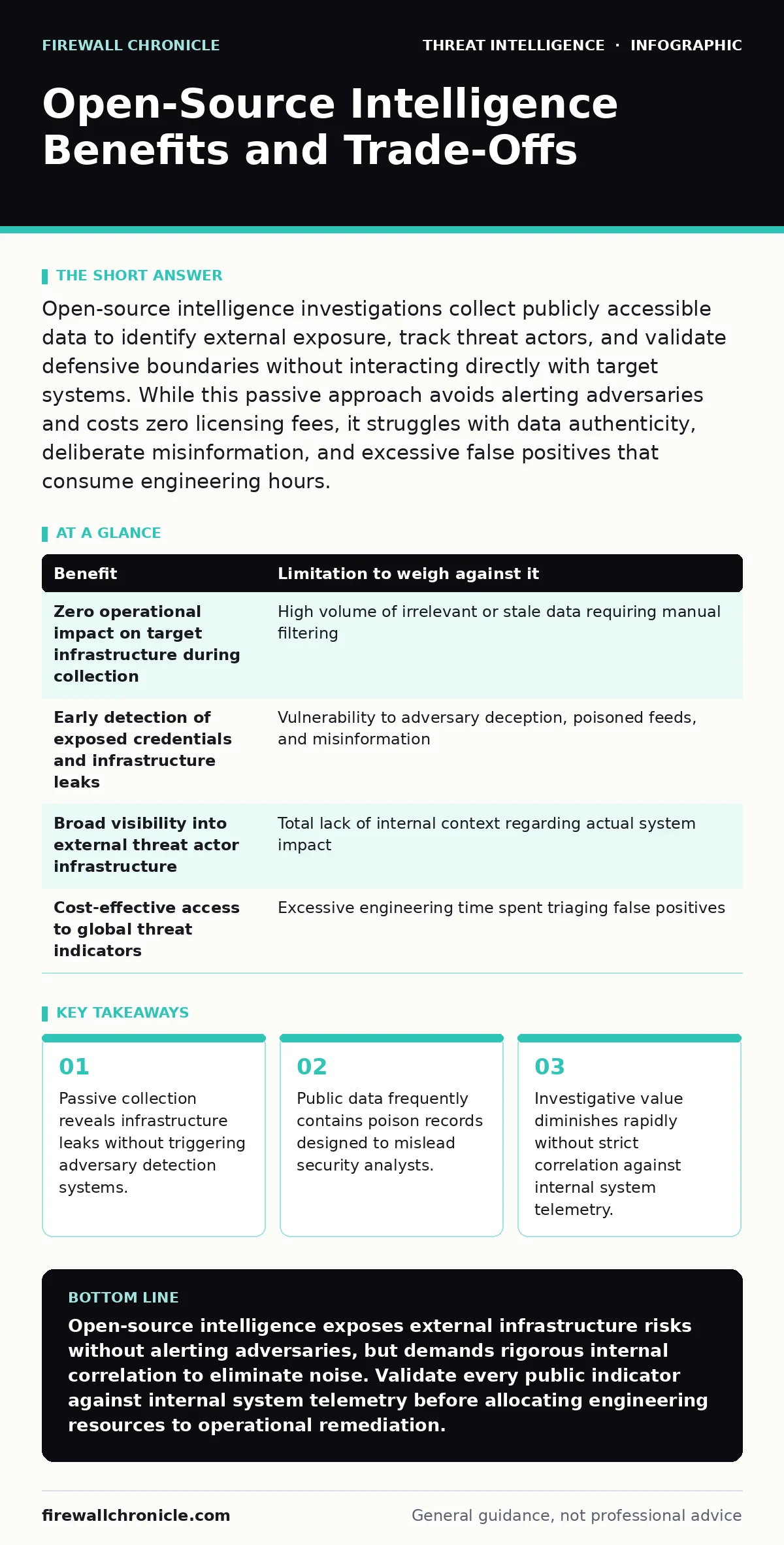
Open-source intelligence investigations collect publicly accessible data to identify external exposure, track threat actors, and validate defensive boundaries without interacting directly with target systems. While this passive approach avoids alerting adversaries and costs zero licensing fees, it struggles with data authenticity, deliberate misinformation, and excessive false positives that consume engineering hours.
Passive Visibility Across Public Infrastructure
Open-source intelligence gathering examines publicly accessible repositories, code hosts, public registries, and domain records to build an accurate model of external exposure. Defenders discover exposed application programming interface keys, misplaced cloud storage buckets, and subdomains before malicious actors exploit them. Because this collection relies entirely on existing public indexes, target networks register zero traffic during the investigation phase.
Security teams run these checks alongside active network enumeration to establish a baseline of what an external observer sees. Combining external records with internal asset databases highlights blind spots created by shadow infrastructure or forgotten staging environments.
The Structural Cost of Untrusted Datasets
Investigating public data introduces a severe data integrity challenge because adversaries control the publication source. Threat actors routinely inject false indicators, manipulate public code repositories, and deploy honeypots to throw off security analysis. Validating a single public code leak requires manual review, pulling engineering focus away from internal remediation work.
Raw public indicators lack internal operational context, generating high rates of unactionable alerts. A public source might report a compromised IP address, but without correlation against log management systems, defenders cannot confirm whether that address ever touched internal resources.
| Benefit | Limitation to weigh against it |
|---|---|
| Zero operational impact on target infrastructure during collection | High volume of irrelevant or stale data requiring manual filtering |
| Early detection of exposed credentials and infrastructure leaks | Vulnerability to adversary deception, poisoned feeds, and misinformation |
| Broad visibility into external threat actor infrastructure | Total lack of internal context regarding actual system impact |
| Cost-effective access to global threat indicators | Excessive engineering time spent triaging false positives |
How Attacker Reconnaissance Inverts OSINT Value
Adversaries use public intelligence techniques against defensive teams to map out target organizations. Threat actors analyze job postings to determine software stacks, examine public code commits for architectural flaws, and scrape corporate directories to orchestrate targeted phishing campaigns. Understanding this asymmetrical visibility helps defenders minimize their external footprint.
Defenders counter this activity by conducting self-directed investigations that mimic attacker reconnaissance techniques. Uncovering exposed metadata in public documents or sensitive internal naming conventions in public repositories allows infrastructure teams to scrub sensitive details before an active intrusion occurs.
Technical Trade-offs in Passive Analysis
Analyzing third-party public data requires trade-offs between investigative speed and technical accuracy. Automated scrapers collect massive volumes of raw indicators, but storage and parsing pipelines demand constant maintenance as public page schemas change. Manual verification guarantees high accuracy but scales poorly across large asset footprints.
Public Records -> Domain/IP Scrapers -> Parsing Pipeline -> Internal Correlation -> Verified Threat Lead
Passive investigations fail to uncover deep administrative activity inside a compromised network. While public data spots exposed initial access vectors, tracking internal lateral movement requires active host telemetry and internal network monitoring that open-source records cannot provide.
When It Is Worth It
External intelligence investigations yield high returns when auditing perimeter exposures, validating cloud migrations, and performing due diligence during corporate acquisitions. Organizations launching new public services use passive analysis to confirm that internal staging endpoints, credential files, and development keys remain completely invisible to commercial search indexes.
- Pre-deployment exposure audits: Run passive sweeps before pointing production DNS records to new cloud infrastructure to catch exposed administrative interfaces.
- Brand and credential monitoring: Monitor public code platforms continuously for leaked authorization tokens, database strings, and private keys.
- Supply chain assessment: Evaluate third-party vendor exposures by analyzing their public certificate logs, expired domains, and misconfigured assets.
Evaluating threat intelligence reports against internal telemetry helps prioritize patching schedules for software components that are actively exploited in the wild.
See also: How Disinformation Bot Networks Operate: Mechanics and Mitigation · What ISACs Are: Sector-Specific Threat Sharing Explained
When It Is Not Worth It
Passive external collection becomes counterproductive when applied to internal incident response scenarios where active host monitoring is required. Attempting to track an active attacker inside a corporate network using external indicators wastes critical containment time, as public databases update hours or days after adversary infrastructure shifts.
- Active internal intrusions: Do not rely on external databases to track an attacker who already possesses internal network access.
- Low-maturity operations: Avoid building complex external scraping pipelines if basic internal logging and patch management remain incomplete.
- High-noise threat feeds: Discontinue ingestion of generic, unverified indicator lists that generate hundreds of low-priority tickets daily without clear asset context.
Directing engineering resources toward internal host detection engineering delivers higher security ROI than maintaining brittle scrapers for unvalidated public sources.
Key takeaways
- Passive collection reveals infrastructure leaks without triggering adversary detection systems.
- Public data frequently contains poison records designed to mislead security analysts.
- Investigative value diminishes rapidly without strict correlation against internal system telemetry.
Open-source intelligence exposes external infrastructure risks without alerting adversaries, but demands rigorous internal correlation to eliminate noise. Validate every public indicator against internal system telemetry before allocating engineering resources to operational remediation.
Frequently asked questions
What is the main difference between active and passive threat investigations?
Active threat investigations interact directly with target systems through network probes, sending packets that target firewalls can detect. Passive investigations collect data exclusively from third-party indexes, public records, and cached repositories without sending traffic to target infrastructure.
How do defenders prevent public code repositories from leaking secrets?
Defensive teams run automated secret detection scanners in local continuous integration pipelines before code reaches public repositories. Additionally, security groups set up external monitoring to alert engineers immediately if private keys or credentials appear in public commits.
Why do public intelligence feeds contain so many false positives?
Public intelligence feeds aggregate raw data automatically across millions of global endpoints without knowing your operational architecture. Without internal asset context, a feed marks harmless testing infrastructure or shared web hosting addresses as malicious threats.
Can open-source intelligence replace traditional vulnerability scanning?
Open-source intelligence cannot replace vulnerability scanning because passive collection only reveals exposed assets and publicly advertised software versions. Internal vulnerability scanning probes deep application configurations, patch levels, and non-public services that external public indexes cannot see.
How this guide was produced: written by the Firewall Chronicle editorial team with AI assistance, checked against the public references listed below, and reviewed when the facts change. See our editorial policy or report an error.