Threat Intelligence for Small Teams: Practical Application
Transform raw threat data into actionable security controls without hiring a dedicated analyst or buying expensive enterprise platforms.
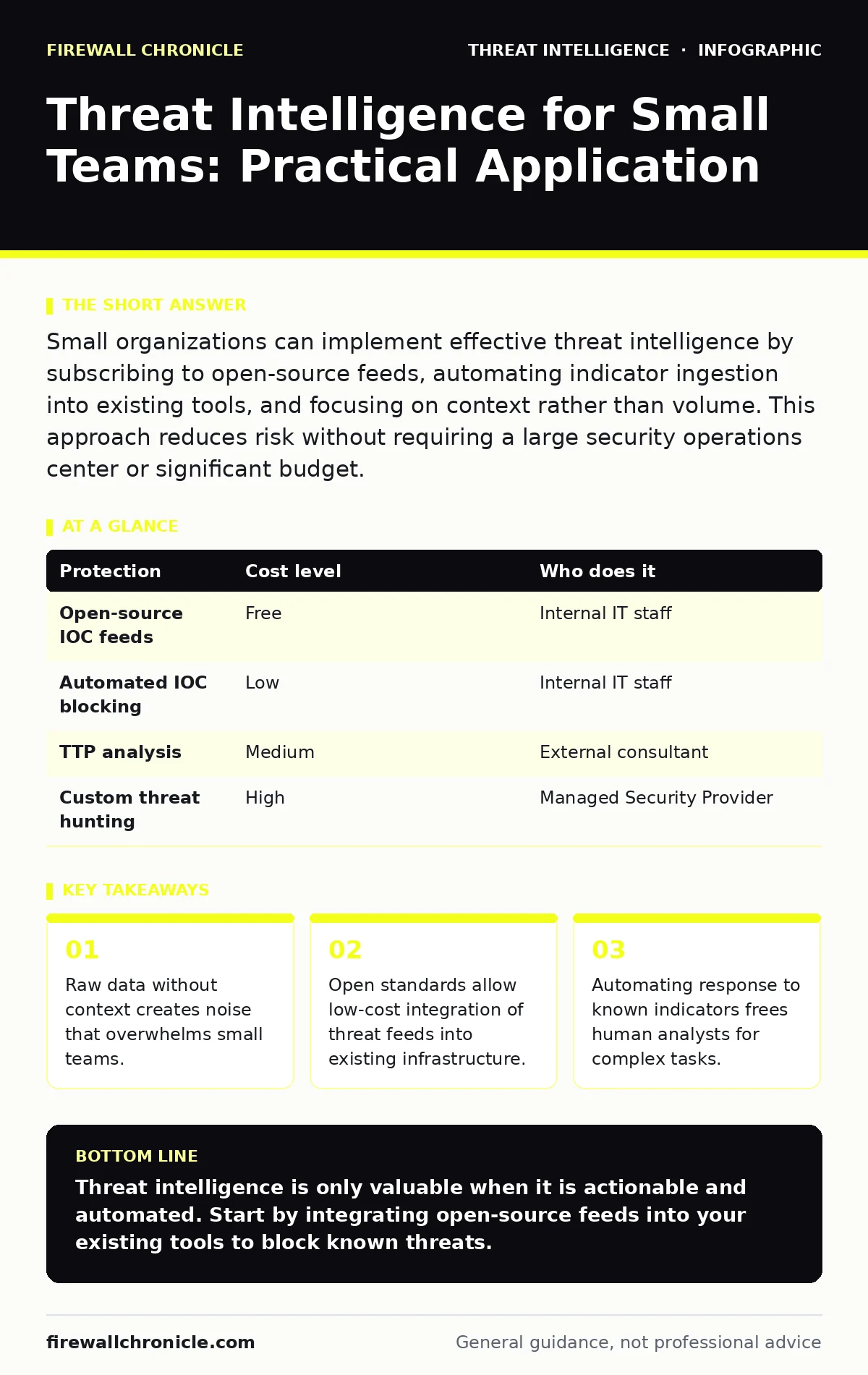
Small organizations can implement effective threat intelligence by subscribing to open-source feeds, automating indicator ingestion into existing tools, and focusing on context rather than volume. This approach reduces risk without requiring a large security operations center or significant budget.
The Signal-to-Noise Ratio Trap
Threat intelligence reports often suffer from information overload. Large security vendors publish daily digests containing thousands of indicators of compromise (IOCs). These IOCs are digital fingerprints, such as IP addresses, file hashes, or domain names, associated with malicious activity. For a small team, reviewing every item is impossible. The result is alert fatigue, where real threats are ignored because they are buried in irrelevant data.
You must filter intelligence based on relevance. A report about a banking trojan is useless if you do not handle financial transactions. Context is the differentiator between raw data and actionable intelligence. You need to know not just that an IP address is malicious, but why it matters to your specific environment. This requires mapping external threats to your internal assets.
Affordable Intelligence Sources
You do not need expensive commercial feeds to stay informed. Open-source intelligence (OSINT) provides a wealth of data at no cost. Community-driven platforms share IOCs and tactics, techniques, and procedures (TTPs). TTPs describe how an attacker operates, which is more valuable than a single IP address that may change quickly.
Subscribe to feeds that align with your technology stack. If you use a specific cloud provider, follow their security blogs and open-source threat sharing communities. Look for feeds that support standard formats. The Open Source Intelligence (OSINT) community often uses the STIX/TAXII standards. STIX allows for the structured representation of cyber threat information, while TAXII provides a protocol for exchanging that information. Using these standards ensures compatibility with various tools.
| Protection | Cost level | Who does it |
|---|---|---|
| Open-source IOC feeds | Free | Internal IT staff |
| Automated IOC blocking | Low | Internal IT staff |
| TTP analysis | Medium | External consultant |
| Custom threat hunting | High | Managed Security Provider |
Automating Indicator Ingestion
Manual review of threat lists is inefficient and error-prone. Instead, integrate feeds directly into your security tools. Most firewalls, endpoint detection and response (EDR) systems, and email gateways allow you to import blocklists. You can configure these tools to pull updates automatically from trusted sources. This ensures that known malicious domains are blocked before they reach your users.
Automation handles the low-hanging fruit. It blocks traffic to known command-and-control servers and prevents downloads of identified malware. This frees your team to focus on anomalies that automation cannot catch. However, automation has limits. It cannot interpret nuanced threats or distinguish between a false positive and a real attack in complex scenarios. You must maintain a process for reviewing blocked items to avoid disrupting legitimate business operations.
The Hidden Cost of Context
Raw indicators have a short shelf life. An attacker can change their IP address or register a new domain in minutes. Relying solely on IOCs is a reactive strategy that often fails against sophisticated adversaries. You need to understand the attacker’s behavior, not just their current location. This is where Tactics, Techniques, and Procedures (TTPs) become critical.
TTPs provide a deeper understanding of the threat. They describe the methods an attacker uses to gain access, escalate privileges, and exfiltrate data. By monitoring for these behaviors, you can detect attacks even when the attacker uses new infrastructure. This requires more sophisticated monitoring capabilities. You must log system events and network traffic. You then analyze these logs for patterns that match known TTPs. This approach is more resource-intensive but offers better protection.
What to Delegate
Not every aspect of threat intelligence requires internal expertise. Analyzing complex malware samples or tracking advanced persistent threats requires specialized skills. Small teams often lack the bandwidth for deep-dive investigations. In these cases, delegating to a managed security service provider (MSSP) is prudent. An MSSP can provide 24/7 monitoring and incident response capabilities.
When selecting a provider, ask specific questions about their intelligence capabilities. Do they use open standards for data sharing? How do they tailor alerts to your environment? Can they provide context for the alerts they generate? You want a partner that enhances your internal team, not one that replaces your understanding of your own systems.
- Does the provider use STIX/TAXII for data exchange?
- How do they filter noise for small organizations?
- What is their process for verifying new indicators?
- Can they provide TTP-based alerts, not just IOC blocks?
- How do they handle false positives?
See also: Log Retention for Small Teams: Keep Evidence Without Breaking Budget · Security Awareness Training for Small Business: Real Defense
Building a Feedback Loop
Threat intelligence is not a one-way street. Your organization generates valuable data through its own security events. Analyzing your internal logs can reveal trends that are not yet visible in public feeds. You may notice unusual login attempts or strange network connections that precede a wider attack.
Share this information with your community. Many open-source platforms allow you to contribute your own findings. This reciprocal sharing improves the collective defense. It also helps you validate your own assumptions. If your internal data aligns with external reports, you can be more confident in your response. This creates a virtuous cycle of improvement.
Integrating Intelligence into Development
For software teams, threat intelligence must extend beyond the network perimeter. Developers need to understand the vulnerabilities in the libraries and frameworks they use. Software composition analysis (SCA) tools can scan your codebase for known vulnerable components. These tools rely on databases of vulnerabilities, which are a form of threat intelligence.
Integrate SCA into your continuous integration and continuous deployment (CI/CD) pipeline. This ensures that vulnerable code is caught before it reaches production. It shifts security left, addressing issues earlier in the development lifecycle. This is more effective than trying to patch vulnerabilities after deployment. It reduces the window of exposure and minimizes the impact on users.
Key takeaways
- Raw data without context creates noise that overwhelms small teams.
- Open standards allow low-cost integration of threat feeds into existing infrastructure.
- Automating response to known indicators frees human analysts for complex tasks.
Threat intelligence is only valuable when it is actionable and automated. Start by integrating open-source feeds into your existing tools to block known threats.
Frequently asked questions
How often should I update my threat intelligence feeds?
Update feeds automatically and continuously. Manual updates are too slow to keep pace with modern threats.
Can I trust open-source threat intelligence?
Yes, but verify sources. Community-vetted feeds are generally reliable, but you should cross-reference critical indicators.
What is the difference between IOCs and TTPs?
IOCs are specific artifacts like IP addresses, while TTPs describe attacker behavior. TTPs are more durable and useful for detection.
Do I need a SIEM for threat intelligence?
A SIEM helps aggregate logs and detect patterns, but it is not strictly required for basic IOC blocking.
How this guide was produced: written by the Firewall Chronicle editorial team with AI assistance, checked against the public references listed below, and reviewed when the facts change. See our editorial policy or report an error.