Breach and Attack Simulation Explained: Automated Security Testing
Breach and attack simulation turns static firewall rules into active challenges, proving whether your defenses stop realistic intrusion techniques before a real adversary arrives.
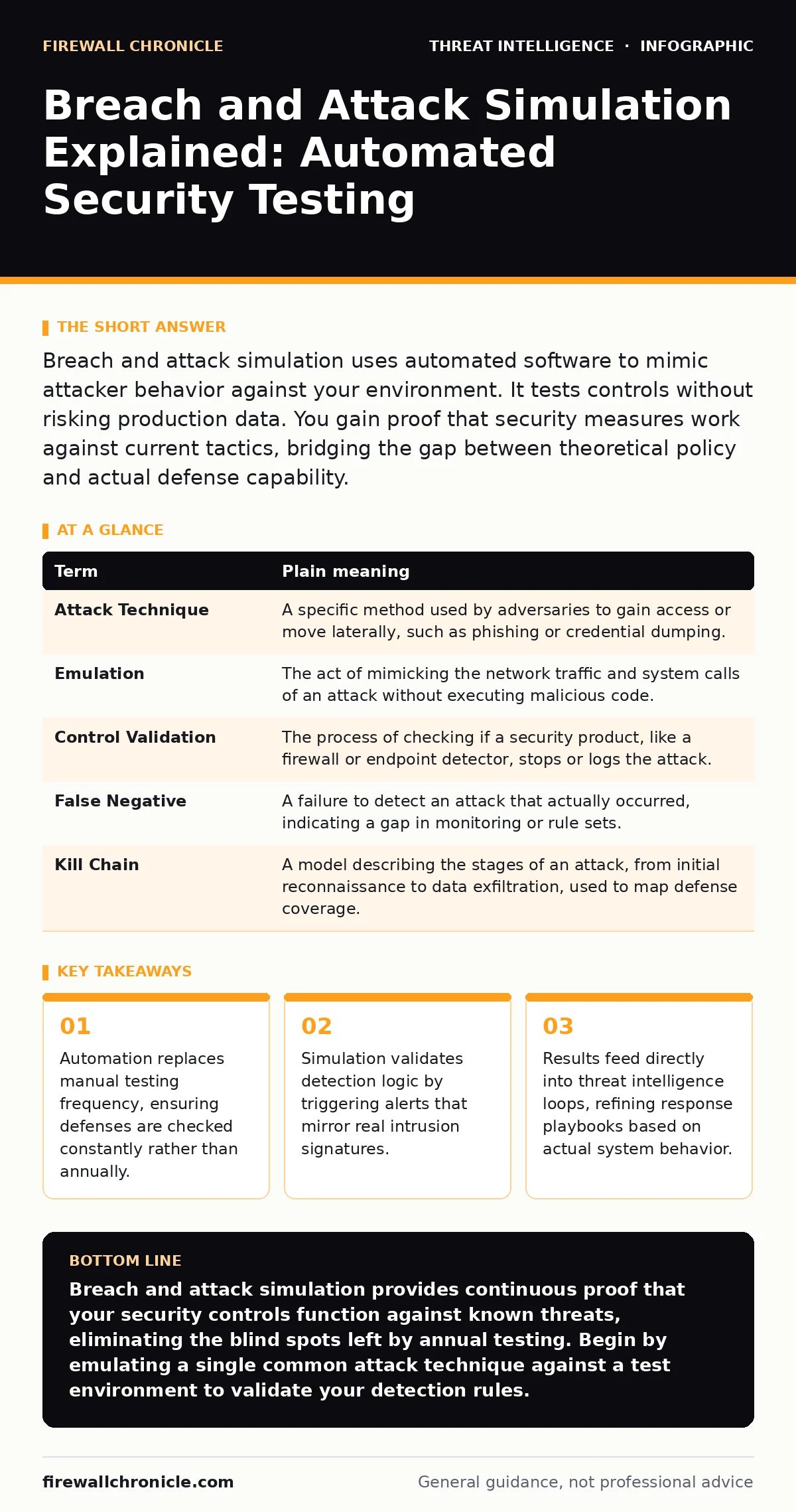
Breach and attack simulation uses automated software to mimic attacker behavior against your environment. It tests controls without risking production data. You gain proof that security measures work against current tactics, bridging the gap between theoretical policy and actual defense capability.
The Fire Drill Analogy
Imagine a building with a sophisticated fire suppression system. The hardware is installed, and the manuals are written. Yet, you do not know if the sprinklers will activate until a real fire occurs. Waiting for a real fire is not a viable strategy. You need a way to test the system without burning the building down. This is the core problem in cybersecurity. Static configurations look secure on paper, but they may fail under pressure. Breach and attack simulation acts as the controlled sprinkler test. It triggers the sensors and checks the response without causing actual damage. This analogy will frame how we view automated security validation.
Defining the Mechanism
Breach and attack simulation is an automated process that emulates adversary techniques against a target environment. Unlike a penetration test, which relies on a human expert spending weeks finding one path, simulation runs thousands of techniques repeatedly. It focuses on breadth and frequency rather than depth and novelty. The goal is not to exploit a zero-day vulnerability but to verify that known attack patterns are blocked or detected. This distinction matters for long-term security posture. It shifts the focus from finding new bugs to verifying that existing controls function as intended.
Key Terms and Concepts
To understand the workflow, you must separate the execution from the detection. The following terms define the core components of this practice.
| Term | Plain meaning |
|---|---|
| Attack Technique | A specific method used by adversaries to gain access or move laterally, such as phishing or credential dumping. |
| Emulation | The act of mimicking the network traffic and system calls of an attack without executing malicious code. |
| Control Validation | The process of checking if a security product, like a firewall or endpoint detector, stops or logs the attack. |
| False Negative | A failure to detect an attack that actually occurred, indicating a gap in monitoring or rule sets. |
| Kill Chain | A model describing the stages of an attack, from initial reconnaissance to data exfiltration, used to map defense coverage. |
The Hidden Cost of Manual Testing
Many organizations rely on annual penetration tests. These are valuable for finding unique vulnerabilities, but they provide only a snapshot in time. If you change your network configuration or update your software between tests, the previous results become obsolete. This creates a false sense of security.
The gap between tests is often where compromises occur. Breach and attack simulation fills this gap by running tests continuously. It reveals when a configuration change breaks a security rule. For example, a new firewall rule might inadvertently allow traffic that should be blocked. Manual tests would miss this until the next annual engagement. Automation catches it immediately.
Integrating with Threat Intelligence
The value of simulation increases when it aligns with current threat trends. You should prioritize techniques that are actively seen in the wild. This requires consulting threat intelligence reports to identify which tactics are prevalent. If a specific ransomware group is trending, you simulate their entry methods. This ensures your testing is relevant. It also helps in refining security metrics. This metric is more useful for decision-making. It shows exactly where your defenses are weak against current adversaries.
See also: Port Scan Response: Containment, Recovery, and Prevention Steps
Practical Execution Steps
You can start validating your environment without complex setup. The following steps outline a basic workflow for beginners.
- Define your scope and select a small, non-critical segment of your network to avoid disruption.
- Choose a set of common attack techniques, such as port scanning or basic credential brute-forcing, to emulate.
- Run the simulation and review the logs to see if your detection systems generated alerts for each technique.
Refining Blue Team Operations
The output of these simulations is raw data for blue team operations. Analysts can use the results to tune their detection rules. If a simulation generates too many alerts, the rule may be too noisy. If it generates none, the rule may be too strict or broken. This feedback loop improves the accuracy of your monitoring over time. It reduces alert fatigue by ensuring that alerts are meaningful. It also supports log management strategies by highlighting which logs are necessary for detecting specific techniques. You can archive logs that do not contribute to detection, saving storage costs.
Beyond Network Enumeration
Simulation goes deeper than simple network enumeration. While enumeration maps out what exists, simulation tests how it behaves under attack. It checks if an open port is actually protected by an intrusion prevention system. It verifies that endpoint detection and response agents are active and communicating. This depth provides a realistic view of security. It moves beyond inventory to validation. You learn not just what you have, but how well it works. This insight is critical for maintaining a resilient posture against evolving threats.
Key takeaways
- Automation replaces manual testing frequency, ensuring defenses are checked constantly rather than annually.
- Simulation validates detection logic by triggering alerts that mirror real intrusion signatures.
- Results feed directly into threat intelligence loops, refining response playbooks based on actual system behavior.
Breach and attack simulation provides continuous proof that your security controls function against known threats, eliminating the blind spots left by annual testing. Begin by emulating a single common attack technique against a test environment to validate your detection rules.
Frequently asked questions
Is breach and attack simulation the same as penetration testing?
No, penetration testing involves manual exploration to find unique vulnerabilities, while simulation automates known techniques to verify control effectiveness at scale.
Can simulation cause downtime in production systems?
It can if not scoped correctly, as emulated traffic consumes resources, so it should be run in test environments or with strict rate limits during off-hours.
How often should simulations be run?
Ideally on a continuous or daily basis to catch configuration drift, but weekly runs are acceptable for organizations with slower change cycles.
Do I need specialized hardware for this?
No, most solutions are software-based and run on virtual agents or cloud instances, requiring only network access to the target environment.
How this guide was produced: written by the Firewall Chronicle editorial team with AI assistance, checked against the public references listed below, and reviewed when the facts change. See our editorial policy or report an error.