Social Engineering: How Manipulation Bypasses Technical Defenses
Attackers exploit cognitive biases and trust signals to bypass technical controls that strictly verify data integrity but ignore human intent.
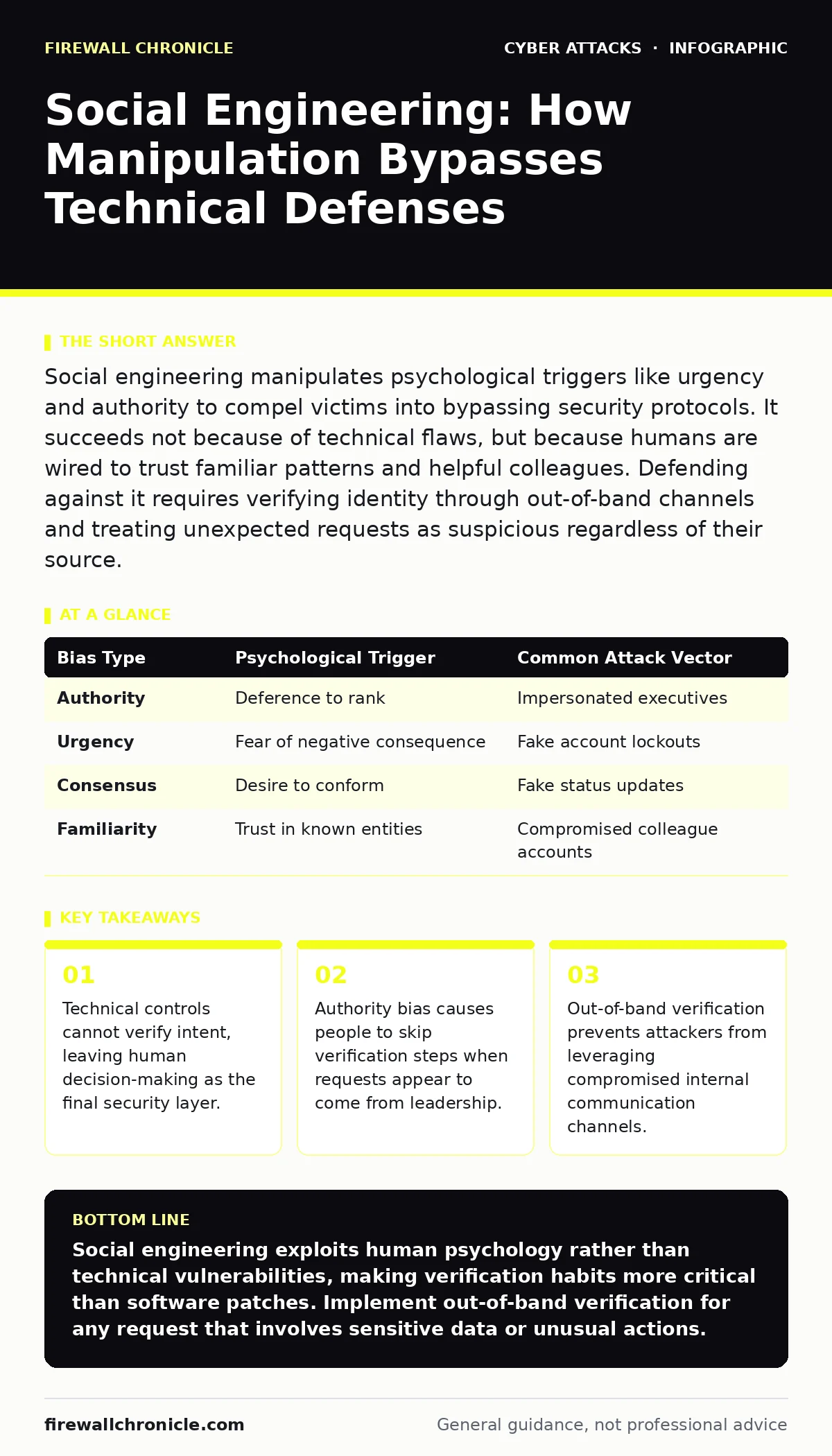
Social engineering manipulates psychological triggers like urgency and authority to compel victims into bypassing security protocols. It succeeds not because of technical flaws, but because humans are wired to trust familiar patterns and helpful colleagues. Defending against it requires verifying identity through out-of-band channels and treating unexpected requests as suspicious regardless of their source.
Why do technical controls fail against social engineering?
Technical controls verify data integrity and access rights, but they cannot assess human intent or context. A firewall blocks unauthorized network traffic, yet it allows legitimate users to voluntarily share credentials with an attacker. Security systems assume that authenticated users act in the organization’s best interest. Social engineering exploits this assumption by convincing authenticated users to perform malicious actions. This creates a blind spot where the most secure systems are undermined by trusted insiders.
How does authority bias bypass security protocols?
Authority bias causes individuals to comply with requests from perceived superiors without standard verification. Imagine a message from your CEO requesting immediate fund transfers to avoid a legal penalty. The urgency and status of the sender suppress your natural skepticism. You might bypass multi-factor authentication or ignore approval workflows to satisfy the request. Attackers craft messages that mimic executive tone and urgency to trigger this psychological response.
| Bias Type | Psychological Trigger | Common Attack Vector |
|---|---|---|
| Authority | Deference to rank | Impersonated executives |
| Urgency | Fear of negative consequence | Fake account lockouts |
| Consensus | Desire to conform | Fake status updates |
| Familiarity | Trust in known entities | Compromised colleague accounts |
Can social engineering target non-human systems?
Yes, attackers manipulate the humans who manage non-human systems to achieve indirect access. They do not hack the server directly; they trick the administrator into granting access or changing configurations. This is often called supply chain manipulation. An attacker might pose as a vendor support agent calling IT helpdesk. They convince the technician to reset a service account password or disable a monitoring rule. The technical system remains uncompromised, but its configuration is altered by a trusted operator.
What is the role of familiarity in these attacks?
Familiarity reduces the cognitive load required to verify a request. When a message appears to come from a known colleague, you skip the step of checking the sender’s actual identity. Attackers compromise legitimate accounts to exploit this trust. They monitor the victim’s communications to mimic writing style and context. This makes the request appear normal and expected. The attack succeeds because the verification step is skipped due to perceived familiarity.
How does urgency disable critical thinking?
Urgency triggers a fight-or-flight response that prioritizes speed over accuracy. When you feel pressured to act immediately, your brain bypasses the prefrontal cortex where critical analysis occurs. Attackers use phrases like "immediate action required" or "account suspended" to create this pressure. You are more likely to click a malicious link or share credentials when you fear negative consequences. The goal is to prevent you from pausing to verify the request through a separate channel.
Why is out-of-band verification effective?
Out-of-band verification requires confirming a request through a different communication channel than the one used for the request. If you receive an email asking for sensitive data, you call the sender using a known, verified phone number. This breaks the attacker’s control over the communication path. Even if the attacker compromised the email account, they likely do not control the phone line. This method adds friction that stops automated or casual attacks. It forces the attacker to compromise multiple independent channels simultaneously.
How do attackers use technical knowledge to gain trust?
Attackers often demonstrate deep technical knowledge to appear legitimate and helpful. They might reference specific error codes, internal project names, or recent system changes. This signals that they are insiders who understand your environment. You are more likely to trust someone who speaks your language and understands your pain points. This technique is particularly effective against software developers and system administrators. It lowers defenses by validating the attacker’s perceived competence.
What is the hidden cost of phishing simulations?
Phishing simulations can create a false sense of security and encourage click-driven behavior rather than critical thinking. If users are tested frequently, they may become desensitized to warnings or overly cautious, slowing productivity. Some organizations focus on catching users rather than teaching them to recognize subtle manipulation. This turns security into a game of gotcha rather than a habit of verification. Effective training focuses on the psychology of manipulation, not just spotting fake URLs.
How does SIM swapping facilitate account takeover?
SIM swapping transfers a victim’s phone number to an attacker-controlled SIM card. This allows the attacker to intercept SMS-based multi-factor authentication codes. Many services use SMS as a recovery method or second factor. Once the attacker controls the phone number, they can reset passwords for email, banking, and social media accounts. This bypasses traditional password security entirely. It highlights the weakness of using a mobile network as a security boundary.
Can hardware security keys prevent all social engineering?
Hardware security keys protect against credential theft but not against direct manipulation of user behavior. If an attacker convinces you to connect a malicious USB device that mimics a keyboard, the key cannot stop the input. Similarly, if you are tricked into enabling remote desktop access, the key is irrelevant. Hardware keys ensure that the private key never leaves the device. They prevent phishing of passwords but do not prevent you from being tricked into performing other actions.
Key takeaways
- Technical controls cannot verify intent, leaving human decision-making as the final security layer.
- Authority bias causes people to skip verification steps when requests appear to come from leadership.
- Out-of-band verification prevents attackers from leveraging compromised internal communication channels.
Social engineering exploits human psychology rather than technical vulnerabilities, making verification habits more critical than software patches. Implement out-of-band verification for any request that involves sensitive data or unusual actions.
Frequently asked questions
How do I verify an email from my boss asking for urgent help?
Do not reply to the email or click any links. Call your boss using a phone number you already have saved, not one in the email. Confirm the request verbally before taking any action.
Is it safe to use SMS for two-factor authentication?
SMS is vulnerable to SIM swapping and interception. Use authenticator apps or hardware security keys instead, as they do not rely on the mobile carrier network for security.
What should I do if I think I fell for a social engineering attack?
Immediately change your passwords and revoke active sessions. Report the incident to your security team. Assume that your credentials are compromised and monitor for unusual activity.
How can I protect my organization from internal social engineering?
Implement strict least-privilege access controls and require multi-person approval for high-risk actions. Train staff to recognize urgency and authority bias tactics. Regularly review access logs for anomalies.
How this guide was produced: written by the Firewall Chronicle editorial team with AI assistance, checked against the public references listed below, and reviewed when the facts change. See our editorial policy or report an error.