Blue Team Operations: How Detection and Response Actually Works
Blue teams do not stop attacks at the perimeter; they manage the inevitable breach by slowing down lateral movement and forcing attackers to reveal their presence.
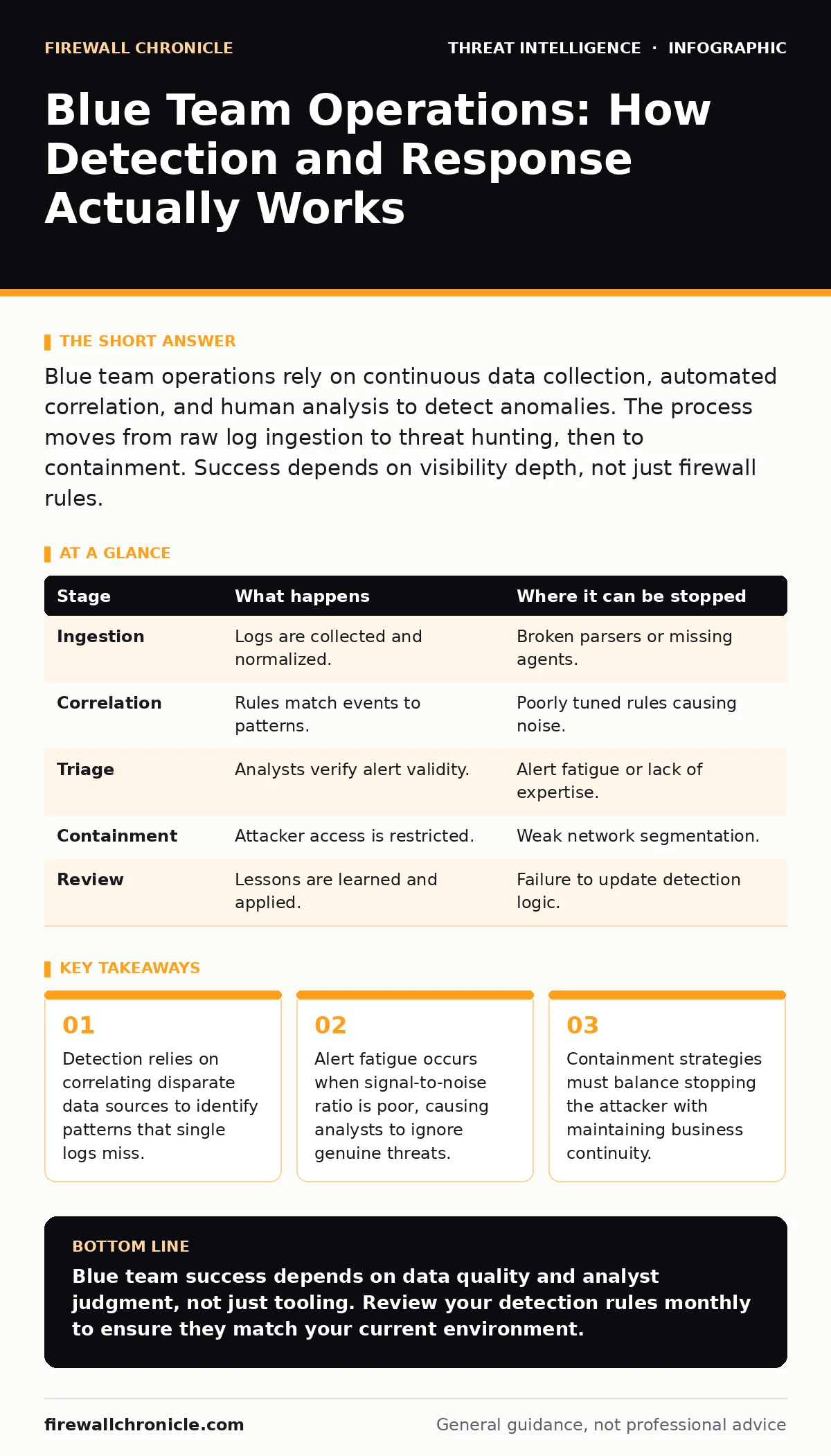
Blue team operations rely on continuous data collection, automated correlation, and human analysis to detect anomalies. The process moves from raw log ingestion to threat hunting, then to containment. Success depends on visibility depth, not just firewall rules.
The Foundation of Visibility
You cannot detect what you cannot see. Most organizations assume their perimeter defenses are sufficient, but modern operations assume breach. The blue team’s primary job is not to build an impenetrable wall, but to create a transparent environment where malicious activity leaves a trace. This requires aggregating data from endpoints, networks, and identity providers.
Without centralized log management, this data remains siloed and useless. You must ship logs to a central repository where they can be correlated. This is not just about storage; it is about structure. Unstructured data cannot be queried efficiently. If your logs lack context, such as user identity or process lineage, you are blind to the attacker’s intent.
Imagine a server that receives a connection from an unusual IP address. By itself, this is noise. But if that server also shows a new process spawning and a file modification, the pattern changes. The blue team looks for these sequences. This is the core mechanism: turning raw events into meaningful context.
Data Ingestion and Normalization
The first operational stage is ingestion. Agents on endpoints and collectors on network devices send telemetry to your security information and event management system. This system, often called a SIEM, acts as the central nervous system. It receives millions of events daily.
Normalization is the hidden cost of this stage. Different vendors format logs differently. A Windows event log looks nothing like a Linux syslog. You must map these disparate formats to a common schema. If you skip this, your queries become brittle. A change in an operating system version can break your detection logic if you rely on specific field names.
This stage is where most failures occur. If the data is wrong, the analysis is wrong. You must validate that critical fields are present and accurate. This is not a one-time setup. It requires ongoing maintenance as your infrastructure changes.
Correlation and Alerting
Once data is normalized, the system applies correlation rules. These rules define what constitutes a threat. A single failed login is normal. Ten failed logins from the same source in one minute is suspicious. The system groups these events and generates an alert.
This is where alert fatigue becomes a critical issue. If your rules are too broad, you generate thousands of false positives. Analysts burn out and start ignoring alerts. If your rules are too narrow, you miss sophisticated attacks. You must tune these rules continuously.
Consider AS-REP roasting. This is an attack where an adversary requests ticket-granting tickets for accounts that do not require pre-authentication. The network sees a legitimate request. The log shows a standard Kerberos transaction. Without specific correlation logic, this looks like normal activity. You must understand the protocol to detect the abuse.
Triage and Analysis
An alert triggers human intervention. The analyst reviews the event. They ask: Is this expected? Who is the user? What is the asset? This is not just clicking through a dashboard. It is investigative reasoning.
The analyst enriches the alert with external context. They check threat intelligence feeds to see if the IP address is known malicious. They check internal assets to see if the server is critical. This step separates noise from signal.
If the analyst determines it is a false positive, they suppress the rule. This improves the signal-to-noise ratio for future events. If it is true, they escalate. This human judgment is irreplaceable. Automation can flag, but it cannot judge intent.
Containment and Eradication
Once confirmed, the goal is containment. You must stop the attacker from moving further. This often means isolating the host from the network. You do not shut it down, as you need the memory and disk state for forensic analysis.
Network segmentation plays a key role here. If the attacker is in the marketing VLAN, they should not reach the finance VLAN. If your segmentation is weak, the attacker performs lateral movement easily. You must verify that micro-segmentation is enforced at the switch or hypervisor level.
Eradication involves removing the attacker’s tools. This includes deleting backdoors, resetting credentials, and patching the vulnerability used. You must ensure the attacker has no residual access. A missed backdoor leads to re-infection.
See also: SOC vs NOC: Operational Differences and Security Impact · Log Management and Analysis: Turning Noise into Signal
Post-Incident Review
The operation does not end when the threat is gone. You must analyze why the detection worked or failed. Did the alert trigger too late? Was the data missing? This review improves your defenses for the next incident.
You update your detection rules based on what you learned. If the attacker used a new technique, you add a rule for it. You also check your Windows event log monitoring configuration. Did you capture the right events? Often, organizations disable verbose logging to save space, which hides critical activity.
This feedback loop is what makes a blue team effective. It is not a static set of rules. It is an evolving process. You adapt to the attacker’s tactics. This continuous improvement is the only defense against persistent adversaries.
| Stage | What happens | Where it can be stopped |
|---|---|---|
| Ingestion | Logs are collected and normalized. | Broken parsers or missing agents. |
| Correlation | Rules match events to patterns. | Poorly tuned rules causing noise. |
| Triage | Analysts verify alert validity. | Alert fatigue or lack of expertise. |
| Containment | Attacker access is restricted. | Weak network segmentation. |
| Review | Lessons are learned and applied. | Failure to update detection logic. |
Limits of the Model
Blue team operations have inherent limits. You cannot detect every attack. Some techniques leave no logs. Some attackers use living-off-the-land binaries that are native to the OS. You must accept that some breaches will occur.
The goal is to increase the attacker’s cost. If they take months to move laterally, you have time to detect and respond. If they take minutes, you are likely overwhelmed. Focus on slowing them down.
Also, consider attacker reconnaissance. If they are careful, they may not trigger alerts. They may use low-and-slow techniques to avoid detection thresholds. Your defenses must account for patience, not just volume.
Key takeaways
- Detection relies on correlating disparate data sources to identify patterns that single logs miss.
- Alert fatigue occurs when signal-to-noise ratio is poor, causing analysts to ignore genuine threats.
- Containment strategies must balance stopping the attacker with maintaining business continuity.
Blue team success depends on data quality and analyst judgment, not just tooling. Review your detection rules monthly to ensure they match your current environment.
Frequently asked questions
How do I reduce alert fatigue?
Tune your correlation rules to require multiple indicators before alerting. Suppress known benign activities. Focus on high-fidelity signals rather than volume.
What is the difference between SIEM and SOAR?
A SIEM collects and correlates logs. A SOAR automates the response actions based on those logs. They work together to speed up incident handling.
Do I need 24/7 monitoring?
Attacks do not respect business hours. If you cannot staff analysts around the clock, you must have automated containment for critical alerts.
How do I handle insider threats?
Monitor for unusual data access patterns and privilege escalation. Insider threats often use legitimate credentials, making behavioral analysis key.
How this guide was produced: written by the Firewall Chronicle editorial team with AI assistance, checked against the public references listed below, and reviewed when the facts change. See our editorial policy or report an error.