STIX and TAXII Explained: How Cyber Threat Intelligence Actually Moves
STIX structures threat data while TAXII transports it, allowing security teams to share actionable intelligence without manual file exchanges or custom integrations.
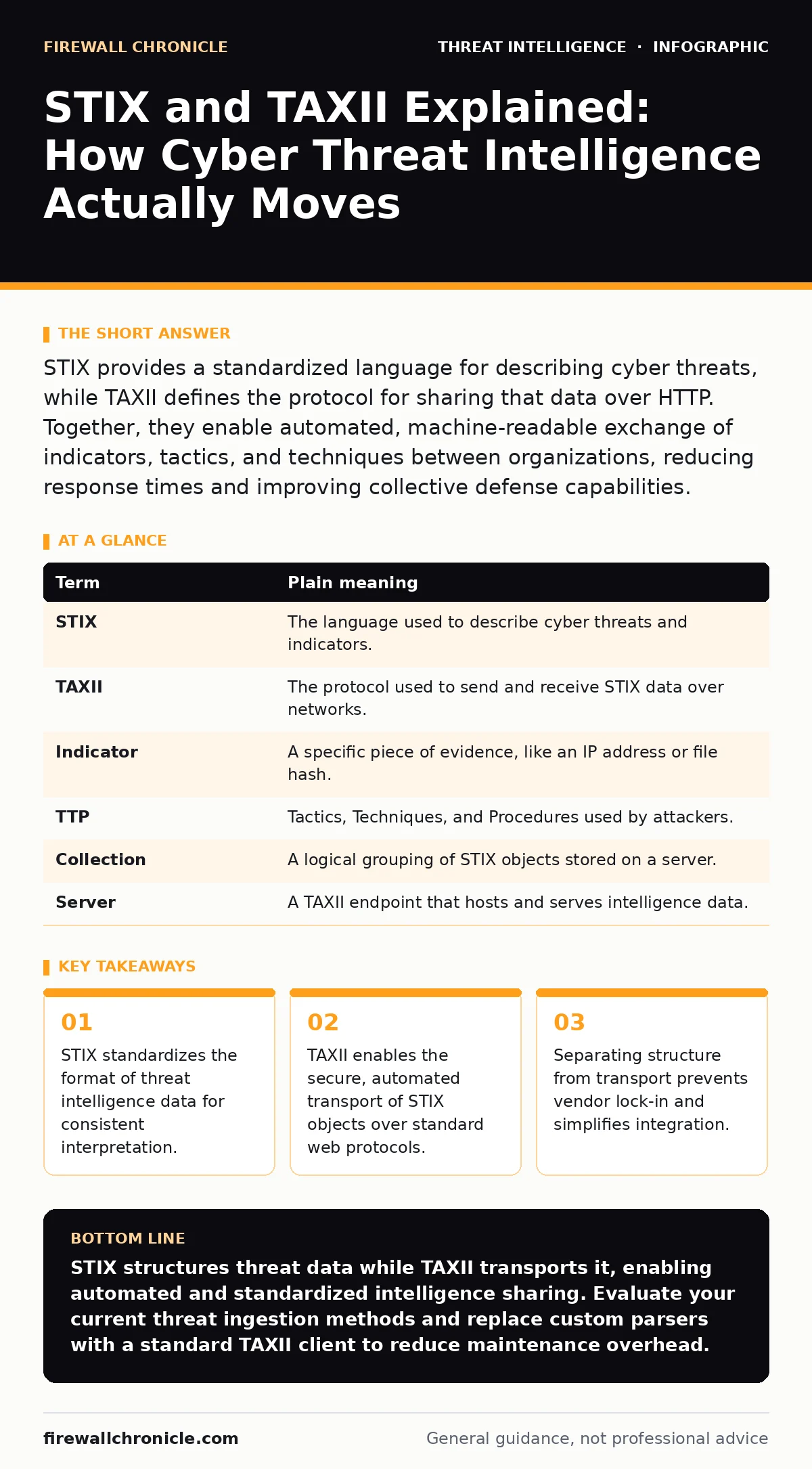
STIX provides a standardized language for describing cyber threats, while TAXII defines the protocol for sharing that data over HTTP. Together, they enable automated, machine-readable exchange of indicators, tactics, and techniques between organizations, reducing response times and improving collective defense capabilities.
The Library Analogy for Threat Sharing
Imagine a global library where every book represents a cyber threat. Without standards, each librarian would write descriptions in their own dialect, using unique cataloging systems. Finding a specific threat becomes a manual translation exercise. STIX acts as the universal language for writing these descriptions. TAXII serves as the automated delivery truck that moves the books between libraries. This separation ensures that the content remains readable regardless of the transport method used.
Defining the Core Standards
STIX stands for Structured Threat Information eXpression. It is a JSON-based language that describes cyber threats, including malware, vulnerabilities, and attacker tactics. TAXII stands for Trusted Automated eXchange of Intelligence Information. It is an HTTP-based protocol that allows systems to push or pull STIX data. These two standards work together but serve distinct purposes. Confusing them is a common error for beginners who assume they are a single product.
| Term | Plain meaning |
|---|---|
| STIX | The language used to describe cyber threats and indicators. |
| TAXII | The protocol used to send and receive STIX data over networks. |
| Indicator | A specific piece of evidence, like an IP address or file hash. |
| TTP | Tactics, Techniques, and Procedures used by attackers. |
| Collection | A logical grouping of STIX objects stored on a server. |
| Server | A TAXII endpoint that hosts and serves intelligence data. |
Why Structure Matters More Than Speed
Many teams focus on speed, assuming faster data transfer equals better security. This view ignores the cost of parsing inconsistent formats. If you receive threat data in a proprietary XML format, you must write custom parsers for every new source. STIX eliminates this friction. By using a common schema, your security tools can ingest data from multiple sources without re-engineering. This reduces the operational burden on developers who would otherwise maintain brittle integration scripts.
The Hidden Cost of Custom Integrations
Suppose you build a custom script to fetch data from a threat feed. That script works until the feed provider changes their API version. You must then update your code, test it, and redeploy it. This cycle repeats indefinitely. Using TAXII standardizes the transport layer. You write one client that speaks TAXII, and it works with any compliant server. This approach mirrors the benefits of log management systems that normalize logs from diverse sources into a single format for analysis.
Common Points of Confusion
Readers often mistake TAXII for a storage solution. TAXII does not store data; it only moves it. The storage mechanism is defined by the server implementation. Another confusion involves versioning. STIX 2.0 and 2.1 have structural differences. Mixing versions can cause data loss or misinterpretation. Always verify the STIX version supported by your TAXII server. This diligence prevents the kind of data corruption that complicates network enumeration efforts when indicators are malformed.
See also: Open-Source Intelligence Benefits and Trade-Offs · Dark Web Monitoring Services: How They Work and What They Miss
Integrating with Existing Defenses
Threat intelligence is useless if it does not reach your detection engines. You must map STIX indicators to your firewall rules, endpoint detection lists, or SIEM correlations. This mapping requires understanding the semantic meaning of each STIX object. For example, a TTP object describes behavior, while an Indicator object describes a specific artifact. Confusing these leads to false positives. Proper mapping enhances security metrics by providing clear attribution for blocked threats.
Try This Now: Building a Minimal Pipeline
- Install a local TAXII server or use a public open-source implementation to host sample STIX data.
- Write a simple script that queries the TAXII server for the latest STIX bundles using standard HTTP requests.
- Parse the returned JSON to extract indicators and validate them against your existing blocklists.
This exercise reveals the simplicity of the protocol. You will see that TAXII endpoints behave like standard REST APIs. The complexity lies not in the transport, but in the quality of the intelligence shared. This clarity helps avoid the pitfalls of disinformation bot networks that might pollute unverified feeds with noise.
Maintaining Long-Term Viability
Standards evolve. STIX and TAXII are maintained by the OASIS standards body. New versions introduce features and deprecate old ones. Your integrations must account for this lifecycle. Regularly update your parsers and clients. This maintenance is similar to keeping Windows event log monitoring rules updated as operating systems change their logging schemas. Neglecting updates leads to blind spots.
The Role of Community Sharing
Organizations rarely operate in isolation. ISACs (Information Sharing and Analysis Centers) use STIX and TAXII to share threat data among members. This collective intelligence improves everyone's defense. However, sharing requires trust and validation. You must ensure that the data you share does not expose sensitive internal information. Anonymization techniques are critical here. This process prevents accidental leakage that could aid lateral movement by revealing internal network structures.
Key takeaways
- STIX standardizes the format of threat intelligence data for consistent interpretation.
- TAXII enables the secure, automated transport of STIX objects over standard web protocols.
- Separating structure from transport prevents vendor lock-in and simplifies integration.
STIX structures threat data while TAXII transports it, enabling automated and standardized intelligence sharing. Evaluate your current threat ingestion methods and replace custom parsers with a standard TAXII client to reduce maintenance overhead.
Frequently asked questions
Can I use STIX without TAXII?
Yes, you can store and exchange STIX data using other methods like email or file transfer, but you lose the automation and standardization benefits of TAXII.
Is TAXII secure?
TAXII supports HTTPS for encryption and integrates with authentication mechanisms, but security depends on how the server is configured and managed.
What is the difference between STIX 1.0 and 2.0?
STIX 2.0 is a complete rewrite that simplifies the structure, uses JSON instead of XML, and focuses on machine readability, making it easier to implement.
Do I need a TAXII server to use STIX?
No, you can create and consume STIX data locally, but a TAXII server is required if you want to share that data with other systems automatically.
How this guide was produced: written by the Firewall Chronicle editorial team with AI assistance, checked against the public references listed below, and reviewed when the facts change. See our editorial policy or report an error.