What ISACs Are: Sector-Specific Threat Sharing Explained
Information Sharing and Analysis Centers transform isolated security alerts into collective defense by standardizing how sectors exchange raw threat data without legal exposure.
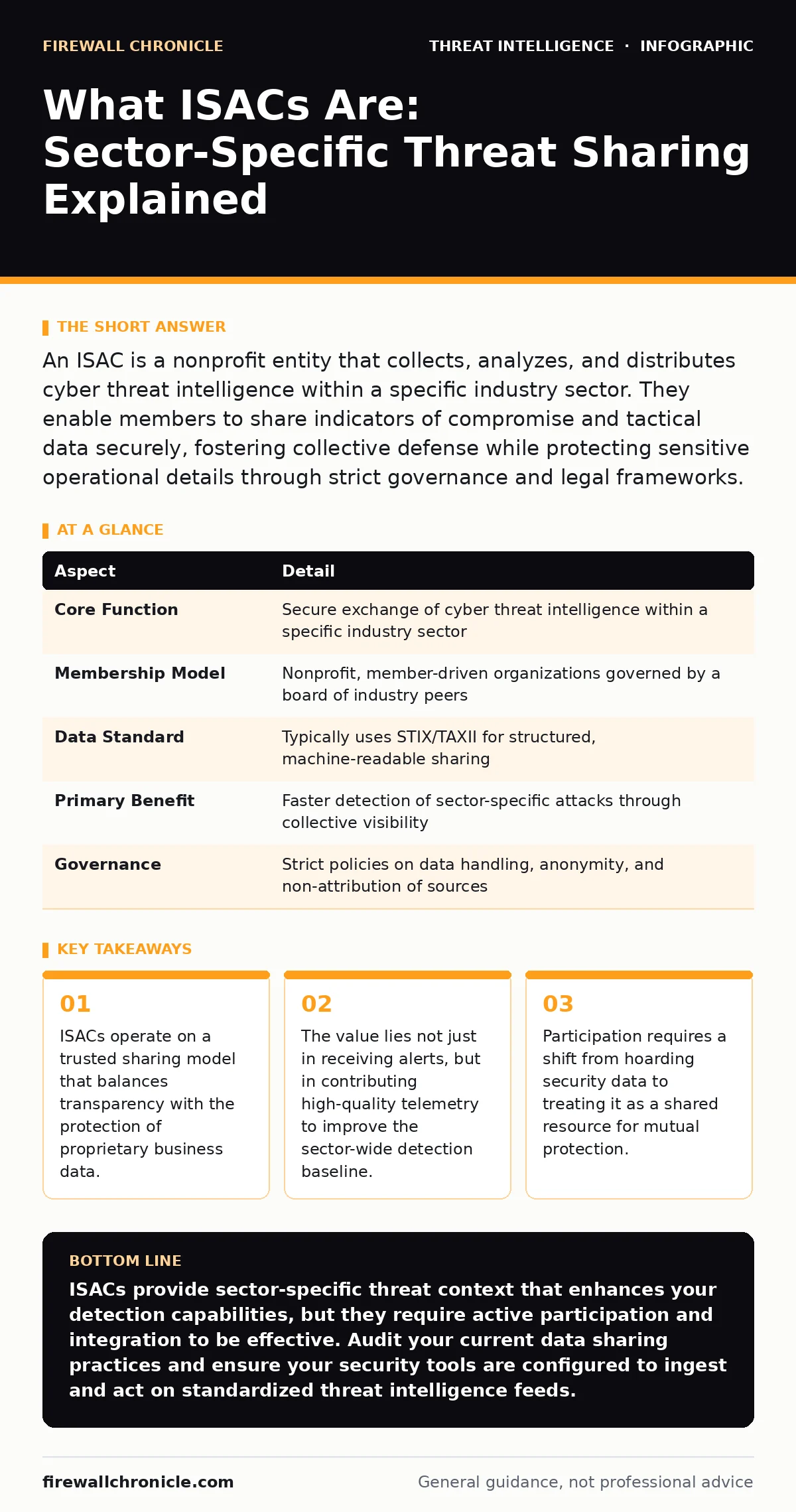
An ISAC is a nonprofit entity that collects, analyzes, and distributes cyber threat intelligence within a specific industry sector. They enable members to share indicators of compromise and tactical data securely, fostering collective defense while protecting sensitive operational details through strict governance and legal frameworks.
The Postal System for Threat Data
Imagine you discover a specific pattern of malicious network traffic in your environment. You know it is bad, but you do not know if it is a global campaign or a localized mistake. If you keep this knowledge secret, your neighbor faces the same risk tomorrow. If you shout it on a public forum, you might reveal sensitive architectural details about your own systems.
An Information Sharing and Analysis Center (ISAC) solves this dilemma. It acts as a secure, neutral clearinghouse where organizations within the same industry can exchange threat data. The mechanism relies on trust and standardization. You send raw data or analyzed reports to the ISAC. The ISAC sanitizes the data to remove identifying information about your infrastructure. Then, it distributes the generalized threat intelligence to other members.
This model prevents the "free rider" problem where organizations benefit from shared data without contributing their own. It also provides legal and operational safeguards that public forums lack. You are not broadcasting your vulnerabilities; you are contributing to a collective shield.
| Aspect | Detail |
|---|---|
| Core Function | Secure exchange of cyber threat intelligence within a specific industry sector |
| Membership Model | Nonprofit, member-driven organizations governed by a board of industry peers |
| Data Standard | Typically uses STIX/TAXII for structured, machine-readable sharing |
| Primary Benefit | Faster detection of sector-specific attacks through collective visibility |
| Governance | Strict policies on data handling, anonymity, and non-attribution of sources |
The Blind Spot Problem
Security teams often suffer from isolated visibility. You monitor your own logs and networks, but you cannot see what is happening at your suppliers, partners, or competitors. Attackers exploit this fragmentation. They move laterally between organizations that appear separate but share common protocols, software stacks, or business processes.
Without a sharing mechanism, you are reacting to attacks only after they hit your perimeter. You lack context. An unusual login attempt might look like a failed password guess, but if three other members of your sector report the same pattern simultaneously, it is likely a coordinated credential stuffing campaign.
ISACs fill this blind spot by aggregating data across the sector. They identify trends that are invisible to any single organization. This allows you to adjust your defenses before the attack reaches your environment. It shifts your posture from reactive containment to proactive prevention.
Anatomy of an ISAC
An ISAC is more than a mailing list. It is an operational infrastructure designed for high-volume, high-velocity data exchange. The structure typically includes a technical operations center, a governance board, and a membership committee.
The technical operations center handles the ingestion and analysis of data. They use standardized formats to ensure that data from one member’s system can be understood by another’s. This is where the work of normalization happens. Raw logs are stripped of personally identifiable information and proprietary business logic. What remains are the technical indicators: IP addresses, file hashes, domain names, and attack signatures.
The governance board sets the rules of engagement. They define what can be shared, how it is shared, and who can access it. This prevents the misuse of shared data for competitive advantage or legal liability. The membership committee ensures that participants meet security baselines before they can contribute or consume data. This maintains the integrity of the information pool.
Integration with Defensive Operations
Sharing data is useless if your security team cannot act on it. ISAC feeds must integrate into your existing defensive workflows. This means connecting ISAC data sources to your Security Information and Event Management (SIEM) or Security Orchestration, Automation, and Response (SOAR) platforms.
When an ISAC publishes a new indicator of compromise, your systems should automatically check for matches in your current traffic. If a match is found, an alert is generated. This automation reduces the burden on analysts. They do not need to manually review every shared report. Instead, they focus on the alerts that require human judgment.
This integration also supports blue team operations by providing real-world context to your detection rules. You can tune your sensors to look for the specific behaviors highlighted by the ISAC. It turns passive intelligence into active detection. Your teams spend less time hunting for unknowns and more time responding to known threats.
Common Misconceptions About Sharing
Many organizations hesitate to join an ISAC due to fear of exposure. They believe that sharing data reveals their weaknesses. This is a misunderstanding of how ISACs operate. The process is designed to protect the contributor. Data is anonymized and aggregated. No one knows which organization reported a specific incident unless explicitly agreed upon.
Another misconception is that ISACs provide complete solutions. They do not. They provide intelligence, not protection. You still need to implement the defenses. The ISAC tells you what to look for; it does not block the attack for you. Expecting an ISAC to act as a firewall is a fundamental error in strategy.
Some believe that sharing is a one-way street. They want to receive alerts without contributing data. This degrades the quality of the intelligence pool. High-quality sharing requires reciprocity. If everyone hoards data, the ISAC becomes a collection of outdated noise. Your contribution improves the accuracy of the alerts you receive.
See also: SIEM Misconceptions: Fixing 6 Common Security Logic Errors · How Disinformation Bot Networks Operate: Mechanics and Mitigation
The Hidden Cost of Participation
Participating in an ISAC is not free. The cost is not just the membership fee. It is the operational overhead of data preparation and review. You must have processes in place to identify relevant data, sanitize it, and submit it. This requires skilled analysts and time.
There is also the risk of alert fatigue. If you ingest all ISAC data without filtering, your security team may be overwhelmed by low-priority alerts. You must curate the information. Focus on indicators that match your technology stack and business risk profile. Ignore the rest.
Finally, there is the cultural cost. You must shift from a mindset of secrecy to one of collaboration. This requires training and leadership support. Teams accustomed to guarding data may resist sharing. You need to demonstrate the value of collective defense through concrete examples.
Where ISACs Fit in the Defense Stack
ISACs are a layer in your defense strategy, not the entire strategy. They sit above your technical controls and below your strategic risk management. They provide the context that makes your technical controls effective.
For instance, when performing attacker reconnaissance mitigation, ISAC data helps you understand what information attackers are seeking in your sector. You can then harden your external-facing assets against those specific reconnaissance techniques. Similarly, when monitoring for AS-REP roasting attempts, ISACs can alert you if this tactic is trending in your industry, prompting you to enforce Kerberos pre-authentication requirements.
They also complement security metrics by providing external benchmarks. You can compare your incident response times and detection rates against sector averages. This helps you identify gaps in your performance. However, you must use these metrics carefully. They are guides, not absolute standards. Your unique risk profile may require different priorities.
Key takeaways
- ISACs operate on a trusted sharing model that balances transparency with the protection of proprietary business data.
- The value lies not just in receiving alerts, but in contributing high-quality telemetry to improve the sector-wide detection baseline.
- Participation requires a shift from hoarding security data to treating it as a shared resource for mutual protection.
ISACs provide sector-specific threat context that enhances your detection capabilities, but they require active participation and integration to be effective. Audit your current data sharing practices and ensure your security tools are configured to ingest and act on standardized threat intelligence feeds.
Frequently asked questions
What is the difference between an ISAC and an ISAO?
An ISAC is sector-specific, serving a particular industry like finance or energy. An ISAO, or Information Sharing and Analysis Organization, serves a broader geographic or multi-sector audience, often with a focus on critical infrastructure protection across multiple industries.
How do ISACs protect member anonymity?
ISACs use strict data sanitization protocols. They remove personally identifiable information, proprietary business data, and specific infrastructure details before distribution. Legal agreements also prohibit members from attributing shared data back to the source organization.
Do I need to share all my security data?
No. You should only share data that is relevant to threat detection and does not compromise your operational security or business confidentiality. Focus on indicators of compromise, attack tactics, and mitigation strategies rather than raw internal logs or sensitive business metrics.
How quickly is ISAC data distributed?
Distribution is often near-real-time for high-priority alerts. Automated feeds can push indicators to member systems within minutes of validation. Slower, more detailed reports may take hours or days to analyze and publish, depending on the complexity of the threat.
How this guide was produced: written by the Firewall Chronicle editorial team with AI assistance, checked against the public references listed below, and reviewed when the facts change. See our editorial policy or report an error.