
Security Metrics: Why Numbers Lie and How to Read Them
Most security metrics measure activity rather than risk, creating a false sense of control that distracts from actual vulnerabilities in your infrastructure.
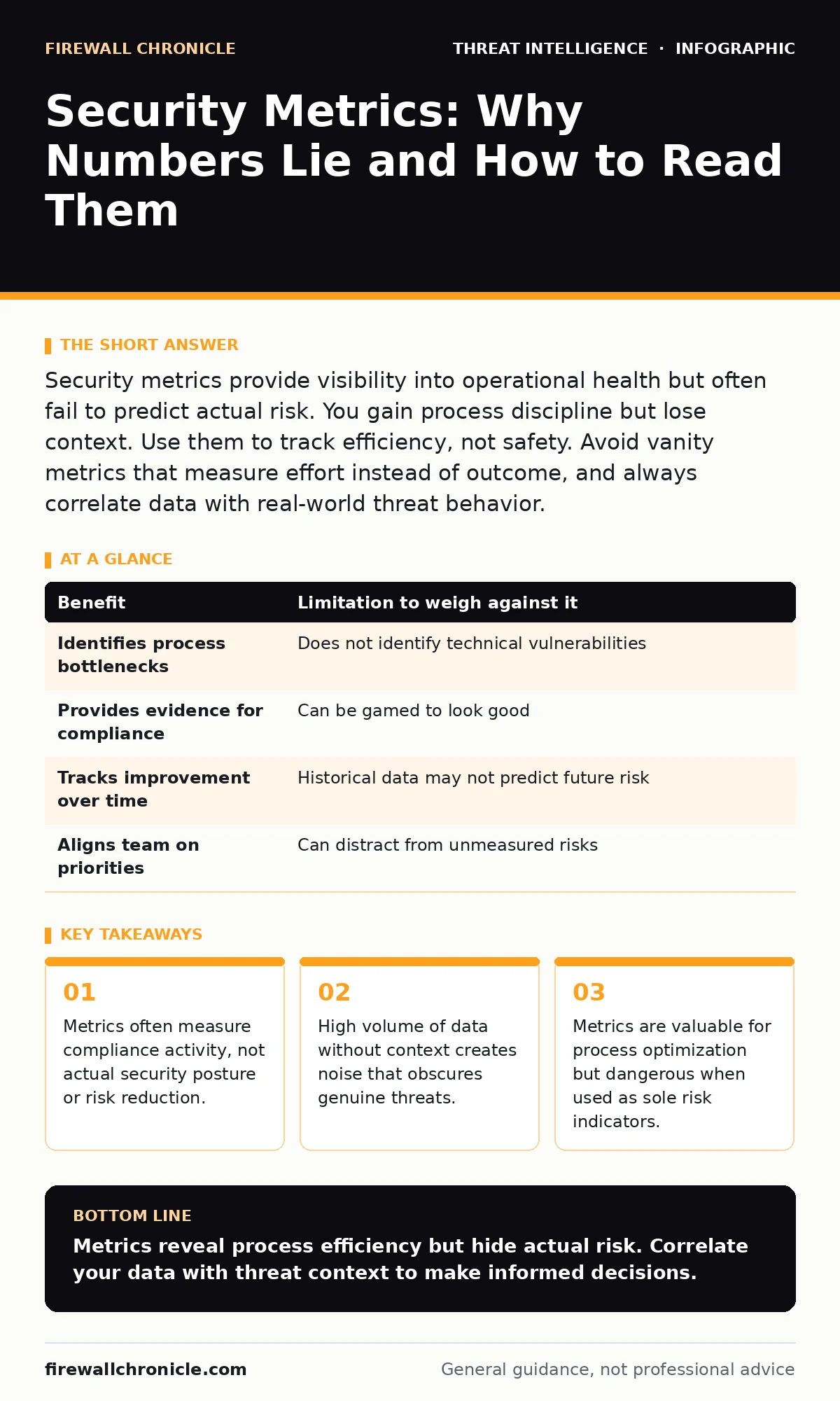
Security metrics provide visibility into operational health but often fail to predict actual risk. You gain process discipline but lose context. Use them to track efficiency, not safety. Avoid vanity metrics that measure effort instead of outcome, and always correlate data with real-world threat behavior.
The Illusion of Measurable Safety
You cannot manage what you cannot measure, or so the saying goes. In cybersecurity, this proverb is dangerous. It implies that if you can count something, you can control it. You can count the number of patches applied, but you cannot count the number of unpatched vulnerabilities that matter to your specific environment.
Metrics create a feedback loop. They tell you what the system did, not what the system prevented. A high number of blocked connections looks good on a dashboard. It tells you nothing about the single connection that slipped through and allowed lateral movement across your internal network.
You must distinguish between output metrics and outcome metrics. Output metrics count actions taken, such as scans run or tickets closed. Outcome metrics measure the state of security, such as the time to detect a breach. Most organizations track outputs because they are easy to collect. Outcomes are hard to define and even harder to measure accurately.
The Cost of Vanity Data
Every metric you collect has a cost. That cost is not just storage. It is attention. When you measure too many things, you dilute the signal. Analysts spend hours interpreting charts that show trends in irrelevant data. This is known as analysis paralysis.
Imagine a dashboard showing thousands of alerts per day. Most are false positives. The team learns to ignore the noise. When a real attack occurs, it looks like noise. The metric of "alerts generated" is high, but the metric of "threats missed" is also high. You have optimized for volume, not precision.
This connects directly to log management. If you are collecting logs you do not analyze, you are paying for storage and processing power for nothing. You are also creating a larger attack surface for data exfiltration. The metric "total logs stored" is a vanity metric. It makes you feel prepared, but it does not make you safer.
When Metrics Drive Behavior
Metrics influence human behavior. If you measure the number of passwords changed per week, users will change passwords frequently. They will also choose simpler passwords to save time. This is Goodhart's Law: when a measure becomes a target, it ceases to be a good measure.
You see this in blue team operations. If analysts are measured by the number of incidents they close, they will close incidents quickly. They may mark complex threats as "false positive" to meet their quota. The metric improves, but the security posture degrades. The system rewards speed over accuracy.
This is why you must be careful with performance metrics. They should support quality, not just quantity. Measure the time to resolve a critical incident, not the total number of incidents resolved. Measure the accuracy of triage, not the speed of closure. The goal is to improve the process, not to game the scorecard.
The Hidden Complexity of Context
A number without context is meaningless. "Ten critical vulnerabilities found" sounds alarming. But if those ten vulnerabilities are in a decommissioned test server that is air-gapped, the risk is near zero. If they are in your public-facing web server, the risk is catastrophic.
Most automated tools report vulnerabilities in isolation. They do not understand your architecture. They do not know which assets are critical. You must add context manually. This is labor-intensive. It requires knowledge of your business logic and network topology.
This is where attacker reconnaissance matters. You need to know how an attacker sees your environment. If a metric does not reflect the attacker's view, it is useless. An internal patching metric is less useful than a metric that shows how long an asset remains exposed to the internet.
When It Is Worth It
Metrics are worth the effort when they drive specific, actionable improvements. Use them to track the efficiency of your response processes. Measure the mean time to detect (MTTD) and mean time to respond (MTTR). These metrics tell you how fast your team can act.
If your MTTD is high, you need better monitoring. If your MTTR is high, you need better tools or training. These metrics point to specific gaps. They help you allocate resources where they are needed most. They turn vague feelings of insecurity into concrete engineering problems.
Metrics are also useful for compliance. You need to prove that you are following procedures. Here, output metrics are acceptable. This does not guarantee security, but it proves due care. It satisfies auditors and regulators.
| Benefit | Limitation to weigh against it |
|---|---|
| Identifies process bottlenecks | Does not identify technical vulnerabilities |
| Provides evidence for compliance | Can be gamed to look good |
| Tracks improvement over time | Historical data may not predict future risk |
| Aligns team on priorities | Can distract from unmeasured risks |
See also: SIEM Misconceptions: Fixing 6 Common Security Logic Errors · How Disinformation Bot Networks Operate: Mechanics and Mitigation
When It Is Not Worth It
Metrics are not worth it when they create a false sense of security. If a dashboard looks green, executives assume the organization is safe. This assumption is dangerous. It reduces urgency and funding for security initiatives. The metric hides the reality.
Do not use metrics to measure "security score" in a single number. Security is multidimensional. You cannot reduce it to a grade from A to F. Such scores are marketing tools, not engineering tools. They obscure the details that matter.
Avoid metrics that require manual data entry. If you have to manually update a spreadsheet, the data will be stale within hours. Automated metrics are only reliable if the underlying data is accurate. If you have to clean the data, the metric is not trustworthy.
Correlating With Threat Intelligence
Raw metrics are static. They show what happened. Threat intelligence reports provide context. They show what is happening in the wild. By correlating your metrics with threat intelligence, you can prioritize your work.
Suppose you see a spike in failed login attempts. That is a metric. If threat intelligence shows a new brute-force campaign targeting your industry, that metric becomes critical. You can act immediately. Without the intelligence, you might ignore the spike as normal noise.
This correlation helps you focus on network enumeration attempts. If you see scanning activity from known malicious IPs, you can block them proactively. You move from reactive to proactive. You use metrics to detect, and intelligence to understand.
The Developer's Perspective
For software developers, metrics can be a burden or a tool. If metrics are used to punish mistakes, developers will hide them. They will not report vulnerabilities. This reduces transparency and increases risk.
Use metrics to improve the development lifecycle. Measure the number of security tests passed in the CI/CD pipeline. Measure the time to fix a vulnerability in code. These metrics encourage secure coding practices. They make security part of the workflow, not an afterthought.
But do not measure the number of vulnerabilities found in code. This discourages testing. If developers are penalized for finding bugs, they will write less code or hide the bugs. Measure the rate of fix, not the rate of find.
Beyond Common Attacks
Metrics can help you prepare for specific attacks. For example, monitor for signs of AS-REP roasting. This attack targets accounts that do not require Kerberos pre-authentication. If you see unusual traffic to domain controllers, it may indicate this attack.
Similarly, track indicators of golden ticket attacks. These involve forged Kerberos tickets. Metrics on authentication failures and unusual ticket requests can help detect this. But you must know what to look for. Generic metrics will not catch these sophisticated attacks.
You must define specific metrics for high-risk scenarios. Generic dashboards will miss them. You need custom alerts and logs. This requires deep knowledge of your environment. It is hard work, but it is necessary.
Key takeaways
- Metrics often measure compliance activity, not actual security posture or risk reduction.
- High volume of data without context creates noise that obscures genuine threats.
- Metrics are valuable for process optimization but dangerous when used as sole risk indicators.
Metrics reveal process efficiency but hide actual risk. Correlate your data with threat context to make informed decisions.
Frequently asked questions
What is the difference between leading and lagging security metrics?
Leading metrics predict future performance, like the number of security training hours completed. Lagging metrics measure past performance, like the number of breaches that occurred. Leading metrics are harder to measure but more useful for prevention.
How often should I review security metrics?
Review operational metrics daily to catch immediate issues. Review strategic metrics monthly or quarterly to assess long-term trends. The frequency depends on the metric's purpose and the speed of your environment.
Can I use metrics to measure the effectiveness of my firewall?
You can measure the number of blocks and allows, but this does not tell you if the firewall is configured correctly. You must also measure the number of false positives and the time to update rules. Configuration quality matters more than volume.
What is the most important security metric?
There is no single most important metric. It depends on your goals. For most organizations, the time to detect and respond to incidents is a strong indicator of overall security posture. It reflects both monitoring and response capabilities.
How this guide was produced: written by the Firewall Chronicle editorial team with AI assistance, checked against the public references listed below, and reviewed when the facts change. See our editorial policy or report an error.