
How Identity Theft Works: The Technical Chain of Compromise
Identity theft rarely begins with a stolen password; it usually starts with fragmented data aggregation that bypasses traditional perimeter defenses entirely.
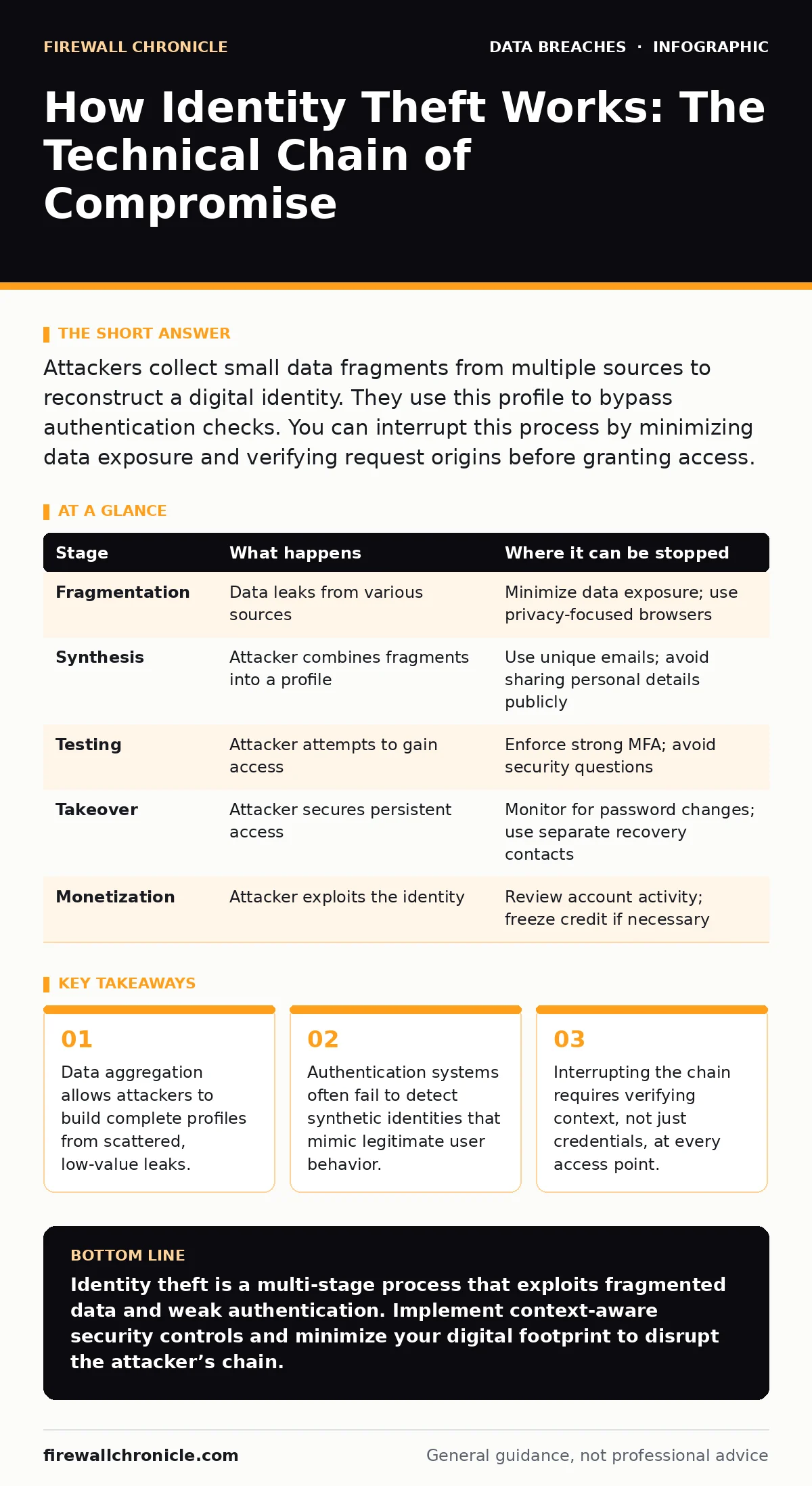
Attackers collect small data fragments from multiple sources to reconstruct a digital identity. They use this profile to bypass authentication checks. You can interrupt this process by minimizing data exposure and verifying request origins before granting access.
The Anatomy of Identity Reconstruction
Identity theft is not a single event. It is a process of reconstruction. An attacker does not need to steal your entire identity in one breach. They need enough fragments to impersonate you convincingly. This approach exploits the distributed nature of modern data storage.
Most organizations store different pieces of user data in separate systems. One system holds email addresses. Another holds phone numbers. A third holds employment history. When these systems are breached at different times, the data appears harmless in isolation.
However, an attacker can correlate these fragments. They match the email from one leak with the phone number from another. This creates a composite profile. This profile is often more accurate than any single record because it combines verified data points.
Stage 1: Data Fragmentation and Collection
The process begins with data leakage. This happens when systems expose information they should keep private. Common sources include public social media profiles, data broker websites, and compromised corporate databases.
Attackers use automated tools to scrape this information. They look for consistent identifiers. An email address is a strong anchor. A partial date of birth is another. These tools run continuously, updating their databases as new leaks emerge.
This stage relies on the assumption that fragmented data is low risk. It is not. The cost of acquiring this data is near zero. The value increases exponentially when combined.
Stage 2: Profile Synthesis and Enrichment
Once the attacker has raw fragments, they synthesize a profile. They fill in gaps using inference. If they have your address and name, they can find your employer through public records. If they have your employer, they can find your colleagues.
This enrichment phase uses open-source intelligence. It also uses data from previous breaches. The goal is to create a profile that passes automated checks. These checks often verify that data points match known patterns.
The attacker now has a synthetic identity. This identity looks real to automated systems. It has a name, an address, an email, and a phone number. It may even have a credit history if the attacker can link financial data.
Stage 3: Credential Harvesting and Testing
With a synthesized profile, the attacker tests for access. They do not guess passwords randomly. They use the data they already have. They try common password patterns associated with your name or birth year.
They also attempt to bypass multi-factor authentication. They may use SIM swapping to intercept codes. This involves tricking a mobile carrier into transferring your phone number to a device they control. This exploits the weakness of SMS-based verification.
If direct login fails, they look for weak points. They target systems that rely on security questions. Answers to these questions are often public. Your mother’s maiden name may be in a census record. Your first pet’s name may be on a social media post.
Stage 4: Account Takeover and Persistence
When the attacker gains access, they do not always act immediately. They may wait to avoid detection. They change the password and add their own recovery options. This locks you out and secures their access.
They then look for sensitive data. They may export contact lists. They may view transaction histories. They use this data to deepen the compromise. For example, they may use your contacts to send phishing messages.
This stage relies on the delay in detection. Many systems do not alert users to password changes. Others send alerts to the compromised email address. This creates a closed loop where the attacker controls the notification channel.
See also: Incident Communication Plans: 9 FAQs on Strategy and Execution
Stage 5: Monetization and Identity Leveraging
The final stage is monetization. The attacker uses your identity to gain value. This could be financial fraud. It could be accessing paid services. It could be creating fake accounts for other purposes.
They may apply for credit cards. They may rent apartments. They may sign up for streaming services. Each action uses the profile they built. The profile is convincing enough to pass initial reviews.
This stage exploits the speed of automated approval systems. Many services approve accounts instantly. They rely on data matching rather than human review. The attacker’s synthetic identity passes these checks.
Interrupting the Chain
You can interrupt this process at each stage. At the collection stage, minimize your digital footprint. Remove your data from broker sites. At the synthesis stage, use unique identifiers for different services.
At the testing stage, enforce strong authentication. Avoid SMS-based verification. Use hardware keys or app-based tokens. At the takeover stage, monitor for unauthorized changes. At the monetization stage, review account activity regularly.
| Stage | What happens | Where it can be stopped |
|---|---|---|
| Fragmentation | Data leaks from various sources | Minimize data exposure; use privacy-focused browsers |
| Synthesis | Attacker combines fragments into a profile | Use unique emails; avoid sharing personal details publicly |
| Testing | Attacker attempts to gain access | Enforce strong MFA; avoid security questions |
| Takeover | Attacker secures persistent access | Monitor for password changes; use separate recovery contacts |
| Monetization | Attacker exploits the identity | Review account activity; freeze credit if necessary |
The Role of System Design
The success of identity theft depends on system design. Many systems assume that data is static. They do not account for the dynamic nature of identity. They verify who you are, not what you are doing.
This is a fundamental flaw. Authentication should consider context. It should check the device, the location, and the behavior. A login from a new device at an unusual time should trigger additional checks.
Systems should also limit data retention. If a system does not need your full name, it should not store it. If it does not need your address, it should not store it. This reduces the value of a breach.
Integration with Security Practices
This process intersects with several security domains. For instance, vendor risk management is critical. Many breaches occur through third-party vendors. If a vendor leaks data, your identity is at risk.
Role-based access control limits internal exposure. If an employee’s account is compromised, the attacker can only access data within their role. This limits the scope of the breach.
File integrity monitoring can detect changes to critical systems. If an attacker modifies authentication logic, this tool can alert you. This helps detect the takeover stage.
Email encryption protects data in transit. It prevents attackers from intercepting reset links or sensitive communications. This adds a layer of security to the notification process.
Employee data breaches often provide the initial fragments. Training employees to recognize phishing attempts can reduce this risk.
Customer breach notification letters inform users of exposure. This allows users to take protective measures.
Payment card theft is a common monetization method. Monitoring financial accounts can detect this activity early.
Printed document leaks are another source of fragments. Physical security is as important as digital security.
The Hidden Cost of Convenience
The drive for convenience undermines security. Single sign-on services make logging in easier. They also create a single point of failure. If the central account is compromised, all linked accounts are at risk.
Automated approval systems speed up service delivery. They also make it easier for attackers to monetize stolen identities. The trade-off is between speed and security.
You must balance these factors. Use convenience where risk is low. Use strict controls where risk is high. There is no one-size-fits-all solution.
Conclusion of the Process
Identity theft is a chain of events. Each link depends on the previous one. By breaking one link, you disrupt the entire process. This requires a holistic approach.
You must protect your data at rest, in transit, and in use. You must verify identity continuously, not just at login. You must assume breach and plan accordingly.
This mindset shift is difficult. It requires effort and vigilance. But it is the only way to stay ahead of attackers.
Key takeaways
- Data aggregation allows attackers to build complete profiles from scattered, low-value leaks.
- Authentication systems often fail to detect synthetic identities that mimic legitimate user behavior.
- Interrupting the chain requires verifying context, not just credentials, at every access point.
Identity theft is a multi-stage process that exploits fragmented data and weak authentication. Implement context-aware security controls and minimize your digital footprint to disrupt the attacker’s chain.
Frequently asked questions
Can changing my password stop identity theft?
Changing passwords helps, but it is not enough. Attackers may have already bypassed authentication or compromised your recovery options. Use strong MFA and monitor for unauthorized changes.
Is two-factor authentication secure?
It depends on the method. SMS-based 2FA is vulnerable to SIM swapping. App-based tokens or hardware keys are more secure. Choose methods that are not easily intercepted.
How do I know if my identity is stolen?
Look for unauthorized transactions, unexpected password reset emails, or changes to your personal information. Monitor your accounts regularly and set up alerts.
Can I remove my data from the internet?
You can request removal from data brokers and social media platforms. However, data may persist in backups or other sources. Minimize new data exposure.
How this guide was produced: written by the Firewall Chronicle editorial team with AI assistance, checked against the public references listed below, and reviewed when the facts change. See our editorial policy or report an error.