Employee Data Breach Myths: Why Insider Threat Models Fail
Most insider data leaks are not malicious acts but structural failures in access control and monitoring that standard policies ignore.
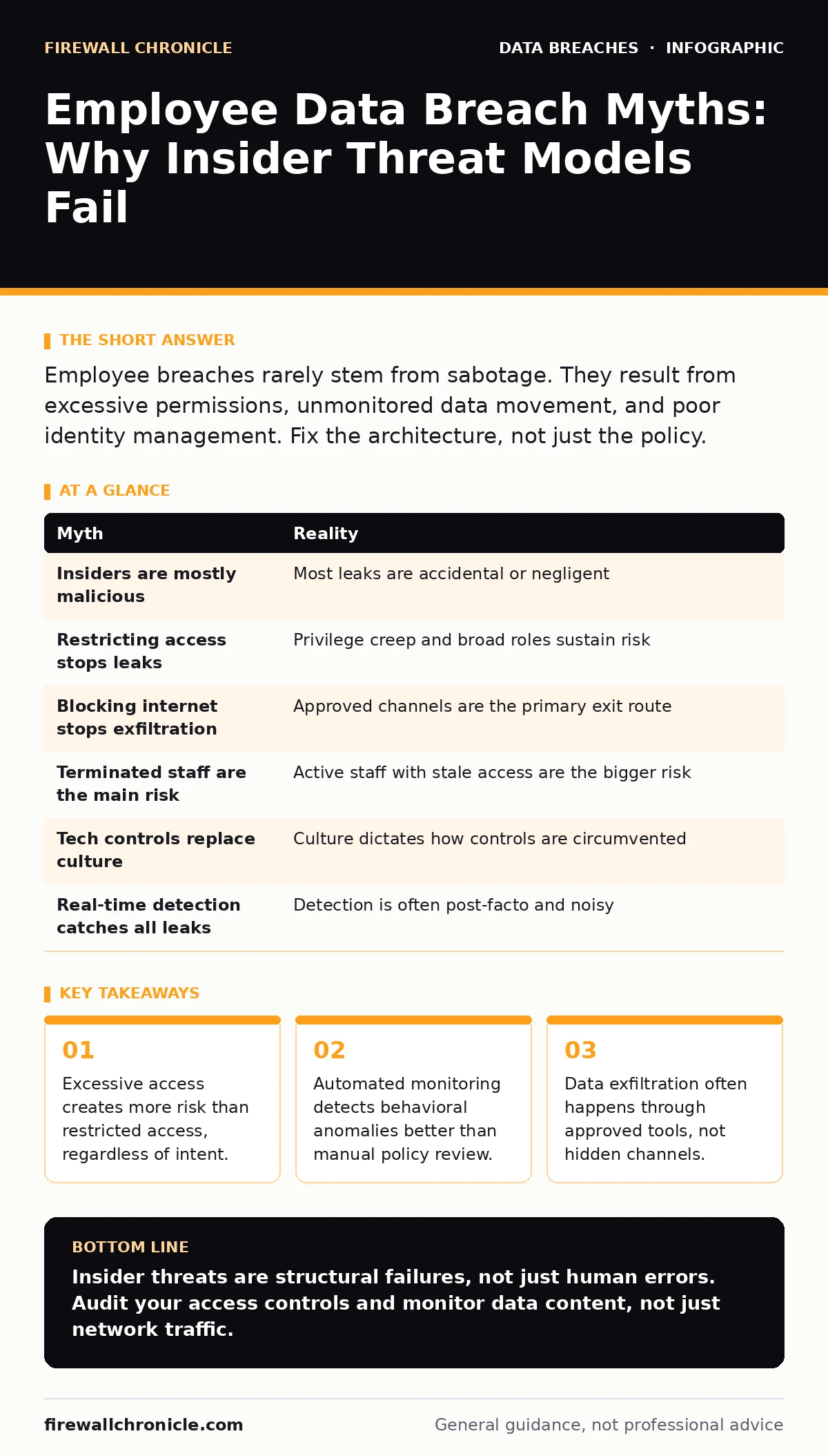
Employee breaches rarely stem from sabotage. They result from excessive permissions, unmonitored data movement, and poor identity management. Fix the architecture, not just the policy.
Myth: The insider threat is primarily malicious
Reality: Most data leaks caused by employees are accidental or the result of negligence, not intentional sabotage. The security industry focuses heavily on the "malicious insider" narrative because it is dramatic, but operational data tells a different story. Employees often share credentials to bypass cumbersome workflows or leave devices unlocked in shared spaces.
Imagine a developer who copies a production database to their local machine to debug an issue faster. They do not intend to steal the data. They intend to work efficiently. When that machine is lost or infected by malware, the data is exposed. This is a process failure, not a moral one. Treating every employee as a potential spy creates a culture of fear that drives bad behavior underground.
Myth: Restricting access eliminates insider risk
Reality: Restricting access reduces the blast radius but does not eliminate the risk of data misuse by those who legitimately need it. Many organizations implement strict perimeter controls while leaving internal data lakes wide open. This creates a false sense of security. An employee with legitimate access to a large dataset can still export, copy, or misinterpret that data.
The principle of least privilege is often applied only at the entry point. Once inside the network, users often have broad read permissions across multiple systems. This is known as privilege creep. Over time, employees accumulate permissions from previous roles that they no longer need. These unused permissions become attack vectors. You must regularly audit and revoke access rights, not just grant them initially.
Consider how role-based access control functions in practice. It assigns permissions based on job function, not individual identity. If the roles are too broad, the control fails. You need granular permissions that align with daily tasks, not just departmental titles.
Myth: Monitoring internet traffic catches all exfiltration
Reality: Most data exfiltration occurs through approved, monitored channels, not hidden tunnels. Security teams often focus on blocking file transfers to personal cloud storage or unusual outbound connections. They assume that if data leaves via a sanctioned tool, it is safe. This is a critical blind spot.
Imagine an employee using a corporate email client to send a large attachment to a partner. The email system logs the event, but the content is not inspected for sensitive patterns. The data leaves the organization legally and technically. The breach happens because the destination was not authorized for that specific data type, not because the channel was blocked. You must monitor data content, not just network flow.
This is where email encryption becomes more than a compliance checkbox. It ensures that even if the email is sent, the data remains unreadable to unintended recipients. Without content-aware monitoring, approved channels become the primary exit route for sensitive information.
Myth: Terminated employees are the biggest risk
Reality: Active employees with lingering access pose a greater risk than those who have been fired. The immediate revocation of credentials upon termination is a standard procedure. Most organizations handle this well. The danger lies in the "shadow access" that remains after a role change or a project ends.
An employee who moves from engineering to sales may retain access to source code repositories. They no longer need this access, but the system does not know they have changed roles. This is a failure of identity lifecycle management. The risk is not the person leaving; it is the permissions staying. You must automate the synchronization of HR records with identity providers.
Myth: Technical controls replace the need for culture
Reality: Technical controls enforce boundaries, but culture determines how employees interact with those boundaries. You can build the most sophisticated detection engine, but if employees view security as a hindrance, they will find ways around it. This is known as security fatigue. When controls are too friction-heavy, users create workarounds that bypass security entirely.
Imagine a policy that requires ten steps to access a file. An employee will find a way to get the file in one step, even if it means sharing a password. This undermines the entire security architecture. You must design controls that are invisible or frictionless for legitimate behavior.
Security awareness training is often ineffective because it is generic. It tells people to "be careful" without explaining the mechanism of the threat. Instead, show them how their specific actions trigger alerts. Connect their daily work to the security outcome. This builds intrinsic motivation rather than compliance out of fear.
See also: Kubernetes RBAC Explained: Control Access Without Breaking Deployments
Myth: Insider breaches are detectable in real-time
Reality: Most insider breaches are detected long after the data has left the organization. Real-time detection requires a baseline of normal behavior for every user. Establishing this baseline is difficult and resource-intensive. Anomalies are often subtle. A user downloading one extra file per day is not an alert. It is noise.
It takes months of consistent abnormal behavior to distinguish a threat from a busy work period. By the time the pattern is clear, the damage is done. This is why prevention is more effective than detection for insider threats. You must reduce the opportunity for data loss before it happens.
This is where the 3-2-1 backup rule becomes relevant. It does not prevent the breach, but it ensures that if data is corrupted or locked by ransomware, you can restore it. For insider threats, backups ensure business continuity even if the data is exfiltrated. You cannot stop all leaks, but you can survive them.
| Myth | Reality |
|---|---|
| Insiders are mostly malicious | Most leaks are accidental or negligent |
| Restricting access stops leaks | Privilege creep and broad roles sustain risk |
| Blocking internet stops exfiltration | Approved channels are the primary exit route |
| Terminated staff are the main risk | Active staff with stale access are the bigger risk |
| Tech controls replace culture | Culture dictates how controls are circumvented |
| Real-time detection catches all leaks | Detection is often post-facto and noisy |
Key takeaways
- Excessive access creates more risk than restricted access, regardless of intent.
- Automated monitoring detects behavioral anomalies better than manual policy review.
- Data exfiltration often happens through approved tools, not hidden channels.
Insider threats are structural failures, not just human errors. Audit your access controls and monitor data content, not just network traffic.
Frequently asked questions
How do I distinguish between a mistake and a malicious act?
You usually cannot in real-time. Focus on the outcome and the data type. Treat both with the same urgency to contain the spread.
Should I install keyloggers to monitor employees?
Keyloggers are invasive and often illegal. They destroy trust and produce too much noise. Use endpoint detection and response tools instead.
What is the best way to secure remote workers?
Treat remote access as untrusted. Use zero-trust architecture. Verify every request as if it originates from an open network.
Does insurance cover insider breaches?
Cyber insurance varies by policy. Most cover accidental leaks but may exclude intentional acts by employees. Read the exclusions carefully.
How this guide was produced: written by the Firewall Chronicle editorial team with AI assistance, checked against the public references listed below, and reviewed when the facts change. See our editorial policy or report an error.