
Detect SIM Swapping Attacks: Log Signals and Blind Spots
SIM swapping leaves distinct digital footprints in authentication logs, revealing carrier changes and concurrent session anomalies that standard monitoring often misses.
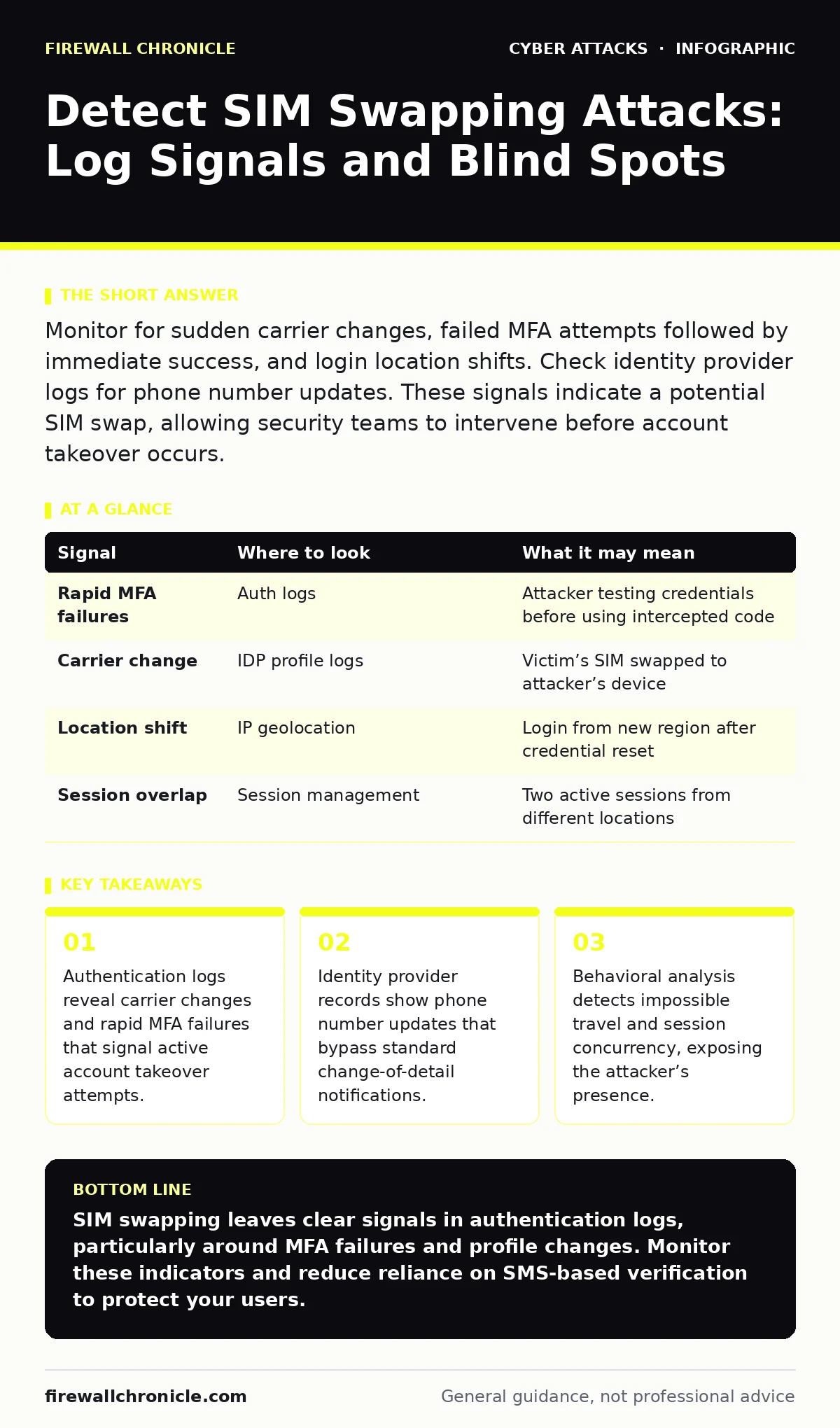
Monitor for sudden carrier changes, failed MFA attempts followed by immediate success, and login location shifts. Check identity provider logs for phone number updates. These signals indicate a potential SIM swap, allowing security teams to intervene before account takeover occurs.
Authentication Log Anomalies
SIM swapping relies on intercepting one-time passwords sent via SMS. As a developer, you must look beyond simple login success rates. The attack surface expands when SMS is treated as a primary authentication factor. You need to inspect your identity provider logs for specific patterns.
Look for a burst of failed multi-factor authentication attempts. An attacker often tries stolen credentials first. When the password fails, they may try again with slight variations. Then, the SMS code arrives on their device. The subsequent login success is the critical signal.
| Signal | Where to look | What it may mean |
|---|---|---|
| Rapid MFA failures | Auth logs | Attacker testing credentials before using intercepted code |
| Carrier change | IDP profile logs | Victim’s SIM swapped to attacker’s device |
| Location shift | IP geolocation | Login from new region after credential reset |
| Session overlap | Session management | Two active sessions from different locations |
Identity Provider Profile Changes
The swap itself happens at the carrier level, but the aftermath appears in your systems. Attackers often update the phone number on the account to lock out the victim permanently. This is a high-privilege action. It requires proof of ownership, which the SMS code provides.
You must monitor for changes to contact information. Specifically, watch for the replacement of a mobile number. This action often triggers a secondary verification. If you do not log the source of this change, you lose visibility. Ensure your audit trails record the IP address and user agent associated with profile updates.
Behavioral and Geographic Signals
Geographic impossibility is a strong indicator of compromise. If a user logs in from New York and then from London within minutes, something is wrong. This is known as impossible travel. It suggests that two different people are accessing the same account.
Combine this with device fingerprinting. New devices often lack the browser history or cookie state of the primary device. Your system should flag logins from unrecognized devices, especially when paired with a password reset. This reduces the noise from legitimate users switching phones.
The Role of Social Engineering
SIM swapping is rarely a technical exploit alone. It is preceded by social engineering. Attackers gather personal data to convince carrier support staff to transfer the SIM. This means the attacker likely knows the victim’s name, address, and recent transactions.
For security teams, this implies that data hygiene is part of detection. If your systems expose too much personal data in error messages or support tickets, you aid the attacker. Review your error handling. Ensure that validation failures do not reveal whether a phone number exists in your database.
This aligns with principles discussed in our guide on social engineering. Understanding the human element helps you prioritize which accounts are at risk. High-value targets with exposed data are more likely to be targeted.
Common Blind Spots in Monitoring
Many organizations focus on network perimeter defenses. They miss the application layer where the swap impacts authentication. A common blind spot is ignoring the "forgot password" flow. This is the primary entry point for SIM swap attacks.
Another blind spot is the lack of monitoring for secondary accounts. Attackers often pivot to email accounts first. They use the compromised email to reset passwords on financial or social accounts. If you do not link these events, you miss the chain of compromise.
Tooling for Detection
You do not need custom code to detect these patterns. Most identity providers offer risk-based authentication features. These tools analyze login context automatically. They flag anomalies based on historical behavior.
Enable these features if available. Configure them to require step-up authentication for risky logins. Step-up authentication asks for additional proof, such as a push notification to a registered device. This bypasses the compromised SMS channel.
Integrate these logs into your SIEM. Create alerts for the signals listed above. Ensure your incident response team knows how to interpret them. False positives will occur, but they are easier to tune than missed detections.
Mitigation and Response
Detection is only half the battle. Once you identify a potential swap, you must act quickly. Disable the compromised account. Force a password reset. Remove the attacker’s session.
Contact the user through an out-of-band channel. Do not use the phone number on file. Use email or a secondary contact method. Verify their identity before restoring access. This prevents the attacker from regaining control.
Long-term, reduce reliance on SMS. Move to FIDO2 security keys or authenticator apps. These methods are bound to the device, not the phone number. This eliminates the SIM swap vector entirely.
Integrating with Broader Security
SIM swapping is part of a broader attack surface. It often accompanies other techniques. For example, attackers may use angler phishing to gather more data. They pretend to be support staff on social media.
You should also consider network segmentation. Isolating critical systems reduces the impact of a compromised account. If an attacker gains access to one system, they cannot easily move laterally.
Review your rate limiting policies. Attackers may automate attempts to find vulnerable accounts. Limiting the number of password reset requests helps mitigate this. See our guide on rate limiting for implementation details.
Finally, ensure your team understands the difference between SIM swapping and man-in-the-middle attacks. The latter intercepts communications in transit. The former hijacks the identity channel. Both require different detection strategies.
Key takeaways
- Authentication logs reveal carrier changes and rapid MFA failures that signal active account takeover attempts.
- Identity provider records show phone number updates that bypass standard change-of-detail notifications.
- Behavioral analysis detects impossible travel and session concurrency, exposing the attacker’s presence.
SIM swapping leaves clear signals in authentication logs, particularly around MFA failures and profile changes. Monitor these indicators and reduce reliance on SMS-based verification to protect your users.
Frequently asked questions
How do I distinguish a SIM swap from a legitimate phone number change?
Look for context clues. Legitimate changes usually happen from known devices and locations. SIM swaps often involve new devices, new locations, and immediate password resets.
Can I detect a SIM swap before the attacker logs in?
No. The swap occurs at the carrier level. You can only detect the result, which is the attacker using the intercepted code to access your system.
What is the best way to verify a user after detecting a swap?
Use an out-of-band communication method. Contact the user via email or a pre-registered secondary phone number. Do not use the number associated with the compromised account.
Do security keys prevent SIM swapping?
Yes. FIDO2 security keys are bound to the physical device. They do not rely on phone numbers or SMS codes, making them immune to SIM swap attacks.
How this guide was produced: written by the Firewall Chronicle editorial team with AI assistance, checked against the public references listed below, and reviewed when the facts change. See our editorial policy or report an error.