Cloud Ransomware: How Attacks Bypass Traditional Perimeters
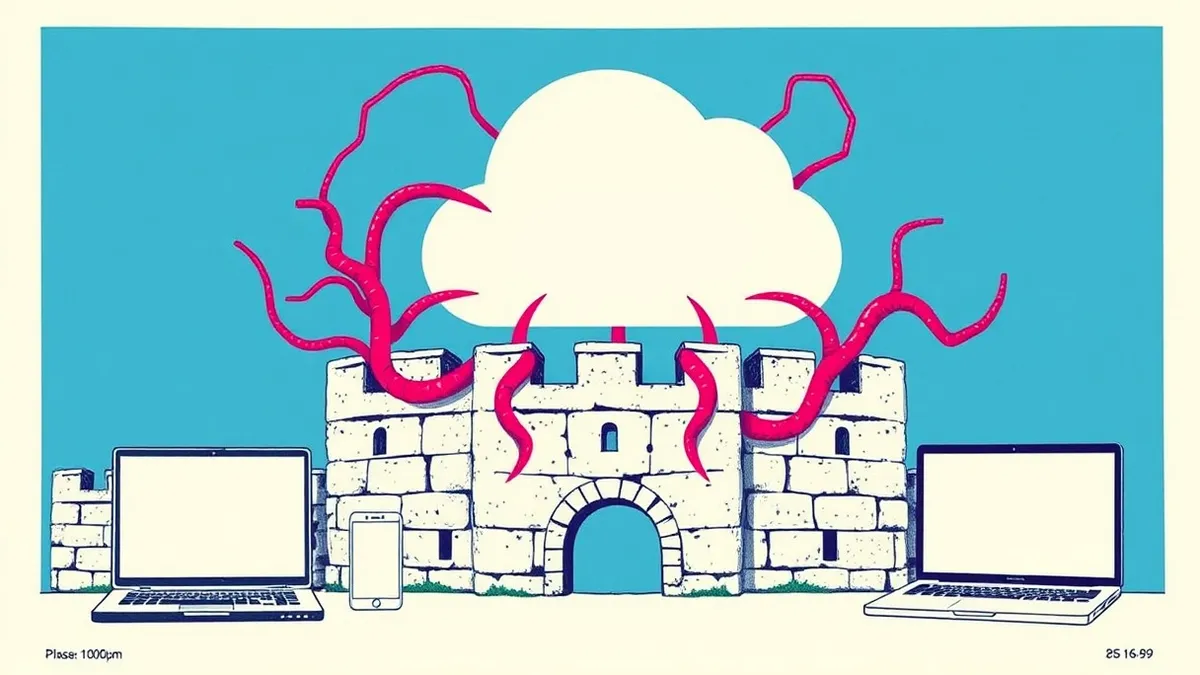
Traditional boundary defenses fail because cloud ransomware exploits identity permissions and automated replication rather than network gaps.
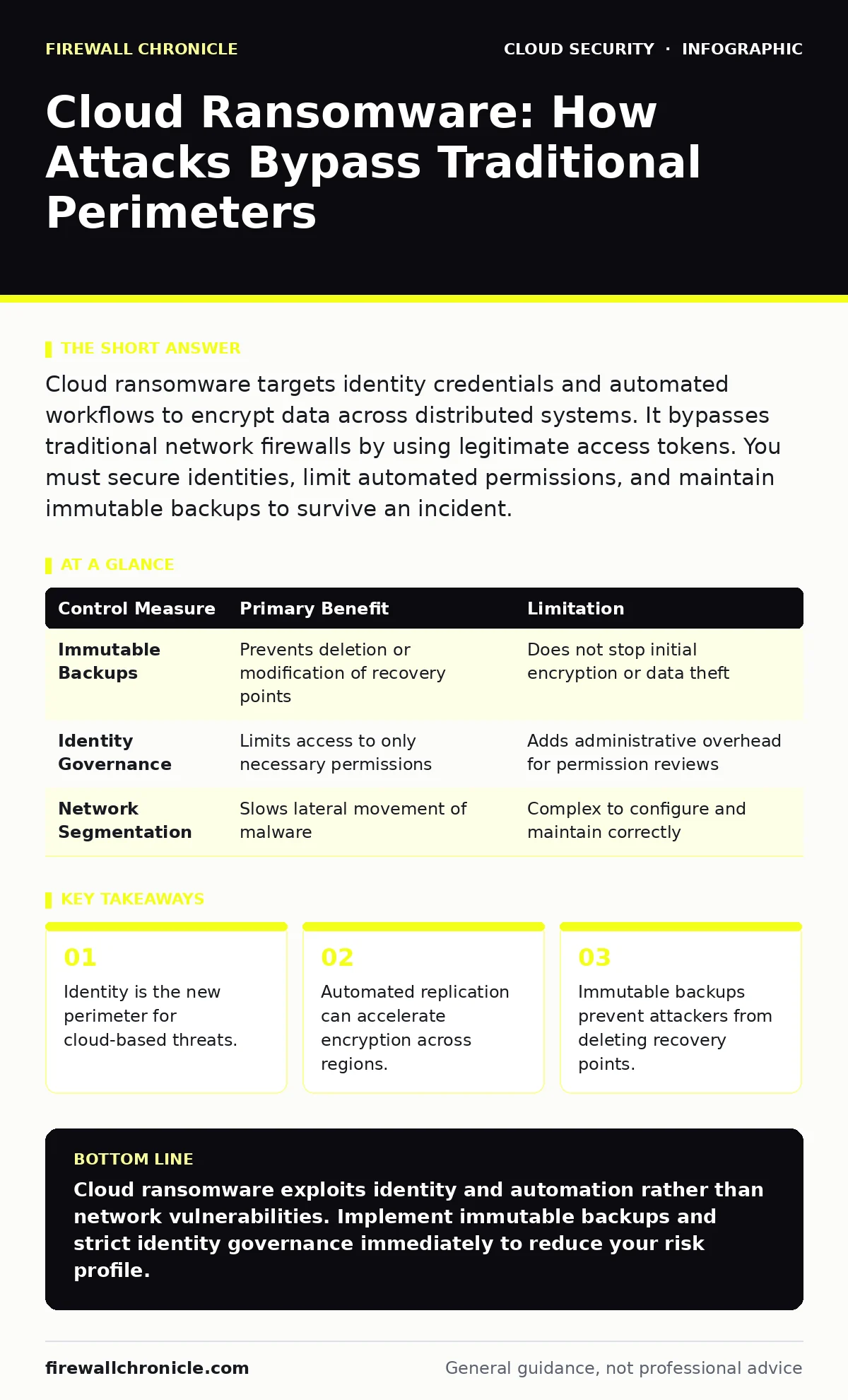
Cloud ransomware targets identity credentials and automated workflows to encrypt data across distributed systems. It bypasses traditional network firewalls by using legitimate access tokens. You must secure identities, limit automated permissions, and maintain immutable backups to survive an incident.
Does cloud architecture eliminate the need for traditional perimeter defenses?
No, cloud architecture shifts the perimeter from a network boundary to an identity boundary. Traditional firewalls protect against external traffic entering a private network, but cloud workloads often reside in shared or public environments. Attackers no longer need to "break in" through a firewall hole. Instead, they compromise valid credentials to act as authorized users. This shift means that securing the network interface is insufficient if the identity management layer is weak. You must treat every API call and user login as a potential entry point for ransomware.
How do attackers gain initial access to cloud environments?
Attackers typically gain access by compromising human credentials or exploiting misconfigured storage buckets. Phishing remains a primary vector for stealing login tokens or multi-factor authentication codes. Once an attacker has a valid token, they can interact with cloud services exactly as the owner could. Many organizations leave cloud storage containers publicly accessible by mistake. This misconfiguration allows attackers to plant malicious code or exfiltrate data without triggering network alerts. The attack succeeds because the cloud provider sees the request as legitimate traffic from an authorized user.
Why does ransomware spread faster in cloud environments than on-premises?
Cloud automation features, designed for efficiency, can accelerate malicious activity. Attackers exploit Infrastructure as Code scripts or serverless functions to replicate encryption commands across thousands of instances simultaneously. Suppose you have a deployment pipeline that updates configuration across a fleet of servers. An attacker who compromises the pipeline credentials can inject ransomware into the deployment artifact. When the pipeline runs, it distributes the malware to every connected system in minutes. This speed outpaces traditional detection mechanisms that rely on network traffic analysis.
Can encryption protect data stored in the cloud from ransomware?
Encryption at rest protects data confidentiality but does not prevent ransomware from encrypting it again. If an attacker gains access to your data encryption keys, they can decrypt, re-encrypt, and lock you out of your own data. Many cloud services manage keys on your behalf, which simplifies operations but creates a single point of failure. If the attacker compromises the account managing those keys, they control access to all associated data. You must separate key management from data access and use customer-managed keys where possible. This separation ensures that compromising one service does not automatically grant access to all encrypted data.
How do attackers evade detection within cloud workloads?
Attackers use low-and-slow techniques and legitimate administrative tools to avoid triggering alarms. They may use cloud-native monitoring tools to gather intelligence before acting. Since these tools are part of the trusted environment, their traffic does not look suspicious. For example, an attacker might query metadata services to discover running instances and sensitive configurations. This reconnaissance phase can last weeks without detection. You must monitor for unusual patterns in API calls, not just for known malware signatures. Anomalous behavior, such as a service account accessing resources it never touched before, is a stronger indicator of compromise.
See also: Mutable vs Immutable Infrastructure: Why State Changes Break Security · Multi Cloud Security Challenges: How to Stop Config Drift
What role do container orchestration platforms play in cloud ransomware?
Container platforms like Kubernetes expand the attack surface by introducing complex networking and identity layers. If you do not secure the cluster API, attackers can deploy malicious pods that have access to other workloads. Many teams ignore Kubernetes security basics, leaving default permissions too broad.
This oversight allows a compromised container to pivot to the host node or other containers. You must implement strict Kubernetes RBAC to limit what each service account can do. Additionally, Kubernetes network policies should restrict lateral movement between pods. Without these controls, ransomware can traverse the entire cluster using legitimate inter-service communication.
How does cloud network segmentation prevent lateral movement?
Segmentation divides your cloud environment into isolated zones to limit the blast radius of a breach. If an attacker compromises one zone, they cannot easily reach others without additional credentials or exploits. This approach contrasts with flat networks where a single breach grants access to all resources. You should design your architecture so that database tiers are not directly reachable from web-facing tiers. Implementing cloud network segmentation requires careful planning of security groups and routing tables. It adds operational complexity but significantly reduces the speed at which ransomware can propagate.
Why are standard backups insufficient against cloud ransomware?
Standard backups are often stored in the same account and under the same permissions as the primary data. Attackers who gain high-level access can locate and encrypt or delete these backups. This renders your recovery plan useless because you have no clean copy of the data to restore. You must use cloud backup strategies that include immutability and air-gapping. Immutable backups cannot be altered or deleted for a set period, even by administrators. This protection ensures that even if an attacker has full control, they cannot destroy your recovery point. Refer to our guide on cloud backup for detailed implementation steps.
How do you recover from a cloud ransomware incident?
Recovery begins with isolating the compromised identity and revoking all associated tokens. You must identify the scope of the breach by analyzing API logs and access patterns. Once the threat is contained, you restore data from immutable backups that were created before the compromise. This process often requires rebuilding workloads from scratch using clean Infrastructure as Code templates. You should also review cloud migration security practices to ensure new workloads are hardened. The goal is to return to a known good state without reintroducing the vulnerability that allowed the attack.
| Control Measure | Primary Benefit | Limitation |
|---|---|---|
| Immutable Backups | Prevents deletion or modification of recovery points | Does not stop initial encryption or data theft |
| Identity Governance | Limits access to only necessary permissions | Adds administrative overhead for permission reviews |
| Network Segmentation | Slows lateral movement of malware | Complex to configure and maintain correctly |
What is the hidden cost of over-privileged service accounts?
Service accounts often have broader permissions than human users because they automate tasks. This convenience creates a high-value target for attackers. If a service account is compromised, the attacker inherits all its permissions, potentially accessing critical infrastructure. Many teams assign administrative rights to simplify development workflows. This practice violates the principle of least privilege. You should audit service account permissions regularly and restrict them to specific resources. Over-privilege is a silent risk that turns a minor breach into a catastrophic failure.
Key takeaways
- Identity is the new perimeter for cloud-based threats.
- Automated replication can accelerate encryption across regions.
- Immutable backups prevent attackers from deleting recovery points.
Cloud ransomware exploits identity and automation rather than network vulnerabilities. Implement immutable backups and strict identity governance immediately to reduce your risk profile.
Frequently asked questions
Can I use single sign-on to prevent cloud ransomware?
Single sign-on centralizes authentication but does not prevent credential theft. It simplifies access management and enables better monitoring of login patterns. You must combine it with multi-factor authentication and conditional access policies.
How does cloud cryptojacking relate to ransomware?
Both attacks exploit compromised cloud resources for unauthorized use. Cryptojacking uses compute power for mining, while ransomware encrypts data for extortion. The initial access vectors are often similar, so defenses overlap significantly.
Do I need separate security controls for serverless functions?
Yes, serverless functions operate differently than traditional servers. They scale automatically and have unique permission models. You must secure the function code and limit the execution permissions to prevent abuse.
Is it possible to fully automate ransomware detection?
Automation helps but cannot replace human analysis. Automated systems can flag anomalies, but context is often required to distinguish between legitimate changes and attacks. A hybrid approach combining automation and expert review is most effective.
How this guide was produced: written by the Firewall Chronicle editorial team with AI assistance, checked against the public references listed below, and reviewed when the facts change. See our editorial policy or report an error.