Multi Cloud Security Challenges: How to Stop Config Drift
Multi-cloud security fails when teams treat each provider as a separate island, creating blind spots that attackers exploit through inconsistent access controls.
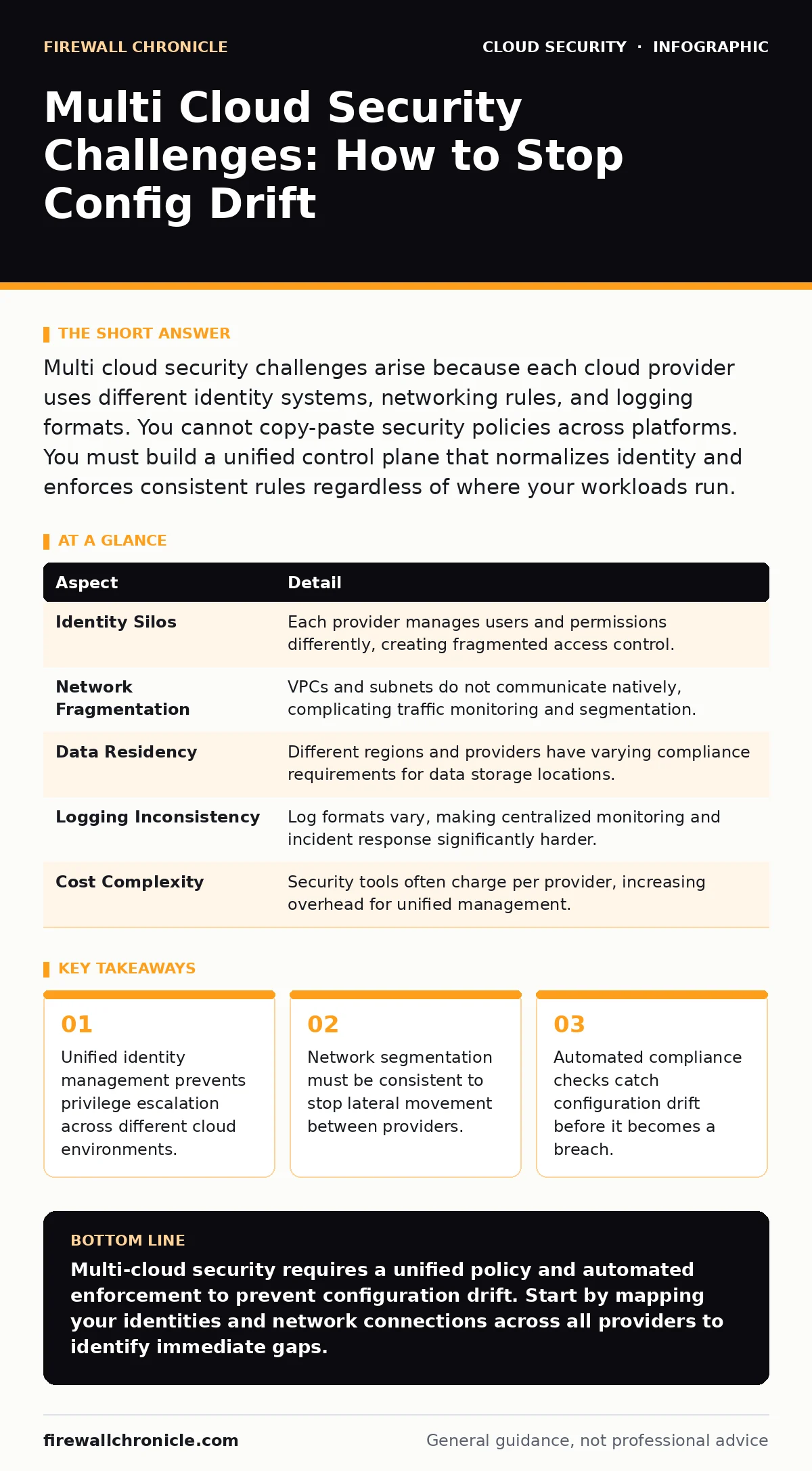
Multi cloud security challenges arise because each cloud provider uses different identity systems, networking rules, and logging formats. You cannot copy-paste security policies across platforms. You must build a unified control plane that normalizes identity and enforces consistent rules regardless of where your workloads run.
The Multi-Cloud Reality Check
Imagine running three different houses, each with its own lock brand, alarm system, and set of keys. You cannot use the same key to open every door. You cannot assume the alarm in one house works like the alarm in another. This is the basic problem with multi-cloud security challenges. You are managing resources across multiple cloud service providers, each with its own unique infrastructure, APIs, and security models.
Multi-cloud security is the practice of protecting data, applications, and infrastructure that span more than one cloud provider. It requires coordinating security controls across these disparate environments to ensure consistent protection. This approach affects any organization that uses public cloud services from different vendors, such as combining compute from one provider with storage from another. The goal is to maintain security posture without being locked into a single vendor’s ecosystem.
| Aspect | Detail |
|---|---|
| Identity Silos | Each provider manages users and permissions differently, creating fragmented access control. |
| Network Fragmentation | VPCs and subnets do not communicate natively, complicating traffic monitoring and segmentation. |
| Data Residency | Different regions and providers have varying compliance requirements for data storage locations. |
| Logging Inconsistency | Log formats vary, making centralized monitoring and incident response significantly harder. |
| Cost Complexity | Security tools often charge per provider, increasing overhead for unified management. |
Why Consistency Fails Across Boundaries
The primary difficulty lies in the lack of standardization. While open standards exist, cloud providers implement them with proprietary extensions and varying degrees of strictness. A security rule that works perfectly in one environment may be ignored or misinterpreted in another. This inconsistency creates gaps in your defense perimeter. Attackers look for these gaps. They exploit the weakest link in your chain, which is often the interface between two different cloud environments.
When you move data or workloads between providers, you introduce new attack surfaces. The transfer mechanism itself becomes a target. If you do not encrypt data in transit with strong, standardized protocols, you risk interception. Furthermore, the configuration of security groups and firewalls differs between providers. A misconfigured firewall rule in one cloud might expose sensitive ports, while the equivalent rule in another cloud might be overly restrictive, breaking functionality. This trade-off between security and usability is harder to balance when you are juggling multiple systems.
The Identity and Access Trap
Identity and Access Management (IAM) is the cornerstone of cloud security. In a multi-cloud setup, IAM becomes a nightmare of context switching. You must manage users, roles, and permissions across different identity providers. Each provider has its own syntax for defining permissions. One provider might use policy files in a specific JSON format, while another uses a graphical interface with different permission levels.
This fragmentation leads to privilege creep. Users accumulate permissions across different clouds because it is easier to grant access than to revoke it. Over time, you have users with excessive privileges in multiple environments. If an attacker compromises one account, they may have access to resources across all your clouds. This is why unified identity management is not just a convenience; it is a security necessity. You need a central directory that authenticates users and then maps those identities to the correct roles in each cloud provider.
Network Segmentation and Visibility
Network segmentation isolates different parts of your infrastructure to limit the spread of an attack. In a single cloud, this is straightforward. You create virtual private clouds and subnets, and you control traffic flow with security groups and network ACLs. In a multi-cloud environment, you have multiple virtual networks that do not inherently trust each other.
You must establish secure connections between these networks. This usually involves virtual private networks or dedicated interconnects. However, monitoring traffic across these connections is difficult. You need visibility into the traffic flowing between clouds to detect anomalies. If you cannot see the traffic, you cannot protect it. This lack of visibility is a major multi cloud security challenge. You must deploy security tools that can inspect traffic regardless of which cloud provider it is traversing.
Automating Compliance and Drift
Configuration drift occurs when your actual infrastructure state diverges from your intended state. In a multi-cloud environment, drift happens faster and more frequently. You might update a security setting in one cloud but forget to update the equivalent setting in another. Manual checks are impossible at scale. You need automated tools that continuously scan your infrastructure and compare it against your security baseline.
These tools must understand the security models of all your cloud providers. They should flag any deviation from your policies immediately. For example, if you require encryption for all storage buckets, the tool should check every bucket in every cloud and report any that are unencrypted. This continuous compliance monitoring helps you maintain a consistent security posture. It also reduces the risk of human error, which is a leading cause of security incidents. See our guide on configuration drift for more on how to detect and remediate these changes automatically.
See also: Mutable vs Immutable Infrastructure: Why State Changes Break Security · Cloud Security Groups Checklist for Tight Network Control
What People Usually Get Wrong
Many teams believe that buying a multi-cloud security platform solves all their problems. These platforms can help, but they do not fix poor security practices. If your underlying architecture is flawed, no tool will save you. You must design your security strategy from the ground up, considering the multi-cloud context from the start.
Another common mistake is treating each cloud as a separate entity. You should have a unified security policy that applies across all clouds. This policy should define how you manage identities, encrypt data, segment networks, and monitor for threats. You then implement this policy using the native tools of each provider or a third-party platform. This approach ensures consistency and reduces the risk of gaps in your defense.
Building a Resilient Defense
To address multi cloud security challenges, you must adopt a zero-trust mindset. Zero trust assumes that no user, device, or network is trustworthy by default. You verify every request, regardless of where it originates. This approach works well in multi-cloud environments because it does not rely on network perimeter defenses. Instead, it focuses on identity and least privilege.
You must also prepare for incidents that span multiple clouds. Your incident response plan should account for the different tools and procedures of each provider. You need to practice responding to breaches in each environment. This includes isolating compromised resources, preserving evidence, and restoring services from backups. See our guide on cloud backup to ensure you have reliable recovery options. Additionally, understand cloud-native security principles to protect your applications at the code level.
Final Thoughts on Multi-Cloud Strategy
Multi-cloud security is complex, but it is manageable. The key is consistency and automation. You must establish a unified security policy and enforce it across all your cloud environments. Use automated tools to monitor for configuration drift and compliance violations. Adopt a zero-trust architecture to minimize the impact of compromised credentials. By taking a proactive approach, you can mitigate the risks associated with multi-cloud security challenges and protect your organization’s data and applications.
Remember that security is a continuous process. You must regularly review and update your security controls to address new threats and changes in your infrastructure. Stay informed about the latest security best practices and emerging threats. See our guide on cloud ransomware to understand how to protect against this growing threat. Also, review exposed storage buckets to prevent accidental data leaks. Finally, consider cloud supply chain risks to ensure that the third-party components you use are secure.
Key takeaways
- Unified identity management prevents privilege escalation across different cloud environments.
- Network segmentation must be consistent to stop lateral movement between providers.
- Automated compliance checks catch configuration drift before it becomes a breach.
Multi-cloud security requires a unified policy and automated enforcement to prevent configuration drift. Start by mapping your identities and network connections across all providers to identify immediate gaps.
Frequently asked questions
Does multi-cloud security require different tools for each provider?
Not necessarily. Many security platforms support multiple cloud providers, allowing you to manage policies from a single console. However, you may still need native tools for specific provider features.
How do I handle data encryption across different clouds?
Use standard encryption algorithms and key management services that are compatible across providers. Ensure that keys are stored securely and access to them is strictly controlled.
What is the biggest risk in multi-cloud environments?
The biggest risk is inconsistency in security configurations. Gaps in one provider’s security can be exploited to access resources in another provider’s environment.
Can I use the same identity provider for all clouds?
Yes, you can use a central identity provider and federate it with each cloud provider. This simplifies user management and ensures consistent access controls.
How this guide was produced: written by the Firewall Chronicle editorial team with AI assistance, checked against the public references listed below, and reviewed when the facts change. See our editorial policy or report an error.