Configuration Drift: How Small Teams Lose Cloud Control
Silent changes in cloud settings create security gaps that standard monitoring tools often miss until an exploit occurs.
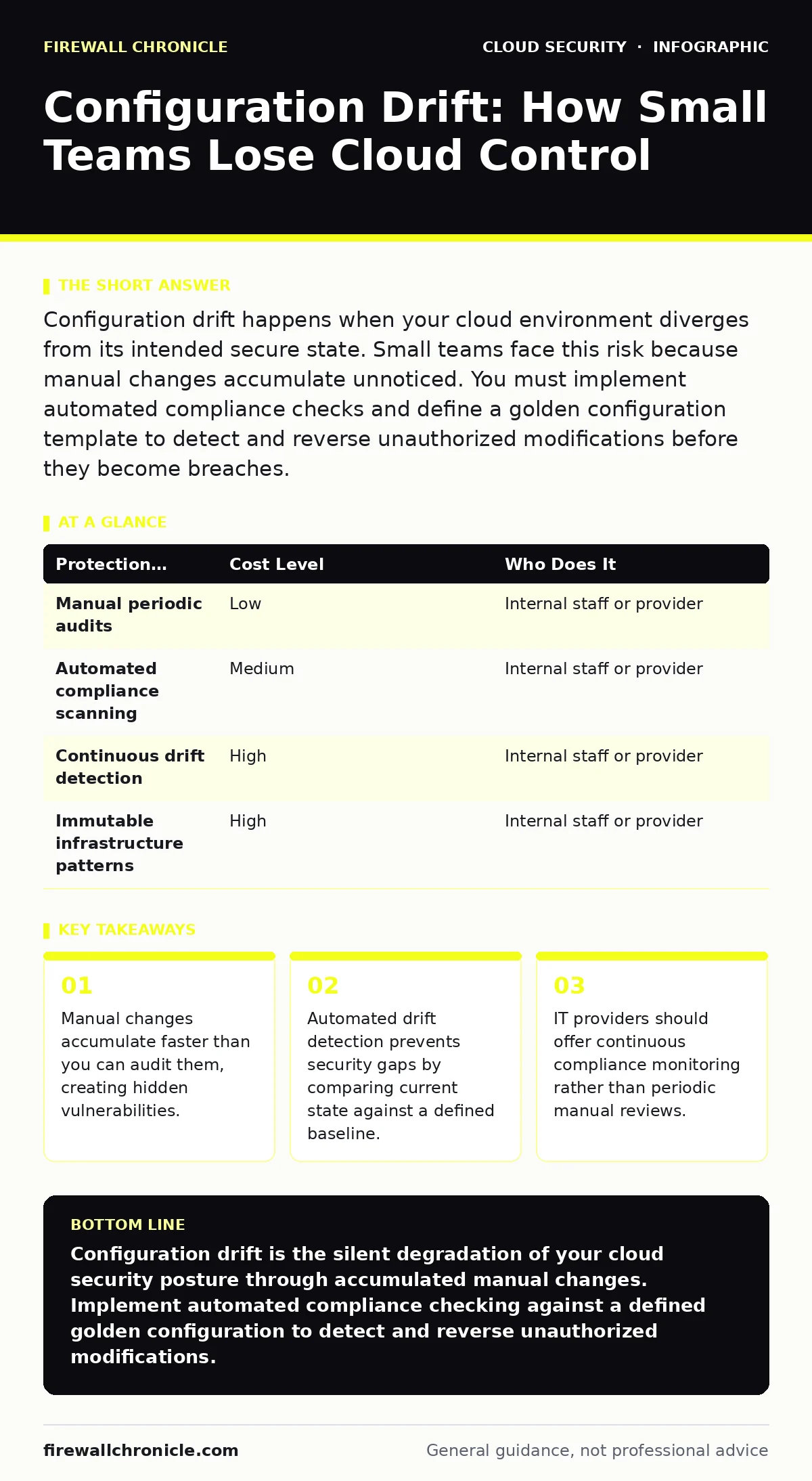
Configuration drift happens when your cloud environment diverges from its intended secure state. Small teams face this risk because manual changes accumulate unnoticed. You must implement automated compliance checks and define a golden configuration template to detect and reverse unauthorized modifications before they become breaches.
Why Small Teams Face Higher Drift Risk
Small organizations lack the structural friction that prevents unauthorized changes in large enterprises. Large companies use strict change management processes and separate teams for development and operations. Small teams often merge these roles to save money and time. This consolidation creates a direct path for configuration drift.
Configuration drift is the gradual divergence of a system’s settings from its intended baseline. It rarely happens through a single malicious act. It accumulates through hundreds of small, well-intentioned adjustments. A developer opens a port to fix a bug and forgets to close it. An administrator disables a security alert because it triggers too often. Each change is rational in isolation. Together, they degrade the security posture.
You assume your cloud environment matches the security policy you wrote at launch. That assumption is your primary vulnerability. The cloud infrastructure changes continuously as applications update and users adjust permissions. Without automated verification, you operate on outdated mental models of your system’s state.
The Hidden Cost of Manual Audits
Manual configuration audits are ineffective for detecting drift in dynamic environments. They provide a snapshot of the system at a single point in time. They miss changes that occur between audits. They also fail to capture the context of why a change was made. You might see an open port but not know which service depends on it.
Manual reviews scale poorly. As your infrastructure grows, the number of configurations increases exponentially. Reviewing every setting by hand becomes impossible. You start sampling. Sampling misses the edge cases where drift causes the most damage. You might check the main database but miss the staging environment where sensitive data leaks.
Imagine a scenario where your IT provider performs a monthly security review. They document the state of your cloud resources on the first Monday of each month. On the fifteenth, a developer modifies a firewall rule to allow a new integration. The review misses this change. The gap remains open for two weeks. An attacker exploits it on the twentieth. The monthly audit provides false assurance of security.
| Protection Method | Cost Level | Who Does It |
|---|---|---|
| Manual periodic audits | Low | Internal staff or provider |
| Automated compliance scanning | Medium | Internal staff or provider |
| Continuous drift detection | High | Internal staff or provider |
| Immutable infrastructure patterns | High | Internal staff or provider |
Defining Your Golden Configuration
You cannot detect drift if you do not know what your system should look like. You must define a golden configuration. This is the approved set of settings for every resource type in your cloud environment. It includes firewall rules, user permissions, logging settings, and encryption standards.
The golden configuration serves as the single source of truth. All automated tools compare the live environment against this baseline. If a resource deviates from the baseline, the system flags it as drift. You must document this configuration in code. This allows you to version control your security policies. You can track who changed what and when.
This approach connects directly to the principles of immutable infrastructure. Instead of modifying running systems, you replace them with new instances that match the desired state. This eliminates drift entirely. You do not patch a server; you build a new one with the patches applied. This method is more complex but removes the risk of accumulated manual changes.
Automated Detection and Remediation
Automated tools scan your cloud environment continuously. They compare the current state of every resource against the golden configuration. They report any differences. Some tools can automatically revert unauthorized changes. This is known as auto-remediation.
Auto-remediation reduces the time between a drift event and its correction. It prevents attackers from exploiting temporary gaps. However, it requires careful setup. If the automation logic is flawed, it might revert legitimate changes. This breaks applications and frustrates developers. You must define clear exceptions for planned changes.
Consider how this relates to cloud security groups. These groups define inbound and outbound traffic rules for your network interfaces. Drift in these rules is common. Developers often modify them to troubleshoot connectivity issues. Automated detection ensures these rules return to their secure state after troubleshooting is complete.
What to Ask Your IT Provider
Your IT provider plays a critical role in managing configuration drift. You must verify that their processes include continuous monitoring. Do not accept promises of "regular reviews." Demand evidence of automated compliance checking.
Ask your provider to demonstrate how they detect drift. Request a report of recent configuration changes and how they were validated. Ask how they handle false positives. A good provider will have a workflow for developers to request and approve configuration changes. This maintains security without blocking productivity.
This diligence supports broader multi-cloud security strategies. If you use services from multiple cloud providers, the complexity of drift management increases. Your provider must have tools and expertise that work across different platforms. They should not rely on manual checks for each provider’s unique configuration syntax.
See also: Multi Cloud Security Challenges: How to Stop Config Drift · Cloud Security Groups Checklist for Tight Network Control
Questions for Vendor Evaluation
You need to assess whether your IT provider can handle the technical depth of drift management. Use these questions to test their competence.
- Do you use infrastructure as code to define and enforce security baselines?
- How do you distinguish between authorized changes and unauthorized drift?
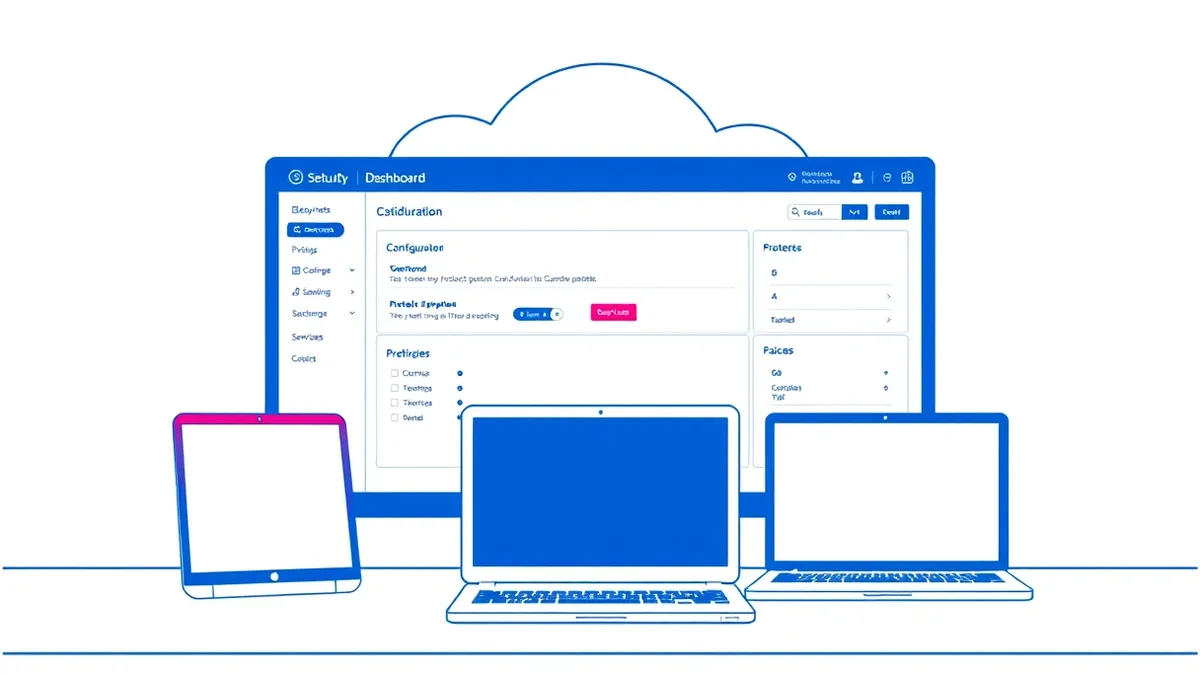
- Can you provide a real-time dashboard of configuration compliance status?
- What is your process for auto-remediation, and how do you prevent it from breaking applications?
- How do you handle configuration drift in development and staging environments?
- Do you integrate drift detection with your incident response procedures?
- Can you show examples of drift events you detected and resolved in the last quarter?
Integrating Drift Management into Operations
Configuration drift management is not a one-time project. It is an ongoing operational discipline. You must integrate it into your development lifecycle. Every code change should trigger a security configuration check. Every deployment should verify that the target environment matches the golden configuration.
This integration supports cloud migration security. As you move workloads to the cloud, you must ensure they land in a secure state. Drift management ensures they stay secure. It prevents the new environment from degrading over time.
You should also consider exposed storage buckets as a common drift outcome. Developers often create storage buckets for temporary data and forget to secure them. Automated drift detection can identify buckets with public access and close them immediately. This prevents data leaks that manual audits might miss.
Building Resilience Against Silent Changes
The goal is not to prevent all changes. Changes are necessary for innovation. The goal is to make all changes visible, approved, and reversible. Configuration drift thrives in opacity. It hides in the gaps between manual reviews.
By implementing automated detection and defining clear baselines, you eliminate those gaps. You create a system that alerts you to every deviation. This gives you control over your security posture. You react to actual threats, not hypothetical risks.
This approach reduces the risk of cloud ransomware attacks that exploit misconfigured permissions. It also ensures your cloud backup systems remain secure and accessible. A comprehensive strategy addresses drift across all layers of your cloud infrastructure.
Key takeaways
- Manual changes accumulate faster than you can audit them, creating hidden vulnerabilities.
- Automated drift detection prevents security gaps by comparing current state against a defined baseline.
- IT providers should offer continuous compliance monitoring rather than periodic manual reviews.
Configuration drift is the silent degradation of your cloud security posture through accumulated manual changes. Implement automated compliance checking against a defined golden configuration to detect and reverse unauthorized modifications.
Frequently asked questions
How often should I check for configuration drift?
You should check for configuration drift continuously. Manual periodic checks are insufficient because they miss changes that occur between reviews. Automated tools provide real-time visibility into your system's state.
Is configuration drift a legal compliance issue?
Yes, many regulatory frameworks require documented control over system configurations. Drift can lead to non-compliance if settings deviate from required security standards. Automated logging helps prove compliance during audits.
Can configuration drift happen in on-premise servers?
Yes, configuration drift occurs in any environment where manual changes are made. However, cloud environments change more frequently and scale more rapidly, making drift harder to track without automation. The principles of baseline management apply everywhere.
What is the difference between configuration drift and technical debt?
Technical debt refers to the cost of choosing an easy solution now instead of a better approach that would take longer. Configuration drift is the actual deviation from the intended secure state. Drift is a symptom of unmanaged technical debt in security settings.
How this guide was produced: written by the Firewall Chronicle editorial team with AI assistance, checked against the public references listed below, and reviewed when the facts change. See our editorial policy or report an error.