Mutable vs Immutable Infrastructure: Why State Changes Break Security
Immutable infrastructure forces every change through a rebuild process, eliminating configuration drift and making every server state auditable by design.
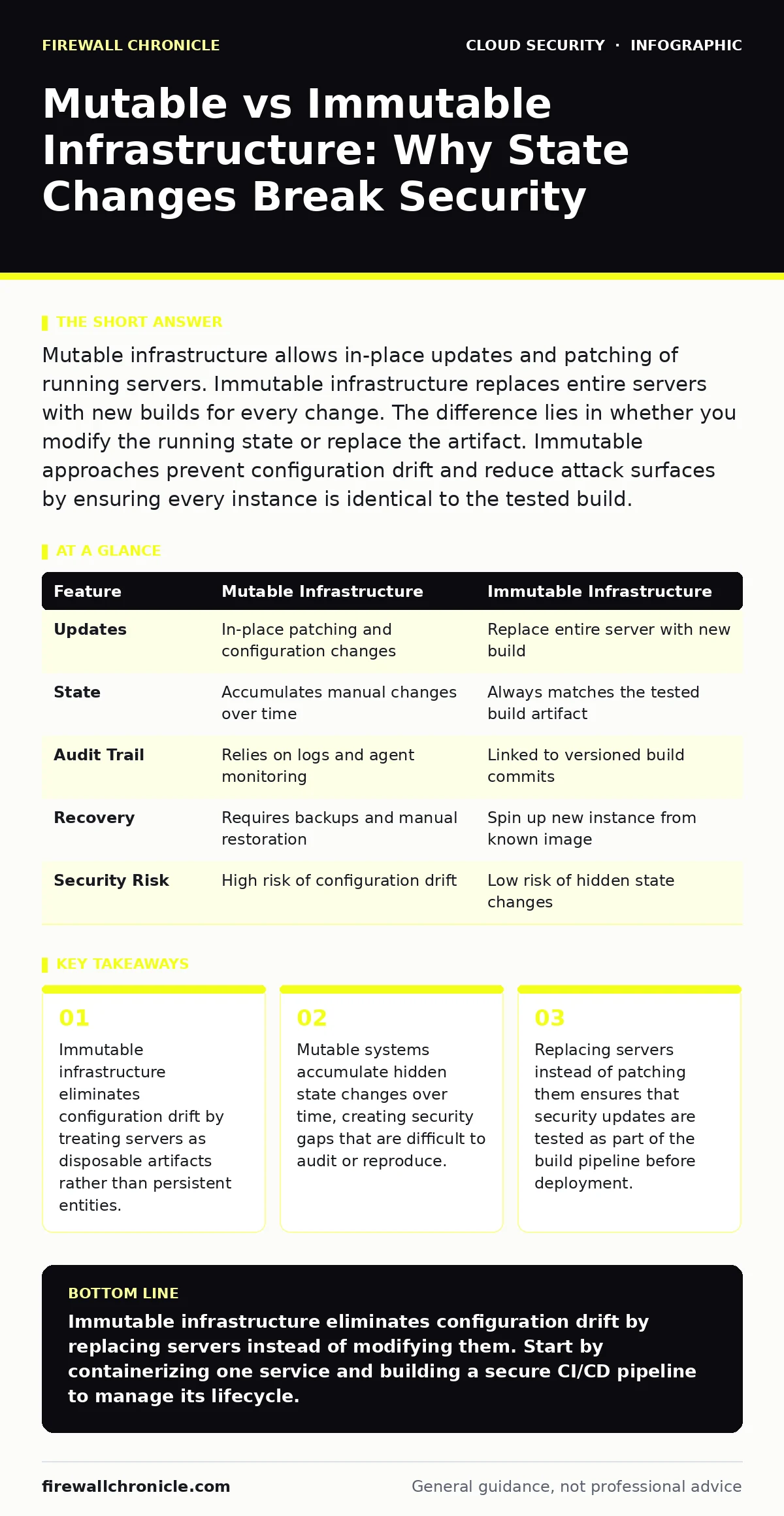
Mutable infrastructure allows in-place updates and patching of running servers. Immutable infrastructure replaces entire servers with new builds for every change. The difference lies in whether you modify the running state or replace the artifact. Immutable approaches prevent configuration drift and reduce attack surfaces by ensuring every instance is identical to the tested build.
What is the difference between mutable and immutable infrastructure?
The difference between mutable and immutable infrastructure is whether you modify running servers or replace them with new builds. Mutable infrastructure treats servers as persistent entities that you update in place. You apply patches, change configuration files, and install software while the system remains online. Immutable infrastructure treats servers as disposable artifacts. You build a new image with the desired changes, test it, and then replace the old server with the new one. The old server is destroyed. This approach ensures that the running state always matches the tested build. It removes the possibility of hidden changes accumulating over time.
Why does configuration drift create security risks?
Configuration drift creates security risks because manual changes accumulate without version control or testing. When you patch a mutable server, you might also change a firewall rule or tweak a database setting. These changes are rarely documented or tested against the rest of the application stack. Over time, the production server diverges from the development environment.
This divergence makes it impossible to reproduce issues or verify security posture. An attacker who exploits a vulnerability might find a misconfigured service that was added manually months ago. That service might have weak permissions because it was never reviewed by a security team. Immutable infrastructure prevents this by requiring every change to go through the build pipeline. The pipeline enforces consistency and auditability.
How does immutability improve auditability and compliance?
Immutability improves auditability by linking every running server to a specific, versioned build artifact. You can trace any security issue back to the exact commit and build number that created the server. This traceability is critical for compliance frameworks that require proof of configuration management. In a mutable environment, you must rely on logs and agent-based monitoring to reconstruct the state of a server.
These logs can be incomplete or tampered with. An immutable server’s state is defined by its image. If the image was signed and verified during the build process, you can trust the server’s integrity. This trust extends to the entire deployment. You do not need to scan every running server for unexpected changes. You only need to verify the build pipeline.
| Feature | Mutable Infrastructure | Immutable Infrastructure |
|---|---|---|
| Updates | In-place patching and configuration changes | Replace entire server with new build |
| State | Accumulates manual changes over time | Always matches the tested build artifact |
| Audit Trail | Relies on logs and agent monitoring | Linked to versioned build commits |
| Recovery | Requires backups and manual restoration | Spin up new instance from known image |
| Security Risk | High risk of configuration drift | Low risk of hidden state changes |
What are the performance costs of immutable deployments?
The performance costs of immutable deployments include longer deployment times and higher resource usage during transitions. Building a new server image takes time. You must compile code, install dependencies, and run tests. This process is slower than applying a simple patch. Deploying the new server also requires provisioning new resources. You cannot simply update the existing server. You must launch a new one and route traffic to it.
This creates a period where both old and new servers are running. It consumes more compute resources temporarily. For large-scale deployments, this can increase cloud costs. You must design your architecture to handle this overhead. Use automated scaling groups to manage the lifecycle of servers. Ensure that your monitoring tools can track the health of both old and new instances during the transition.
How do you handle persistent data in an immutable model?
You handle persistent data in an immutable model by separating state from compute. Immutable servers are designed to be stateless. They do not store user data, logs, or configuration files on their local disks. Instead, they connect to external storage services. These services manage the persistent data. When you replace a server, the new instance connects to the same external storage. It picks up where the old server left off.
This separation is critical for data integrity. If you store data on the local disk, you lose it when the server is destroyed. You must design your applications to be resilient to server replacement. Use cloud-native storage solutions for databases and file systems. Ensure that your applications can reconnect to these services quickly. This approach also simplifies backup and recovery processes. You only need to back up the external storage, not the individual servers.
See also: Multi Cloud Security Challenges: How to Stop Config Drift · Cloud Security Groups Checklist for Tight Network Control
When should you use mutable infrastructure instead?
You should use mutable infrastructure when you need to debug live issues or manage legacy systems that cannot be rebuilt. Immutable infrastructure requires a robust build pipeline. If your application cannot be containerized or virtualized easily, immutable deployment is difficult. Legacy monolithic applications often have dependencies that are hard to reproduce.
In these cases, mutable infrastructure allows you to patch and tweak the system directly. This flexibility can be valuable for emergency fixes. However, this flexibility comes at a cost. You lose the guarantees of consistency and auditability. Use mutable infrastructure as a temporary measure. Plan to migrate to immutable patterns as soon as possible. This migration often requires refactoring the application to be stateless and modular.
How does immutability integrate with cloud-native security practices?
Immutability integrates with cloud-native security practices by enforcing least privilege and reducing the attack surface. Because servers are short-lived, attackers have less time to exploit them. You do not need to harden servers against long-term persistence. Instead, you focus on securing the build pipeline. This aligns with the principles of cloud-native security. You also benefit from the isolation provided by containers and microservices.
Each service runs in its own environment. If one service is compromised, the others remain safe. This isolation is easier to maintain in an immutable model. You can define strict network policies to control traffic between services. For example, you can use Kubernetes network policies to restrict communication. This ensures that even if a service is compromised, the attacker cannot move laterally.
What steps should you take to start with immutable infrastructure?
You should take these steps to start with immutable infrastructure: 1. Containerize your application to ensure consistency across environments. 2. Build a CI/CD pipeline that automates the build, test, and deployment process. 3. Separate state from compute by using external storage services. 4. Implement infrastructure as code to define your server configurations. 5. Monitor the health of your deployments to detect issues quickly.
This approach requires a cultural shift. Your team must embrace automation and testing. You must trust the build pipeline to produce secure artifacts. This trust is built through rigorous testing and code reviews. Start with a small, non-critical service. Prove the concept before scaling it to the rest of your application. This gradual approach reduces risk and allows you to learn from mistakes.
Key takeaways
- Immutable infrastructure eliminates configuration drift by treating servers as disposable artifacts rather than persistent entities.
- Mutable systems accumulate hidden state changes over time, creating security gaps that are difficult to audit or reproduce.
- Replacing servers instead of patching them ensures that security updates are tested as part of the build pipeline before deployment.
Immutable infrastructure eliminates configuration drift by replacing servers instead of modifying them. Start by containerizing one service and building a secure CI/CD pipeline to manage its lifecycle.
Frequently asked questions
Does immutable infrastructure mean I never patch servers?
You still patch servers, but you do it by building a new image with the patches and replacing the old server. This ensures the patches are tested and consistent.
Can I use immutable infrastructure for databases?
Databases are stateful and typically mutable. You should use immutable infrastructure for the compute layer that connects to the database, not the database itself.
How does immutable infrastructure affect disaster recovery?
It simplifies disaster recovery because you can spin up new servers from known, tested images. You do not need to restore individual server states.
Is immutable infrastructure more expensive than mutable?
It can be more expensive due to the resources needed for building and deploying new servers. However, it reduces costs associated with debugging and security incidents.
How this guide was produced: written by the Firewall Chronicle editorial team with AI assistance, checked against the public references listed below, and reviewed when the facts change. See our editorial policy or report an error.