Race Conditions: Step-by-Step Mechanics and Interruption Points
Race conditions exploit the invisible gaps between checking a state and changing it, allowing attackers to rewrite data before the system can lock it.
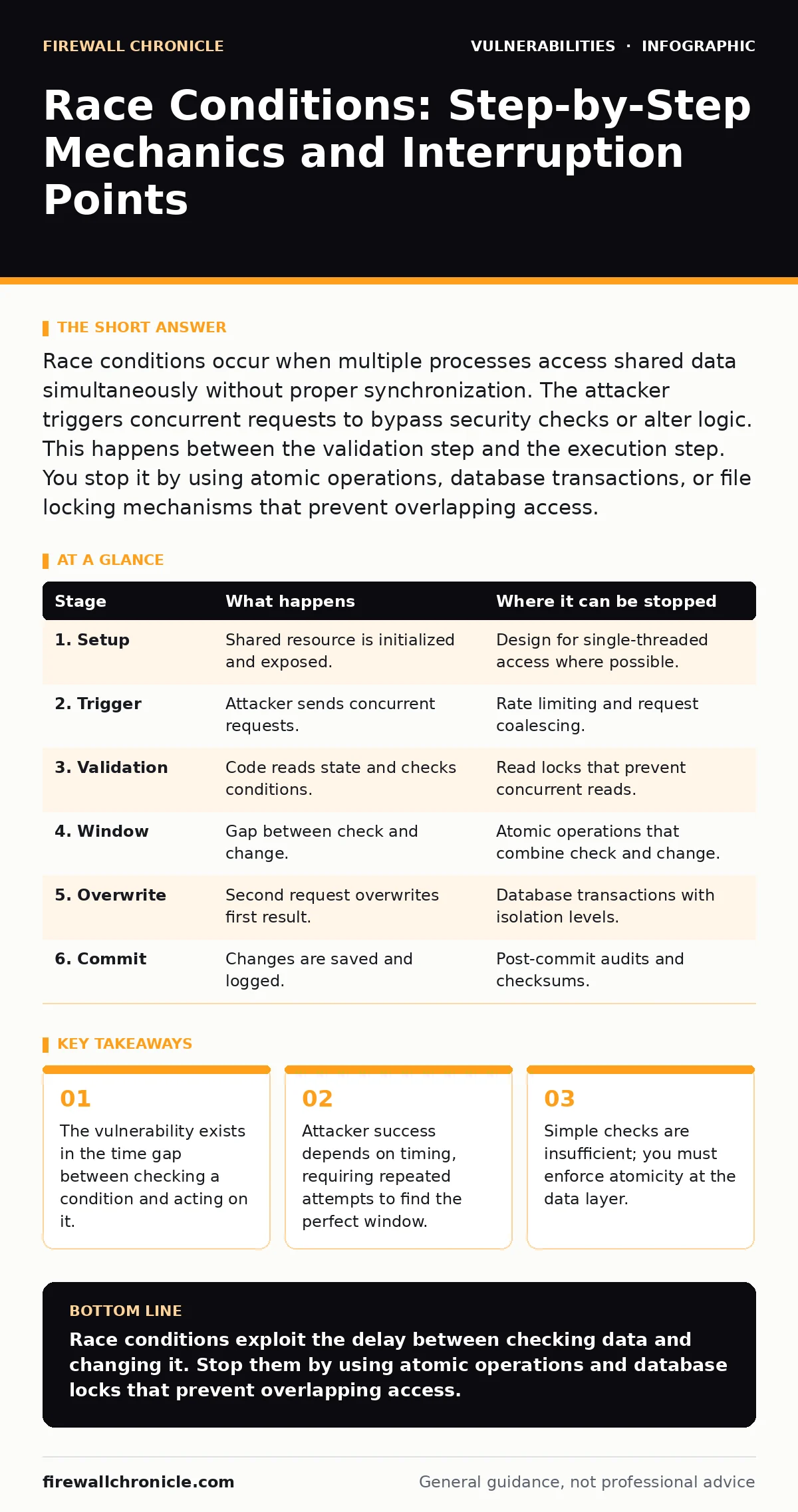
Race conditions occur when multiple processes access shared data simultaneously without proper synchronization. The attacker triggers concurrent requests to bypass security checks or alter logic. This happens between the validation step and the execution step. You stop it by using atomic operations, database transactions, or file locking mechanisms that prevent overlapping access.
The Anatomy of a Timing Gap
A race condition is a logic error that occurs when the behavior of a system depends on the sequence or timing of uncontrollable events. In software, this usually means two or more processes access a shared resource at the same time. The system assumes these actions happen in a strict order. When they do not, the outcome becomes unpredictable.
Imagine a banking application that checks your balance before transferring funds. The code reads the balance, verifies it is sufficient, and then deducts the amount. These are three separate steps. If two requests happen at once, both might read the same sufficient balance. Both might pass the check. Both might then deduct the money. The final balance becomes negative.
This flaw is not about broken code syntax. It is about broken assumptions regarding concurrency. The developer assumes the world is linear. The processor executes in parallel. The gap between assumption and reality is where the vulnerability lives.
### Stage 1: The Shared Resource Setup
The first stage involves identifying a resource that multiple threads can modify. This resource must be mutable and accessible from multiple entry points. It could be a file, a database row, a memory variable, or a session state.
The application initializes this resource. It sets default values. It opens connections. At this point, the system is stable. The danger lies in the accessibility. If the resource is truly private and single-threaded, a race condition cannot occur. The flaw requires exposure.
You must ask what data is shared. Is it a user profile? A shopping cart? A counter? If the answer is yes, the stage is set. The resource is waiting for conflicting instructions.
### Stage 2: The Concurrent Trigger
The attacker sends multiple requests simultaneously. These requests target the same resource and the same function. They are designed to arrive at the server within milliseconds of each other.
Standard web servers handle requests in separate threads or processes. Each request thinks it is the only one talking to the application. They each start their own execution path. They do not know about their siblings.
This stage relies on volume and speed. One request might fail. A hundred might succeed. The attacker automates this. They do not need perfect timing. They need probability. The more requests they send, the higher the chance that two will overlap in the critical window.
### Stage 3: The Validation Check
Each request reaches the security logic. The code performs a check. It asks a question: "Is the balance positive?" or "Has the user already claimed this reward?"
The code reads the current state. It evaluates the condition. This step is fast. It is often just a read operation. It does not change anything. It only observes.
Here is the hidden cost: reading is cheap, but it is not exclusive. Multiple processes can read the same value at the exact same nanosecond. They all see the same truth. They all decide the action is safe. None of them see the other pending actions.
### Stage 4: The Execution Window
This is the critical gap. The check has passed. The change has not yet happened. The system is in a transitional state.
The code prepares to write. It calculates the new value. It opens the database statement. It prepares the file handle. But it has not committed. It has not locked.
Imagine two threads both preparing to write "10" to a variable that holds "20". They have both read "20". They have both decided to subtract "10". They are now waiting to write "10". The original value is still "20" in the database, but the application logic has already committed to the change in memory.
### Stage 5: The Overwrite
The first request writes its result. The database updates the balance to "10". The first request finishes.
The second request writes its result. It also subtracts "10" from the value it read, which was "20". It writes "10" to the database. The balance remains "10". But two deductions occurred. The user should have "0".
This is the corruption. The second write overwrote the first. The system lost track of the intermediate state. The data integrity is broken. The attacker has achieved the goal. They spent money they did not have. They claimed the reward twice.
### Stage 6: The Commit and Cleanup
The application closes the connections. It logs the successful transactions. It displays a success message to the user.
To the end user, everything looks normal. The interface shows the correct final state. The logs show two valid transactions. There is no error. There is no crash. The failure is silent. It is a logical inconsistency, not a runtime exception.
This silence makes detection difficult. The system believes it acted correctly. It followed every line of code. The flaw was in the design of the sequence, not the execution of the lines.
| Stage | What happens | Where it can be stopped |
|---|---|---|
| 1. Setup | Shared resource is initialized and exposed. | Design for single-threaded access where possible. |
| 2. Trigger | Attacker sends concurrent requests. | Rate limiting and request coalescing. |
| 3. Validation | Code reads state and checks conditions. | Read locks that prevent concurrent reads. |
| 4. Window | Gap between check and change. | Atomic operations that combine check and change. |
| 5. Overwrite | Second request overwrites first result. | Database transactions with isolation levels. |
| 6. Commit | Changes are saved and logged. | Post-commit audits and checksums. |
Interrupting the Flow
You cannot stop time. You can only control access. The solution is atomicity. An atomic operation is one that completes entirely or not at all. It cannot be interrupted halfway.
If you use a database, rely on transactions. Set the isolation level to prevent dirty reads. Use "SELECT FOR UPDATE" to lock the row while you check it. This forces other threads to wait. They cannot read the stale value. They must wait for the lock to release.
If you use files, use file locking. Open the file with a lock flag. Do not read and then write. Read, lock, check, write, unlock. Many languages offer libraries for this. Do not roll your own locking logic. It is prone to deadlocks.
If you use memory, use mutexes or semaphores. A mutex ensures only one thread enters the critical section. The others wait. This adds latency. It slows the system. This is the trade-off. Security costs performance.
The Developer’s Blind Spot
Developers often think in straight lines. Input comes in. Logic processes it. Output goes out. This mental model fails in concurrent systems.
You must visualize threads as independent agents. They do not cooperate. They compete. They do not wait for each other unless you force them to.
This mindset shift is hard. It requires testing under load. Unit tests often run sequentially. They will not catch race conditions. You need stress tests. You need tools that simulate high concurrency.
Understanding this helps you spot other flaws. For instance, memory corruption bugs often arise from similar timing issues in low-level code. If you secure the race, you often secure the memory.
Key takeaways
- The vulnerability exists in the time gap between checking a condition and acting on it.
- Attacker success depends on timing, requiring repeated attempts to find the perfect window.
- Simple checks are insufficient; you must enforce atomicity at the data layer.
Race conditions exploit the delay between checking data and changing it. Stop them by using atomic operations and database locks that prevent overlapping access.
Frequently asked questions
How do I test for race conditions in my code?
Use stress testing tools that send thousands of concurrent requests to the same endpoint. Monitor the database for inconsistent states or unexpected value changes after the test.
Are race conditions only a problem for web applications?
No. Any system with shared resources and concurrent processes is at risk. This includes desktop software, embedded systems, and operating kernels.
Does using a thread pool prevent race conditions?
No. Thread pools manage execution but do not enforce data integrity. You still need explicit locking or atomic operations to protect shared state.
Can I fix a race condition with better error handling?
No. Error handling catches exceptions, not logical inconsistencies. A race condition often completes successfully without throwing an error, so try-catch blocks will not help.
How this guide was produced: written by the Firewall Chronicle editorial team with AI assistance, checked against the public references listed below, and reviewed when the facts change. See our editorial policy or report an error.