XML External Entity Myths: Why Common XXE Beliefs Fail
Developers often miss XXE risks because they assume modern parsers are safe by default or that input validation alone stops entity expansion attacks.
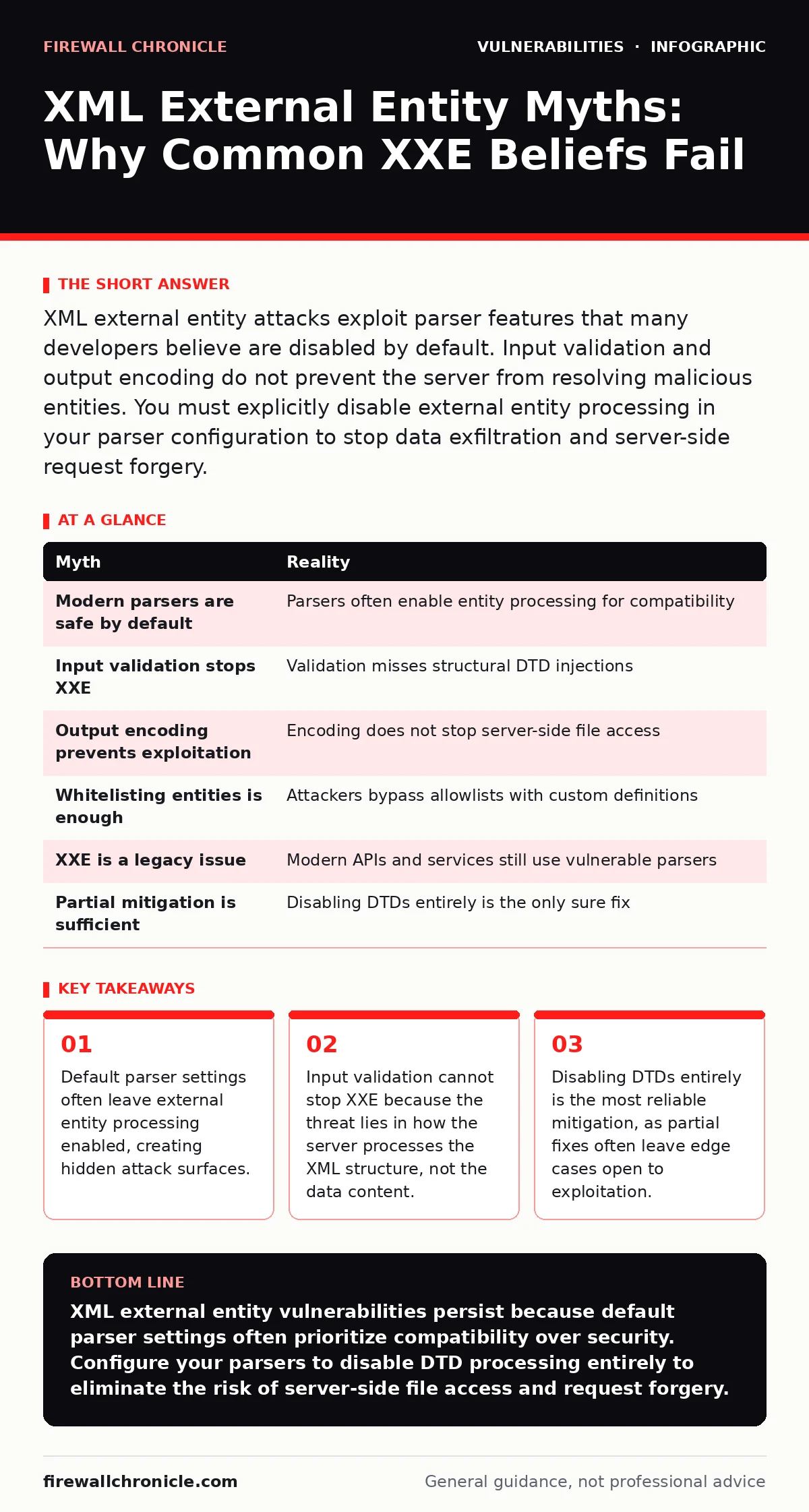
XML external entity attacks exploit parser features that many developers believe are disabled by default. Input validation and output encoding do not prevent the server from resolving malicious entities. You must explicitly disable external entity processing in your parser configuration to stop data exfiltration and server-side request forgery.
Myth: Modern Parsers Disable XXE by Default
Reality: Most XML parsers enable external entity processing unless you explicitly configure them otherwise. Developers often assume that installing a recent library version automatically secures the application against legacy vulnerabilities. This assumption fails because backward compatibility remains a priority for many standard libraries.
When a parser reads an XML document, it may attempt to resolve external entities defined in the Document Type Definition. If the parser fetches these entities, an attacker can trick it into reading local files or making internal network requests. You must verify the specific configuration flags of your chosen library. Many popular frameworks ship with permissive defaults to ensure older applications continue to function without modification.
Myth: Input Validation Stops XXE Attacks
Reality: Input validation checks for malicious content within the data fields, but XXE exploits the structural definition of the XML document itself. An attacker can inject a Document Type Definition that references a local file, such as /etc/pass on Unix systems. The payload is not in the text content you validate; it is in the prologue of the XML stream.
Suppose you sanitize all string inputs to remove special characters. The attacker does not need to inject a string into a text node. They define a new entity in the DTD section that precedes the root element. The parser processes this definition before your validation logic ever sees the resulting data. Therefore, validating the output of the parsing process is too late. The damage occurs during the parsing phase.
Myth: Output Encoding Prevents XXE Exploitation
Reality: Output encoding protects users from seeing malicious scripts in their browsers, but it does nothing to stop the server from processing dangerous XML instructions. This is a common confusion with cross-site scripting (XSS), where the goal is to inject code that executes in the victim’s browser. XXE is a server-side vulnerability that executes on your infrastructure.
When the server parses the XML, it resolves the external entity before it stores or transmits the data. If the entity resolves to a sensitive file, the file contents become part of the parsed object. Encoding this object for HTML display ensures the browser renders it safely, but the server has already accessed the restricted resource. The breach happens before encoding ever takes place.
Myth: Whitelisting Allowed Entities Is Sufficient
Reality: Whitelisting specific entities assumes you can predict every legitimate use case while blocking all malicious variations. Attackers can define custom entities that bypass simple allowlists. They can also use parameter entities, which allow them to construct complex logic within the DTD that standard entity checks might miss.
Consider a system that allows only image references from a specific domain. An attacker might define an entity that points to an internal database server using a different protocol or port. If the parser supports various URI schemes, it may follow the link despite the domain whitelist. The parser’s ability to fetch resources is the root cause, not the destination URL alone. Restricting the parser’s network access is more effective than filtering entity values.
Myth: XXE Only Affects Legacy Web Applications
Reality: XML remains a standard format for many modern APIs, SOAP services, and configuration files. Developers working on new microservices often integrate XML parsers for interoperability with older systems or specific industry standards. These new applications inherit the same parser behaviors as older ones.
Suppose you build a modern REST API that accepts XML for bulk data imports. You might focus on JSON security measures and overlook the XML parser’s configuration. The vulnerability exists wherever an XML parser is present and configured to process external entities. It is not a relic of the past but a persistent risk in any system that parses untrusted XML.
Myth: Partial Mitigations Eliminate All Risk
Reality: Disabling only external entity loading while keeping internal entity processing enabled leaves gaps. Some parsers allow you to disable network access but still process local files or system entities. Attackers can exploit these partial configurations to read local files or cause denial of service through billion laughs attacks.
The safest approach is to disable the Document Type Definition processing entirely if your application does not require it. Many modern use cases do not need the full feature set of XML DTDs. By removing the ability to define entities, you remove the attack vector completely. Partial fixes create a false sense of security that can lead to overlooked edge cases.
| Myth | Reality |
|---|---|
| Modern parsers are safe by default | Parsers often enable entity processing for compatibility |
| Input validation stops XXE | Validation misses structural DTD injections |
| Output encoding prevents exploitation | Encoding does not stop server-side file access |
| Whitelisting entities is enough | Attackers bypass allowlists with custom definitions |
| XXE is a legacy issue | Modern APIs and services still use vulnerable parsers |
| Partial mitigation is sufficient | Disabling DTDs entirely is the only sure fix |
Implementation Strategy for Developers
Reality: You must configure your XML parser to disable external entity processing at the initialization stage. This involves setting specific flags that prevent the parser from reading the DTD section or resolving any entities. Consult the documentation for your specific library to find the correct flags.
For Java applications, this often means setting features on the DocumentBuilderFactory to disable external general entities and external parameter entities. In Python, libraries like lxml require explicit configuration to disable network access and DTD validation. In .NET, the XmlReaderSettings class allows you to prohibit DTD processing.
Summary of Mitigation Steps
Reality: A layered approach reduces the likelihood of successful exploitation. First, disable DTD processing in your parser configuration. Second, restrict network access for the service account running the application to prevent outbound requests even if a parser is misconfigured. Third, use schema validation instead of DTDs to enforce structure without enabling entity resolution.
If you cannot disable DTDs, ensure that the parser does not have access to sensitive files or internal networks. This limits the impact of a successful attack to non-sensitive data. Regularly review your parser configurations during code reviews, just as you would review parameterized queries to prevent SQL injection.
Key takeaways
- Default parser settings often leave external entity processing enabled, creating hidden attack surfaces.
- Input validation cannot stop XXE because the threat lies in how the server processes the XML structure, not the data content.
- Disabling DTDs entirely is the most reliable mitigation, as partial fixes often leave edge cases open to exploitation.
XML external entity vulnerabilities persist because default parser settings often prioritize compatibility over security. Configure your parsers to disable DTD processing entirely to eliminate the risk of server-side file access and request forgery.
Frequently asked questions
Does using JSON instead of XML prevent XXE?
Yes, JSON parsers do not process Document Type Definitions or external entities, so they are not susceptible to XXE attacks.
Can XXE attacks lead to remote code execution?
In rare cases, if the application processes the resolved entity content in a way that executes code, XXE can lead to remote code execution.
Is XXE related to server-side template injection?
No, XXE exploits XML parsers, while server-side template injection exploits template engines that render dynamic content.
How do I test for XXE in my application?
Use fuzz testing to send XML payloads with external entity definitions and monitor server responses for file contents or internal IP addresses.
How this guide was produced: written by the Firewall Chronicle editorial team with AI assistance, checked against the public references listed below, and reviewed when the facts change. See our editorial policy or report an error.