Host Header Injection: Definition, Mechanisms, and Mitigation Strategies
Your application trusts the Host header to build absolute URLs, allowing attackers to redirect users to malicious sites without touching your server code.
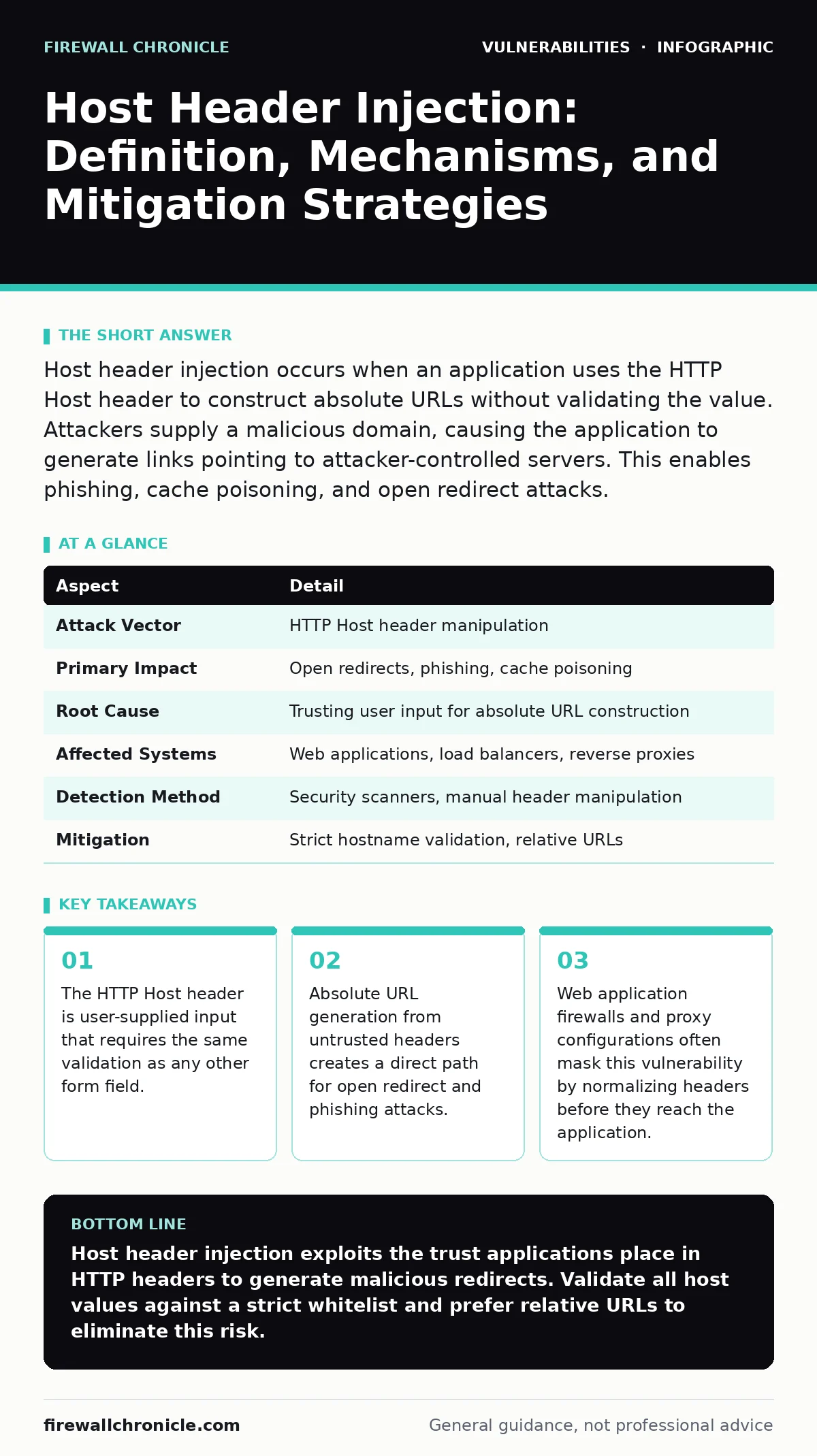
Host header injection occurs when an application uses the HTTP Host header to construct absolute URLs without validating the value. Attackers supply a malicious domain, causing the application to generate links pointing to attacker-controlled servers. This enables phishing, cache poisoning, and open redirect attacks.
How a Postal Address Analogy Explains the Flaw
Imagine you hand a courier a letter with no return address. You ask the courier to write the recipient's address on the envelope. If you tell the courier to use the address written on the front of the package they are holding, they will obey. If the package has a forged address, the letter goes there. The courier did not make a mistake. The instruction to trust the package's own label created the flaw.
Web servers receive requests containing a Host header. This header tells the server which domain the client intended to reach. When you build absolute URLs inside your application logic, you often pull the domain name from this header. If you do not verify that the header matches your expected domain, you allow the sender to dictate where links point. This is the core of host header injection.
| Aspect | Detail |
|---|---|
| Attack Vector | HTTP Host header manipulation |
| Primary Impact | Open redirects, phishing, cache poisoning |
| Root Cause | Trusting user input for absolute URL construction |
| Affected Systems | Web applications, load balancers, reverse proxies |
| Detection Method | Security scanners, manual header manipulation |
| Mitigation | Strict hostname validation, relative URLs |
The Mechanism Behind Host Header Injection
The HTTP protocol requires clients to send a Host header with every request. This header specifies the domain name of the server being accessed. Web servers use this information to serve the correct virtual host when multiple domains share one IP address. Your application code often reads this header to generate absolute URLs for emails, redirects, or API callbacks.
When your code concatenates the Host header value with a path to create a full URL, it assumes the header is trustworthy. It is not. The header is just text sent by the client. An attacker can change this value using simple tools. The server receives the request, reads the malicious domain, and builds a URL pointing to that domain. The application logic remains unchanged, but the output is compromised.
This mechanism relies on the application's need for absolute URLs. If the application uses relative paths, the browser resolves the domain from the current location. Absolute URLs bypass this safety net. The application explicitly tells the browser to go to a specific domain. If that domain comes from the request, the attacker controls the destination.
Who Gets Affected by This Vulnerability
Any web application that generates absolute URLs based on request headers is at risk. This includes e-commerce platforms that send password reset emails. The email contains a link to reset the password. If the link uses the Host header from the initial request, an attacker can change the destination to a fake site. The user clicks the link, sees a familiar login page, and enters credentials. Those credentials go to the attacker.
Load balancers and reverse proxies are also affected. These devices often forward requests to backend servers. If they pass the Host header without validation, the backend application inherits the risk. Some caching systems use the Host header to determine cache keys. A malicious host value can cause the cache to store content for the wrong domain. This leads to cache poisoning, where legitimate users receive malicious content served from the cache.
Single sign-on providers and API gateways face similar risks. They often use the Host header to determine callback URLs. If an attacker controls this value, they can redirect authentication tokens to their own server. This allows them to hijack sessions or steal identity tokens. The impact extends beyond simple phishing. It can lead to full account takeover and data exfiltration.
Common Forms of Exploitation
Attackers use host header injection to achieve several goals. The most common is open redirect. The application redirects the user to a URL derived from the Host header. The attacker supplies a domain they control. The user is sent to that domain, which often mimics the legitimate site. This breaks the trust chain between the user and the application.
Cache poisoning is another form. The attacker sends a request with a malicious Host header and a malicious payload. The caching layer stores this payload under a key derived from the host. When a legitimate user requests the same resource, the cache serves the poisoned content. This allows the attacker to inject scripts or change content without modifying the application code. It persists until the cache expires or is cleared.
Email hijacking is a severe consequence. Many applications send transactional emails with links. These links often use the Host header to determine the base URL. If the header is spoofed, the email contains links to attacker-controlled sites. The user receives an email from a trusted sender, but the links lead to a phishing site. This combines the trust of the email sender with the deception of the redirect.
What People Usually Get Wrong
Many developers believe that using HTTPS prevents host header injection. HTTPS encrypts the connection, but it does not validate the Host header. The attacker can still send a malicious Host header over the secure connection. The application receives the header and uses it to build URLs. The encryption protects the data in transit, but it does not protect the logic that processes the header.
Another common mistake is relying on web application firewalls to block these attacks. Firewalls often have rules to filter common injection patterns. However, host header injection looks like a normal domain name. A firewall may not flag "evil.com" as malicious. The attack does not involve SQL syntax or script tags. It involves a valid domain name that happens to be wrong. The firewall sees a valid request and allows it through.
Some teams assume that only external-facing applications are at risk. Internal applications can also be affected. If an internal tool uses the Host header to build URLs, an attacker with access to the network can exploit it. This can lead to internal phishing or cache poisoning of internal services. The risk exists wherever absolute URLs are generated from request headers.
See also: Formjacking Prevention Checklist for Secure Web Applications · Output Encoding: The Hidden Trade-offs in Web Security
How to Reduce the Risk Effectively
The most effective mitigation is to avoid using the Host header for URL generation. Use configuration files or environment variables to define the application's base URL. This ensures that the URL is always correct, regardless of the request. If you must use the host from the request, validate it against a whitelist of allowed domains. Reject requests with hosts that are not on the list.
Use relative URLs whenever possible. Relative paths do not include the domain name. The browser uses the current domain to resolve the path. This eliminates the risk of redirecting to a different domain. If you need absolute URLs for emails or webhooks, generate them from trusted configuration, not from the request. This separates the source of truth from user input.
Implement strict header validation at the edge. Reverse proxies and load balancers can check the Host header before it reaches the application. If the header does not match the expected domain, the proxy can reject the request. This adds a layer of defense that protects the application from malformed requests. It also reduces the attack surface by filtering bad input early.
Consider related vulnerabilities when hardening your application. Broken object level authorization (BOLA) often accompanies poor input validation. If you trust the Host header, you might also trust other identifiers. Output encoding is necessary to prevent cross-site scripting, but it does not fix host header injection. You must address the source of the URL, not just the output. Penetration testing can reveal these flaws, but automated scans may miss them. Manual review of URL generation logic is required.
Beyond Basic Mitigation: Advanced Considerations
Advanced attackers may bypass simple whitelists by using subdomains. If your application allows "app.example.com", an attacker might try "evil.example.com". If your validation only checks the top-level domain, this bypass succeeds. You must validate the full host string. Do not rely on partial matching. Exact matching is the only safe approach.
Some applications use the Host header for logging or analytics. If you log the Host header, ensure that the logs are not accessible to users. Logged data can be used to reconstruct attacks or identify targets. This is a secondary risk, but it can aid further exploitation. Combine header validation with secure logging practices.
Key takeaways
- The HTTP Host header is user-supplied input that requires the same validation as any other form field.
- Absolute URL generation from untrusted headers creates a direct path for open redirect and phishing attacks.
- Web application firewalls and proxy configurations often mask this vulnerability by normalizing headers before they reach the application.
Host header injection exploits the trust applications place in HTTP headers to generate malicious redirects. Validate all host values against a strict whitelist and prefer relative URLs to eliminate this risk.
Frequently asked questions
Is host header injection the same as DNS rebinding?
No. DNS rebinding tricks the browser into making requests to internal addresses by changing DNS records. Host header injection tricks the server into generating URLs pointing to attacker-controlled domains. They use different mechanisms.
Can a CDN prevent host header injection?
A CDN can help by terminating SSL and validating headers before passing requests to the origin. However, if the CDN passes the Host header to the application, the application must still validate it. The CDN is a layer, not a complete fix.
How do I detect host header injection in my app?
Look for code that uses request headers to build absolute URLs. Check for redirects, email links, and API callbacks. Use security scanners that test header manipulation. Manual code review is the most reliable method.
Does HTTPS fix host header injection?
No. HTTPS encrypts the connection but does not validate the content of headers. The attacker can still send a malicious Host header over HTTPS. The application must validate the header value regardless of the transport security.
How this guide was produced: written by the Firewall Chronicle editorial team with AI assistance, checked against the public references listed below, and reviewed when the facts change. See our editorial policy or report an error.