How VEX Documents Work: Mapping Vulns to Real Risk
VEX documents shift security from counting vulnerabilities to proving which ones actually affect your specific build and runtime environment.
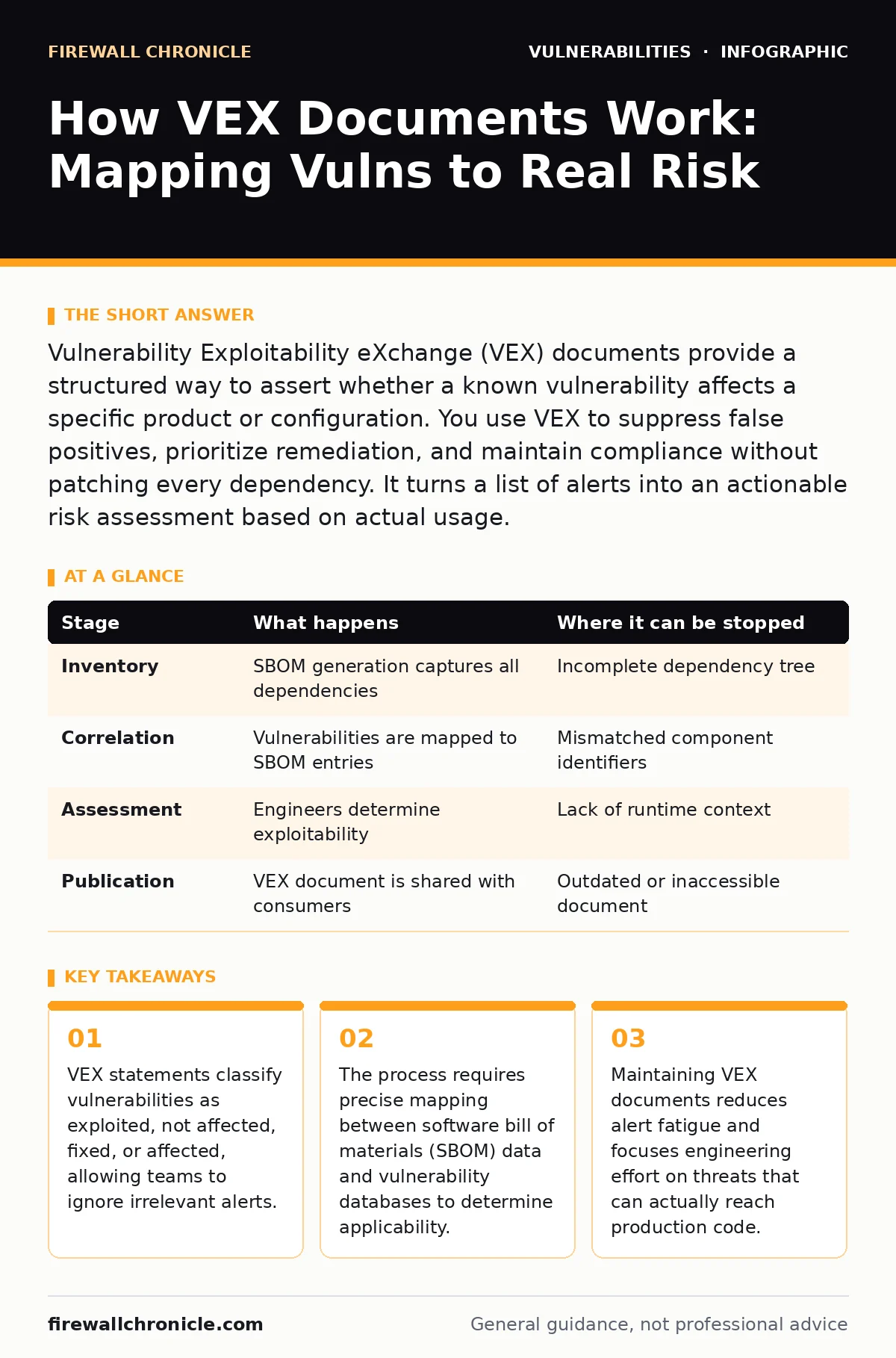
Vulnerability Exploitability eXchange (VEX) documents provide a structured way to assert whether a known vulnerability affects a specific product or configuration. You use VEX to suppress false positives, prioritize remediation, and maintain compliance without patching every dependency. It turns a list of alerts into an actionable risk assessment based on actual usage.
Understanding the VEX Mechanism
Vulnerability Exploitability eXchange (VEX) documents solve the problem of noise in vulnerability scanning. Traditional scanners report every known vulnerability in every dependency, regardless of whether that dependency is loaded, executed, or reachable. This creates a massive backlog of false positives. VEX introduces a layer of context that filters this noise. It allows maintainers to declare that a specific vulnerability does not affect a specific product instance. This declaration is not an excuse to ignore security.
It is a documented assertion of technical reality. The mechanism relies on standardized formats, typically CycloneDX or SPDX, which contain structured data about components. The VEX document references these components using unique identifiers like Package URLs (PURLs). It then links each relevant vulnerability to a specific status. This status determines whether security teams must act. The approach treats vulnerability management as an engineering problem rather than a compliance checkbox. It requires accurate data and consistent logic.
Stage 1: Generating the Component Inventory
The first step is creating a precise inventory of all software components in your application. This is often called a Software Bill of Materials (SBOM). An incomplete SBOM renders VEX useless because you cannot assess risk for components you do not know exist. The SBOM must include exact version numbers and unique identifiers for every library, framework, and module. Static analysis tools generate this inventory during the build process. They parse source code and build artifacts to extract dependency trees. The goal is completeness without duplication.
If a library appears twice with different versions, both entries must be present. This stage also requires consistent naming conventions. A library named "crypto" in one system might be "crypto-js" in another. Mismatched names break the correlation process. The SBOM serves as the ground truth for all subsequent VEX decisions. Without it, you are guessing which parts of your stack are vulnerable. Imagine a build that pulls in five versions of the same logging library. Each version has different vulnerability profiles. Your inventory must reflect this granularity.
| Stage | What happens | Where it can be stopped |
|---|---|---|
| Inventory | SBOM generation captures all dependencies | Incomplete dependency tree |
| Correlation | Vulnerabilities are mapped to SBOM entries | Mismatched component identifiers |
| Assessment | Engineers determine exploitability | Lack of runtime context |
| Publication | VEX document is shared with consumers | Outdated or inaccessible document |
Stage 2: Correlating Vulnerabilities with Components
Once the SBOM exists, the system compares it against vulnerability databases. These databases contain records of known flaws, including affected version ranges. The correlation engine matches the SBOM entries to these records. It identifies which components have known vulnerabilities. This step is purely mechanical. It does not assess risk. It only lists potential matches. The challenge here is accuracy in version matching. Some libraries use semantic versioning, while others use arbitrary tags.
A vulnerability might affect versions 1.0.0 through 1.5.0. If your SBOM lists version 1.5.1, the correlation might incorrectly flag it if the range logic is flawed. Precision matters. A single digit difference can change the outcome. This stage produces a raw list of potential issues. It does not distinguish between a vulnerability in an unused library and one in a core function. That distinction comes later. The output is a set of candidate vulnerabilities that require human or automated review.
Stage 3: Assessing Exploitability and Context
This is the core value of VEX. Engineers or automated systems review each correlated vulnerability to determine if it actually affects the product. This assessment considers several factors. Is the vulnerable code path reachable? Is the vulnerable function called at runtime? Are there input validation controls that prevent exploitation? If the answer to these questions is no, the vulnerability is marked as "not affected." If the code is reachable but the risk is low, it might be marked as "affected" but with low priority.
This stage requires deep technical knowledge. It often involves code review or dynamic analysis. Automated tools can help by analyzing call graphs and data flow. They can detect if a vulnerable function is never invoked. However, they cannot always understand complex business logic. Human judgment is often required for edge cases. This stage transforms a list of alerts into a prioritized action list. It separates critical risks from theoretical ones.
Stage 4: Publishing and Consuming VEX Documents
The final stage is making the VEX document available to stakeholders. This includes developers, security teams, and customers. The document must be easily accessible and machine-readable. It is typically published alongside the SBOM. Consumers of the software can then query the VEX document to see the risk posture. They do not need to re-perform the assessment. They can trust the maintainer's assertion. This builds transparency and trust. It also allows for automation.
Security tools can ingest VEX documents to suppress alerts automatically. If a scanner sees a vulnerability that is marked "not affected" in the VEX document, it ignores it. This reduces noise significantly. The VEX document must be updated whenever the software changes. New releases require new assessments. Old documents become stale. Versioning is critical. Each VEX document must be tied to a specific software version. This ensures that the risk assessment remains accurate over time.
See also: Threat Modeling Cybersecurity: How to Map Attack Paths Before Code
Integrating VEX into Development Workflows
VEX is not a one-time activity. It must be integrated into the continuous integration and continuous deployment (CI/CD) pipeline. Automated checks should run at every commit. If a new vulnerability is discovered in a dependency, the system should check the VEX document. If the document does not cover the new vulnerability, the pipeline should alert the team. If the document covers it and marks it "not affected," the pipeline can proceed. This automation ensures that risk assessment keeps pace with development.
It prevents the accumulation of unassessed vulnerabilities. Teams should define clear policies for VEX maintenance. Who is responsible for assessments? How often are documents reviewed? What is the escalation path for disputed assessments? These policies ensure consistency. They also provide accountability. VEX documents become a shared source of truth for security posture. They align development and security teams around actual risk. This alignment reduces friction and improves velocity. Security stops being a blocker and becomes an enabler.
Common Pitfalls and Edge Cases
VEX documents are powerful but fragile. They rely on accurate data and honest assessments. If the SBOM is wrong, the VEX document is wrong. If the assessment is superficial, the VEX document provides false confidence. One common pitfall is over-reliance on automation. Automated tools can miss subtle context. They might mark a vulnerability as "not affected" because the function is not called in tests, but it is called in production. Human review is necessary for complex cases. Another pitfall is outdated documents.
If the software changes, the VEX document must change. Stale documents give a false sense of security. Teams must have processes for updating VEX documents. This includes monitoring for new vulnerabilities and re-assessing existing ones. A third pitfall is inconsistent terminology. Different teams might use different status labels. Standardization is key. Use established schemas like CycloneDX. This ensures interoperability and clarity. VEX documents are only as good as the effort put into them.
Imagine a scenario where a library is updated to a new major version. The old version had a vulnerability marked "not affected." The new version might introduce new code paths. The old VEX assertion no longer applies. The team must re-assess the new version. Failure to do so leaves the product exposed. This highlights the need for lifecycle management. VEX documents are living artifacts.
They require continuous maintenance. Neglecting this maintenance leads to technical debt and security gaps. The goal is not to eliminate all vulnerabilities. It is to understand and manage them. VEX provides the framework for this understanding. It turns uncertainty into documented risk. This clarity allows teams to make informed decisions about patching and mitigation.
Comparing VEX with Related Security Practices
VEX complements other security practices but does not replace them. For instance, asset inventory for patching focuses on tracking and updating software. VEX focuses on assessing risk without immediate patching. These two practices work together. Asset inventory tells you what you have. VEX tells you what matters. Similarly, security misconfigurations can expose vulnerabilities that VEX might mark as "not affected." If a misconfiguration opens a new attack vector, the VEX status must be re-evaluated. VEX does not protect against misconfigurations. It only assesses code-level vulnerabilities.
Other threats like XML external entity (XXE) attacks or DLL hijacking require specific controls. VEX can help assess the risk of these threats in libraries, but it does not implement the controls. Container escape vulnerabilities are often related to runtime environment issues. VEX can assess the risk in container images, but it cannot prevent escapes. Understanding these distinctions is vital. VEX is a risk assessment tool, not a control mechanism. It informs decisions about controls. It does not replace the need for secure coding, proper configuration, and runtime protection.
Key takeaways
- VEX statements classify vulnerabilities as exploited, not affected, fixed, or affected, allowing teams to ignore irrelevant alerts.
- The process requires precise mapping between software bill of materials (SBOM) data and vulnerability databases to determine applicability.
- Maintaining VEX documents reduces alert fatigue and focuses engineering effort on threats that can actually reach production code.
Frequently asked questions
What is the difference between a VEX document and an SBOM?
An SBOM lists the components in your software, while a VEX document assesses the risk of vulnerabilities in those components. The SBOM is the inventory; the VEX is the risk assessment.
Who is responsible for creating VEX documents?
The software maintainer or vendor is responsible for creating VEX documents. Consumers can use these documents to assess risk, but the maintainer provides the initial assertions.
Can VEX documents be automated?
Yes, VEX documents can be partially automated. Tools can generate SBOMs and correlate vulnerabilities. However, the final risk assessment often requires human judgment or sophisticated static analysis.
How often should VEX documents be updated?
VEX documents should be updated with every software release. They should also be updated when new vulnerabilities are discovered in existing components or when the software architecture changes. BOTTOM LINE: VEX documents transform vulnerability management from a noisy alert system into a precise risk assessment tool by asserting which vulnerabilities actually affect your specific build. Integrate VEX generation into your CI/CD pipeline to automate risk assessments and reduce false positives bef
How this guide was produced: written by the Firewall Chronicle editorial team with AI assistance, checked against the public references listed below, and reviewed when the facts change. See our editorial policy or report an error.