
CVSS Scores: Why High Numbers Mislead Your Risk Assessment
CVSS scores measure exploitability mechanics, not business impact, meaning a critical score often signals low actual risk to your specific infrastructure.
CVSS provides a standardized vector for exploit difficulty and access requirements, not business value. A high score indicates an easy attack path, not necessarily significant damage. You must contextualize the score with your environment’s exposure, asset value, and compensating controls to determine true risk.
Misreading: A High Score Equals Immediate Danger
You see a vulnerability with a score of 9.8 and assume your systems are under immediate threat. This reaction confuses potential with probability. The Common Vulnerability Scoring System (CVSS) calculates the difficulty of exploiting a flaw, not the likelihood that an attacker will find it or the damage it causes in your specific context.
A high Base Score indicates that the vulnerability is easy to exploit if an attacker reaches it. It does not account for whether your system is exposed to the internet, whether the affected component is installed, or whether you have compensating controls in place. Treating the score as a direct measure of danger leads to wasted resources on low-probability threats while ignoring easier targets with lower scores but higher business impact.
Correct reading: The Base Score represents the intrinsic characteristics of the vulnerability itself, independent of your environment. Use it to understand the attack vector, required privileges, and user interaction. Then, evaluate whether your architecture exposes that attack vector. If the vulnerable code runs on an internal network with no external access, the practical risk may be near zero despite a critical score.
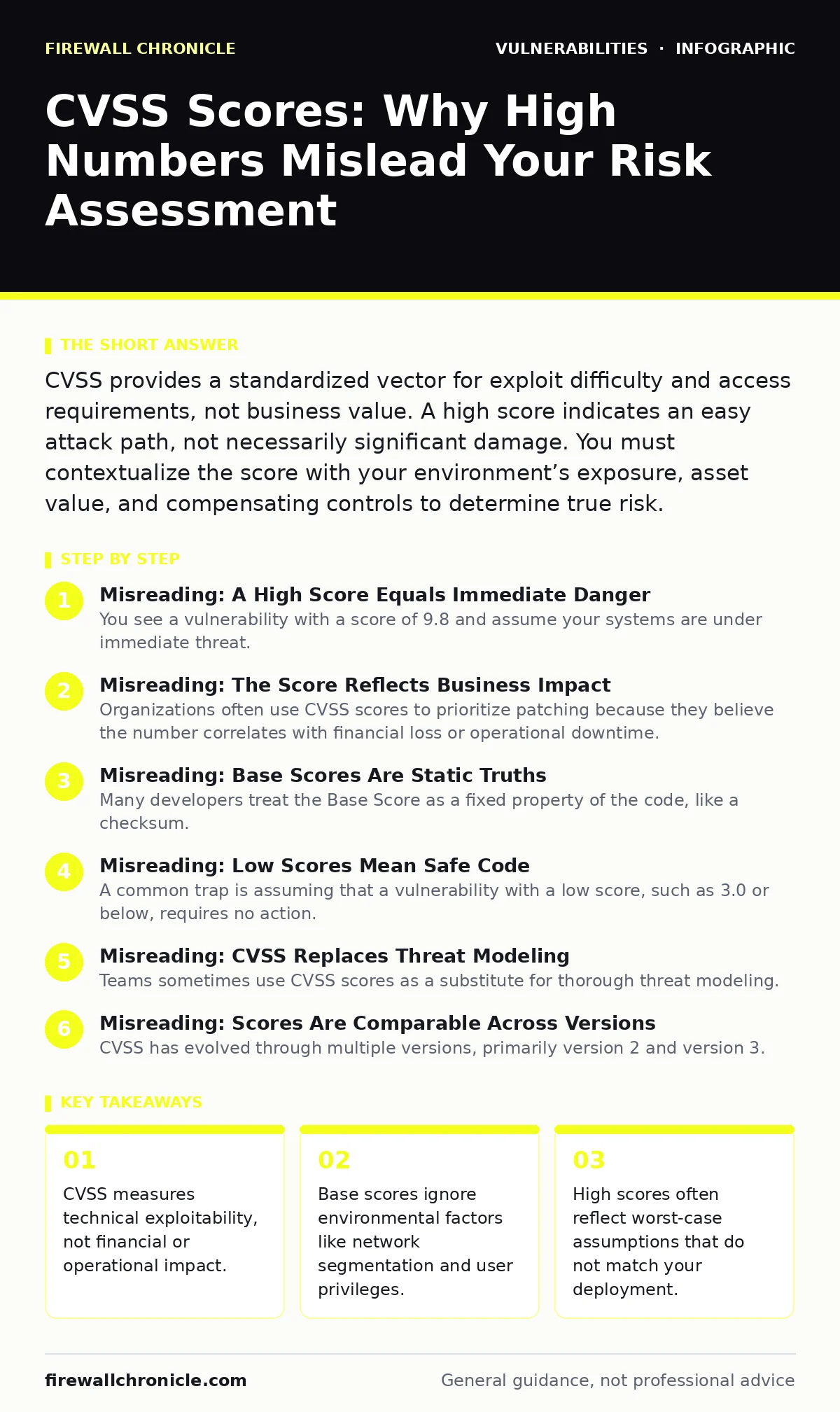
Misreading: The Score Reflects Business Impact
Organizations often use CVSS scores to prioritize patching because they believe the number correlates with financial loss or operational downtime. This is a fundamental error. CVSS does not know what data you store, how much revenue a service generates, or how critical a component is to your workflow.
Imagine a logging library with a critical score that allows remote code execution. If that library runs in a disposable container with no access to databases or user sessions, the business impact is minimal. Conversely, a low-score vulnerability in a core authentication module might cause severe reputational damage if exploited. The score measures the mechanics of the exploit, not the value of the asset.
Correct reading: Separate technical severity from business impact. Use the CVSS score to understand the technical effort required for an attacker. Then, apply your own risk model to determine the business consequence. A vulnerability with a moderate score affecting a customer database is often more dangerous than a critical score affecting a public-facing static page. This approach aligns security efforts with actual organizational priorities.
Misreading: Base Scores Are Static Truths
Many developers treat the Base Score as a fixed property of the code, like a checksum. They do not realize that CVSS includes Environmental and Temporal metrics that significantly alter the final score. Ignoring these adjustments leads to a rigid view of risk that fails to adapt to new evidence or specific configurations.
The Temporal Score adjusts for the maturity of the exploit and the availability of patches. If a proof-of-concept code is released, the score drops because the exploit is no longer theoretical. The Environmental Score adjusts for your specific environment, such as confidentiality requirements or remediation levels. A vulnerability might be critical in a default configuration but moderate in a hardened setup.
Correct reading: Always calculate the Environmental Score when possible. This metric allows you to adjust the vector based on your network segmentation, the sensitivity of the data, and the presence of mitigating controls. By using the Environmental Score, you translate a generic technical assessment into a specific risk profile for your infrastructure. This prevents over-prioritizing issues that your architecture already mitigates.
Misreading: Low Scores Mean Safe Code
A common trap is assuming that a vulnerability with a low score, such as 3.0 or below, requires no action. This mindset ignores the context of privilege escalation and lateral movement. A low-score vulnerability might only require local access, but if an attacker has already breached the perimeter, that local access is a stepping stone.
Suppose you have a minor information disclosure flaw with a low score. An attacker uses this to gather system details that help them craft a more sophisticated attack against a higher-value target. The low score reflects the limited immediate impact, not the strategic value of the information. Furthermore, low scores often indicate vulnerabilities that require user interaction, which can be bypassed through social engineering or phishing.
Correct reading: Evaluate low-score vulnerabilities in the context of defense in depth. Even if a flaw is hard to exploit or has limited impact, it can weaken your overall security posture. Review low-score issues for their potential to aid in reconnaissance or privilege escalation. In environments with strict compliance requirements, even minor information leaks may require remediation regardless of the technical severity score.
Misreading: CVSS Replaces Threat Modeling
Teams sometimes use CVSS scores as a substitute for thorough threat modeling. They assume that if a vulnerability has a low score, it does not need to be considered in the design phase. This approach misses the nuance of how vulnerabilities interact within a complex system.
Threat modeling identifies potential attack paths and assesses the likelihood and impact of various scenarios. CVSS scores individual flaws. A system might have many low-score vulnerabilities that, when combined, create a high-risk attack chain. For example, a low-sequence injection flaw might allow an attacker to manipulate parameters that trigger a more severe issue elsewhere. This concept relates to parameterized queries, where proper input handling prevents the initial foothold.
Correct reading: Use CVSS as one input in your risk assessment, not the sole determinant. Combine scoring with threat modeling to understand how vulnerabilities chain together. Consider how a minor flaw in one component might expose a critical component. This holistic view reveals risks that isolated scores hide. It ensures you address the system as a whole, rather than just fixing individual lines of code.
See also: Threat Modeling Cybersecurity: How to Map Attack Paths Before Code
Misreading: Scores Are Comparable Across Versions
CVSS has evolved through multiple versions, primarily version 2 and version 3. Comparing scores across these versions is misleading because the calculation formulas and metrics have changed significantly. A score of 7.5 in CVSS v2.0 does not carry the same weight as a 7.5 in CVSS v3.1.
CVSS v3.0 introduced metrics for scope change and user interaction, which altered how many vulnerabilities were scored. Many vulnerabilities that were considered critical in v2.0 dropped to high or medium in v3.0 because the new formula better reflected the actual exploitability. Using mixed versions in your tracking tools creates inconsistent prioritization and confuses risk reporting.
Correct reading: Ensure all your tools and processes use the same CVSS version, preferably the latest stable release. Do not compare historical scores from older versions with new findings without converting them. Understand the specific metrics of the version you are using. This consistency ensures that your prioritization logic remains stable and that your risk assessments are based on a uniform standard.
Misreading: The Score Dictates Patch Priority
Automated systems often prioritize patching based solely on CVSS scores. This creates a queue where high-score items are addressed first, regardless of business context. This approach can delay patches for moderate-score vulnerabilities that affect critical business functions while expediting patches for critical-score flaws in unused components.
Imagine a high-score vulnerability in a legacy application that is scheduled for decommissioning next month. Patching it consumes engineering time that could be spent on a moderate-score vulnerability in a revenue-generating service. The score does not account for the lifecycle of the asset or the cost of remediation. Blindly following the score leads to inefficient resource allocation.
Correct reading: Combine CVSS scores with asset criticality and remediation effort to determine patch priority. A simple matrix that plots technical severity against business impact provides a clearer picture. This method ensures that you address risks that matter to your organization, rather than just those that look bad on paper. It balances technical rigor with operational reality.
Key takeaways
- CVSS measures technical exploitability, not financial or operational impact.
- Base scores ignore environmental factors like network segmentation and user privileges.
- High scores often reflect worst-case assumptions that do not match your deployment.
- Environmental and Temporal metrics adjust the base score to reflect reality.
Frequently asked questions
Should I patch every vulnerability with a CVSS score above 7.0?
No. Consider the exposure of the affected component and the business impact. A high score on an internal, segmented system may require less urgent attention than a moderate score on a public-facing endpoint.
How do Environmental Scores differ from Base Scores?
Base Scores reflect the inherent characteristics of the vulnerability. Environmental Scores adjust this value based on your specific environment, such as network security, data sensitivity, and existing mitigations.
Can I trust CVSS scores from third-party scanners?
Scanners provide automated assessments that may not reflect your specific configuration. Always verify the findings and adjust the score using Environmental metrics to account for your actual deployment.
Does a CVSS score of 0.0 mean the code is secure?
No. A score of 0.0 typically means the vulnerability could not be scored or is not applicable. It does not guarantee the absence of other flaws. Security is a continuous process, not a single metric.
How this guide was produced: written by the Firewall Chronicle editorial team with AI assistance, checked against the public references listed below, and reviewed when the facts change. See our editorial policy or report an error.