Asset Inventory for Patching: 9 Questions Answered
Patching fails when the inventory omits ephemeral containers and shadow IT, creating blind spots that attackers exploit before remediation begins.
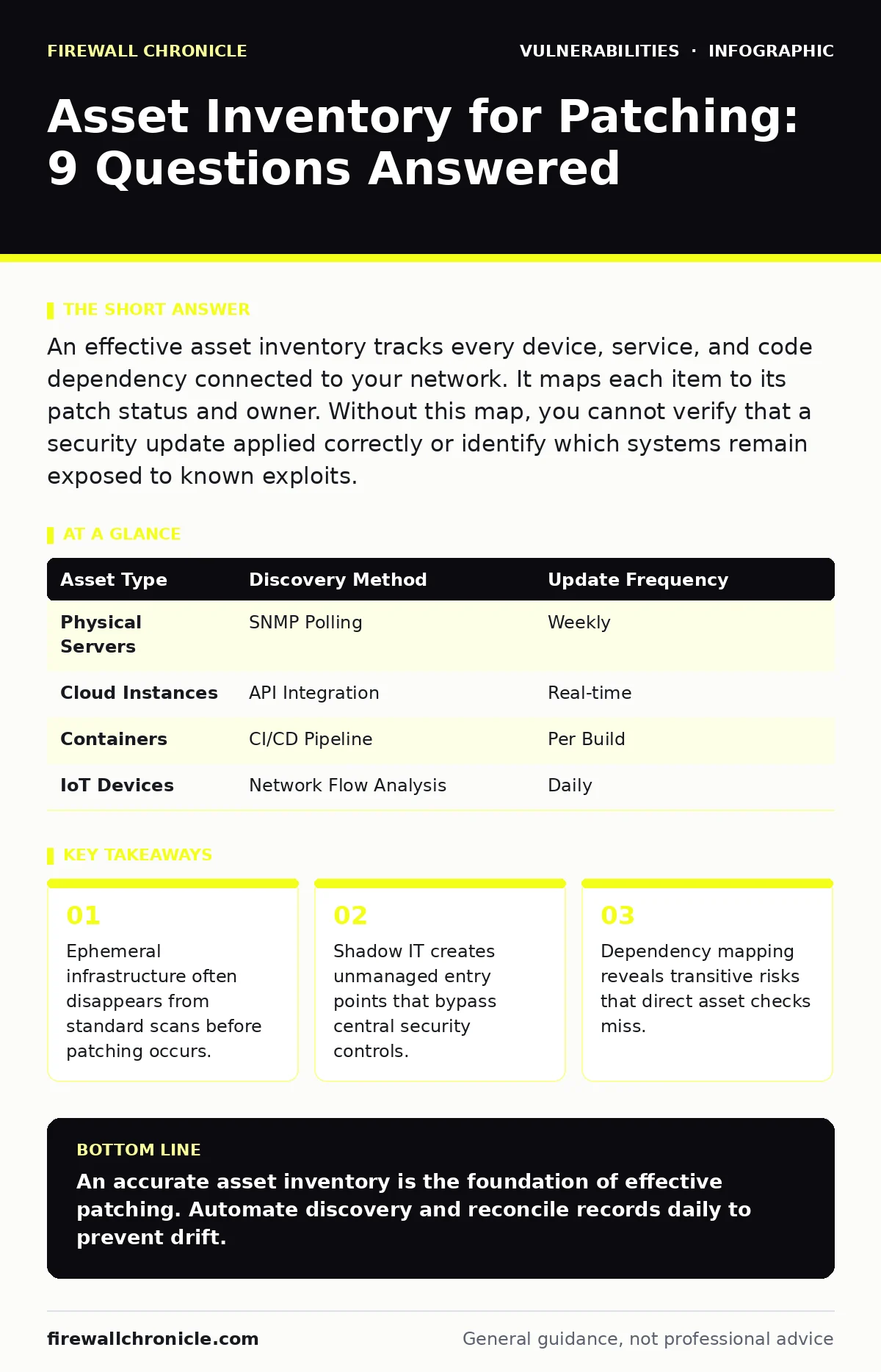
An effective asset inventory tracks every device, service, and code dependency connected to your network. It maps each item to its patch status and owner. Without this map, you cannot verify that a security update applied correctly or identify which systems remain exposed to known exploits.
What defines a complete asset inventory for patching?
A complete inventory lists every hardware device, software application, cloud instance, and third-party service connected to your network. It includes metadata such as version numbers, owners, and criticality ratings. This list serves as the single source of truth for remediation efforts. Without it, you patch known assets while leaving invisible components exposed to attack.
How do you discover shadow IT assets?
You discover shadow IT by correlating network traffic logs with authorized asset lists. Look for outbound connections to unknown cloud endpoints or unusual DNS queries. Monitor for authentication attempts from unrecognized device fingerprints. These signals reveal devices that operate outside your central management scope. Ignoring them leaves gaps that attackers exploit to pivot into your core systems.
Why do ephemeral containers escape standard inventories?
Ephemeral containers start and stop rapidly, often existing for minutes rather than months. Traditional scanning tools run on fixed schedules and miss these short-lived instances. You must integrate scanning into the deployment pipeline to capture the image hash before runtime. This approach ensures you verify the integrity of every container layer. See our guide on container escape vulnerabilities to understand how unpatched base images enable privilege escalation.
How do you track software dependencies accurately?
You track dependencies by generating a software bill of materials (SBOM) for each application. This document lists every library and module, including those nested within other libraries. Transitive dependencies often introduce risks that direct checks miss. You must update the SBOM whenever code changes. This practice prevents supply chain attacks where a compromised library affects your entire application stack.
What is the role of criticality in patch prioritization?
Criticality determines which assets require immediate patching based on their exposure and data sensitivity. Not all systems hold equal value. Public-facing servers demand faster remediation than isolated development machines. Assigning risk scores helps you allocate limited engineering resources effectively. This prioritization prevents burnout and ensures high-value targets remain secure. Review our analysis of vulnerabilities in VPN gateways and application delivery controllers to see how edge devices often carry disproportionate risk.
See also: Log Management Mistakes That Blind Your Security Monitoring
How do you handle legacy systems that cannot patch?
You handle legacy systems by isolating them from the general network and applying strict access controls. When vendors stop supporting software, you cannot apply standard updates. You must segment these assets using virtual local area networks or firewalls. Monitor their traffic closely for anomalies. This containment strategy reduces the attack surface while you plan for replacement.
What causes inventory drift over time?
Inventory drift occurs when assets change state without updating the central record. Developers may spin up test instances, or cloud auto-scaling groups may create new nodes. Manual updates lag behind these changes. You must automate discovery through agent-based tools or API integrations with cloud providers. Regular reconciliation checks ensure the inventory matches reality. Without automation, your patching efforts target a ghost map.
| Asset Type | Discovery Method | Update Frequency |
|---|---|---|
| Physical Servers | SNMP Polling | Weekly |
| Cloud Instances | API Integration | Real-time |
| Containers | CI/CD Pipeline | Per Build |
| IoT Devices | Network Flow Analysis | Daily |
How do you verify patch application success?
You verify success by scanning for the presence of the updated version and the absence of the vulnerability signature. Rebooting alone does not guarantee that the patch loaded correctly. Some services require manual restarts to apply changes. You must test the system functionality after patching to ensure stability. This validation step prevents outages caused by incompatible updates.
What is the hidden cost of incomplete inventories?
The hidden cost is the time spent investigating false positives and missed breaches. When an incident occurs, responders waste hours determining which systems are affected. An incomplete inventory forces manual verification of every potential target. This delay allows attackers to expand their foothold. Accurate records reduce mean time to detect and respond. They also simplify compliance audits by providing auditable proof of due diligence.
How do you manage third-party service risks?
You manage third-party risks by requiring vendors to provide their own SBOMs and patch status reports. You cannot patch services you do not control, but you can monitor their public security advisories. Establish contracts that mandate timely remediation of critical flaws. If a vendor fails to patch, you must mitigate the risk through network segmentation or alternative providers. This approach shifts some security burden to the supplier.
Key takeaways
- Ephemeral infrastructure often disappears from standard scans before patching occurs.
- Shadow IT creates unmanaged entry points that bypass central security controls.
- Dependency mapping reveals transitive risks that direct asset checks miss.
An accurate asset inventory is the foundation of effective patching. Automate discovery and reconcile records daily to prevent drift.
Frequently asked questions
How often should I scan for new assets?
Scan for new assets in real-time using API integrations with cloud providers and network monitoring tools. Weekly scans leave too large a window for shadow IT to operate undetected.
Can I use open-source tools for inventory management?
Yes, open-source tools can map assets if you integrate them with your deployment pipelines. You must ensure they handle ephemeral resources and update their databases frequently to avoid drift.
What is the difference between an asset inventory and an SBOM?
An asset inventory lists hardware and software instances, while an SBOM lists the code components within a specific software application. Both are necessary for comprehensive patching.
How do I handle patching for IoT devices?
IoT devices often lack standard update mechanisms. You must isolate them on separate networks and monitor for firmware anomalies. See our guide on **IoT device patching** for detailed segmentation strategies.
How this guide was produced: written by the Firewall Chronicle editorial team with AI assistance, checked against the public references listed below, and reviewed when the facts change. See our editorial policy or report an error.