
Container Escape Vulnerabilities: How Breaches Bypass Isolation
Container escapes occur when an attacker exploits the shared kernel to break isolation, granting full host access rather than just container privileges.
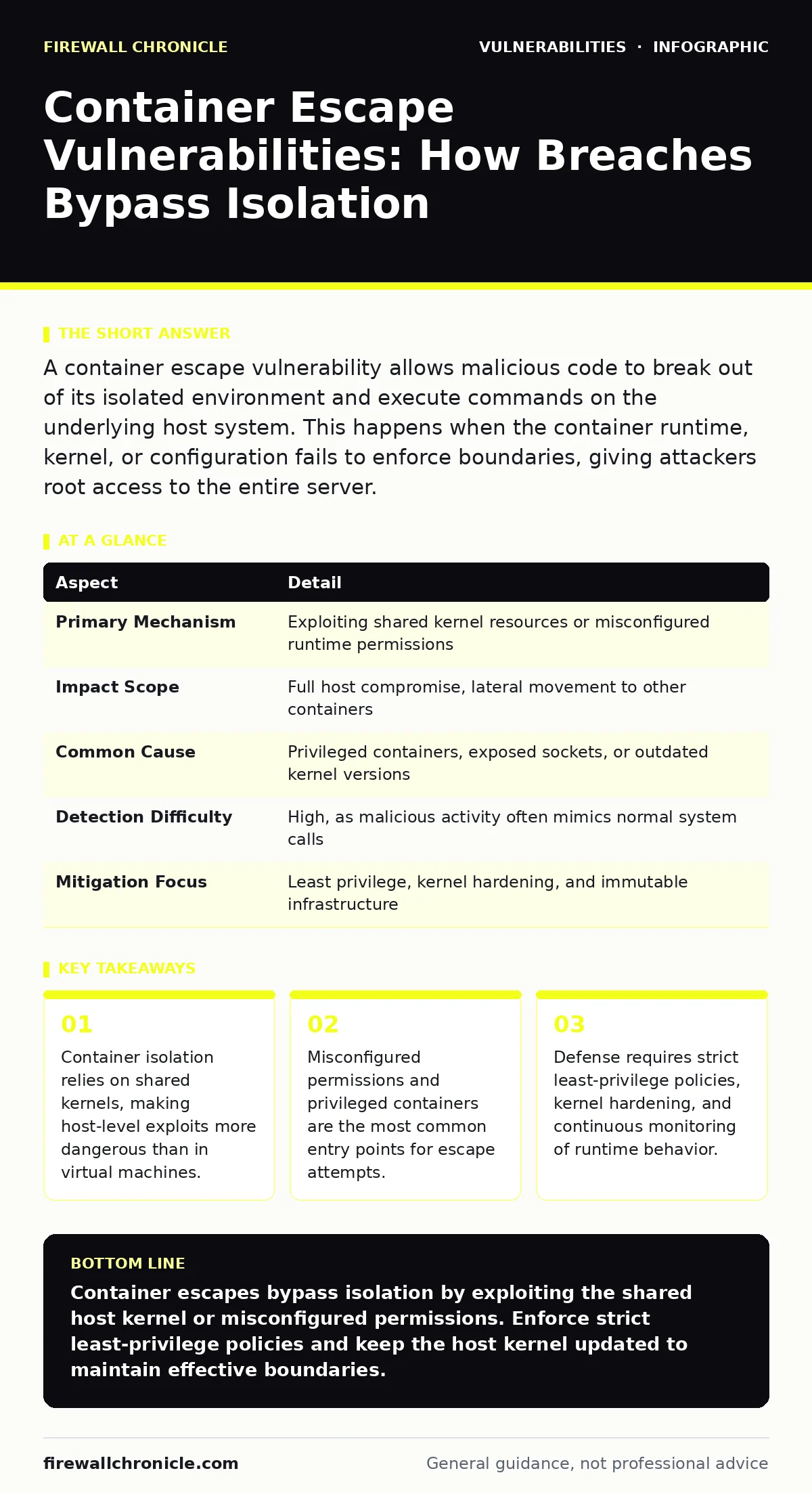
A container escape vulnerability allows malicious code to break out of its isolated environment and execute commands on the underlying host system. This happens when the container runtime, kernel, or configuration fails to enforce boundaries, giving attackers root access to the entire server.
The Illusion of Separation
Imagine a hotel where every guest room shares the same plumbing, electrical wiring, and structural foundation. If a guest drills through the wall, they do not just enter the next room; they access the building’s core infrastructure. Containers operate similarly. They provide process isolation, not hardware isolation. The guest operating system is stripped away, leaving only the application and its libraries. This efficiency creates a single point of failure: the host kernel. When that kernel is compromised, every container on that host falls immediately.
| Aspect | Detail |
|---|---|
| Primary Mechanism | Exploiting shared kernel resources or misconfigured runtime permissions |
| Impact Scope | Full host compromise, lateral movement to other containers |
| Common Cause | Privileged containers, exposed sockets, or outdated kernel versions |
| Detection Difficulty | High, as malicious activity often mimics normal system calls |
| Mitigation Focus | Least privilege, kernel hardening, and immutable infrastructure |
Why Escapes Happen
Container escape vulnerabilities arise when the boundary between the container and the host dissolves. Developers often assume the container runtime enforces strict separation. In reality, the runtime relies on operating system features like namespaces and cgroups. Namespaces isolate process trees, network stacks, and filesystem views. Cgroups limit resource usage. If an attacker finds a flaw in how these features are implemented, or if the configuration grants excessive access, they can step outside their designated namespace. The result is direct interaction with the host file system and network interfaces.
Who Faces the Risk
Any organization running containers on shared infrastructure faces this risk. Multi-tenant cloud environments are particularly vulnerable because a breach in one tenant’s container can affect others. Internal development teams often run containers with elevated privileges for debugging. This practice creates a permanent attack surface. If a developer’s workstation is compromised, the attacker inherits those high privileges. The risk extends to CI/CD pipelines that build and run containers. A compromised build agent can inject malicious layers into images, which then execute with host-level access during deployment.
Common Forms of Escape
Attackers use several methods to break isolation. One common form involves exploiting kernel vulnerabilities. Since all containers share the host kernel, a bug in the kernel affects every container. Another method targets container runtimes. Flaws in how Docker or containerd handle image extraction or process spawning can allow code execution on the host. A third form relies on misconfigurations. Mounting the host’s root filesystem or exposing the Docker socket inside a container gives direct control. These mistakes are frequent because they are often required for legitimate administrative tasks, blurring the line between convenience and security.
What People Usually Get Wrong
Many teams believe that container security is solely about image scanning. They scan for known vulnerabilities in libraries but ignore runtime behavior. This approach misses escape attempts that exploit configuration or kernel bugs. Another misconception is that user namespaces fully protect against escapes. While user namespaces map container users to unprivileged host users, they do not prevent kernel exploits. Attackers can still trigger crashes or memory corruption in the kernel. Furthermore, teams often overlook the risk of shared volumes. Even if the container process is restricted, a writable volume can contain scripts that execute on the host if other services mount it.
Reducing the Risk
Mitigating container escape vulnerabilities requires a defense-in-depth strategy. Start by enforcing least privilege. Never run containers as root. Use read-only root filesystems and drop unnecessary Linux capabilities. Capabilities are a subset of root privileges. Dropping them reduces the attack surface. Next, harden the host kernel. Keep the kernel updated to patch known vulnerabilities. Enable security modules like SELinux or AppArmor to enforce mandatory access controls. These modules restrict what processes can do, regardless of their user identity. Regularly audit container configurations. Check for exposed sockets, privileged flags, and host mounts.
Integrate security into the development lifecycle. Use tools that scan for misconfigurations in Dockerfiles and Kubernetes manifests. Implement policy enforcement that blocks deployment of non-compliant containers. Monitor runtime behavior for anomalies. Look for unexpected system calls or network connections. If a container tries to access the host filesystem, alert immediately. Finally, consider using virtual machines for high-risk workloads. VMs provide hardware-level isolation, making kernel exploits much harder to exploit. This trade-off between performance and security is worth considering for sensitive data.
The Hidden Cost of Convenience
Developers often disable security features to speed up debugging. They run containers in privileged mode to bypass permission errors. This convenience creates a hidden cost. When a breach occurs, the attacker has full control. Remediation becomes complex and time-consuming. The cost of a single container escape can exceed years of development time. Teams must balance speed with security. Automated testing can catch misconfigurations early. Security policies should be enforced automatically, not manually. This ensures that convenience does not compromise the integrity of the entire infrastructure.
Beyond Basic Isolation
Container security is not just about the container itself. It involves the entire stack. The host operating system, the kernel, the runtime, and the orchestration layer all play a role. Misconfigurations in any layer can lead to an escape. Teams must understand the dependencies. For example, a vulnerability in a VPN gateway might allow an attacker to reach the internal network, where they can target containers. Similarly, cross-site scripting (XSS) in a web application running in a container might not directly cause an escape, but it can lead to credential theft. These credentials can then be used to access the container management API.
Final Considerations
Securing containers requires continuous effort. New vulnerabilities are discovered regularly. Kernel updates are frequent. Policies must evolve. Teams should establish a routine for reviewing container configurations. Regular audits help identify drift from security baselines. Training developers on secure container practices is also critical. They need to understand why certain configurations are dangerous. Knowledge reduces the likelihood of accidental misconfigurations. By treating container security as a shared responsibility, organizations can significantly reduce the risk of escape vulnerabilities.
Key takeaways
- Container isolation relies on shared kernels, making host-level exploits more dangerous than in virtual machines.
- Misconfigured permissions and privileged containers are the most common entry points for escape attempts.
- Defense requires strict least-privilege policies, kernel hardening, and continuous monitoring of runtime behavior.
Container escapes bypass isolation by exploiting the shared host kernel or misconfigured permissions. Enforce strict least-privilege policies and keep the host kernel updated to maintain effective boundaries.
Frequently asked questions
Do container escapes only happen in cloud environments?
No, container escapes can occur in any environment where containers share a host kernel, including on-premises servers and personal development machines.
Can antivirus software prevent container escapes?
Traditional antivirus software is not designed to detect kernel exploits or runtime misconfigurations. Specialized container security tools and host-based intrusion detection are more effective.
How do I know if my container has been escaped?
Look for unexpected processes running on the host, new user accounts, or modified system files. Runtime monitoring tools can alert on anomalous system calls or network activity.
Are virtual machines safer than containers?
Yes, virtual machines provide hardware-level isolation, making kernel exploits significantly harder to exploit. However, VMs have higher resource overhead and slower startup times.
How this guide was produced: written by the Firewall Chronicle editorial team with AI assistance, checked against the public references listed below, and reviewed when the facts change. See our editorial policy or report an error.