Stop Network Enumeration: Hardening Measures That Actually Work
Most enumeration defenses fail because they rely on hiding services, which attackers bypass by observing protocol behavior rather than port states.
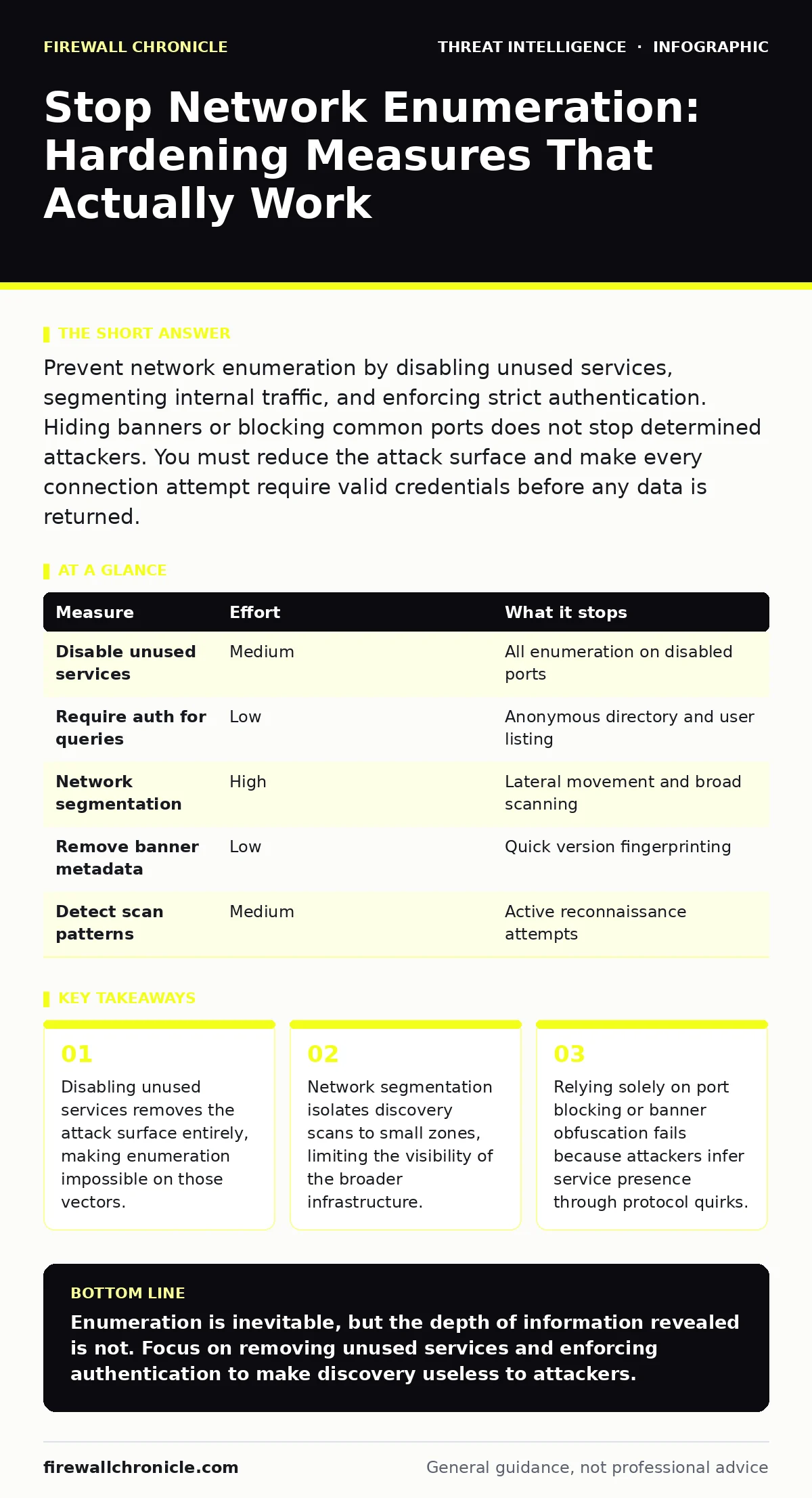
Prevent network enumeration by disabling unused services, segmenting internal traffic, and enforcing strict authentication. Hiding banners or blocking common ports does not stop determined attackers. You must reduce the attack surface and make every connection attempt require valid credentials before any data is returned.
Eliminate the Attack Surface First
The most effective defense against network enumeration is removing the target itself. If a service is not running, it cannot be enumerated. Many environments keep legacy services enabled for convenience or forgotten compatibility requirements. These services expose metadata, version strings, and protocol behaviors that help attackers build a map of your infrastructure.
Audit your systems and disable any service that does not directly support a current business function. This includes unused RPC endpoints, legacy management interfaces, and default administrative ports. When you stop the service, you do not just hide it; you remove the memory footprint and the code path that could contain vulnerabilities. This approach is foundational to security metrics that measure exposure risk.
Enforce Authentication Before Discovery
Standard network services often allow anonymous queries. An attacker can ask an SMTP server for its hostname or query an LDAP directory for user lists without providing credentials. This is known as anonymous enumeration. You must configure services to require authentication before they respond to any query, even simple ones.
For directory services, disable anonymous bind. For file shares, require explicit login before listing contents. This forces an attacker to guess credentials before they can learn anything about the system structure. It shifts the effort from easy scanning to difficult brute-forcing. This principle complements strategies used to prevent AS-REP roasting, where weak authentication policies allow ticket retrieval without passwords.
Segment Internal Traffic
Internal networks are often flat, meaning a compromised device can see all other devices. This allows an attacker to perform lateral enumeration, mapping the entire enterprise from a single foothold. Segment your network into smaller zones based on function or sensitivity.
Use firewalls or VLANs to restrict traffic between these zones. A development server should not be able to ping a database server unless explicitly required. When you limit connectivity, you limit the scope of any enumeration attempt. An attacker who compromises one zone can only enumerate that zone. This containment strategy is a core component of effective log management, as it reduces noise and clarifies the context of alerts.
Hide Metadata and Banners
Many services respond with version numbers and software details in their initial handshake. This is called banner grabbing. Attackers use this information to identify specific vulnerabilities associated with that software version. Configure your services to return generic or empty banners.
For web servers, remove the Server header that reveals the software name and version. For SSH, change the identification string to a generic value. This does not stop the attacker from seeing that a service is running, but it removes the shortcut to finding known exploits. It forces them to use slower, more noisy techniques to fingerprint the software.
Detect and Alert on Scan Patterns
You cannot stop all traffic, so you must recognize malicious patterns. Enumeration often involves rapid, sequential connection attempts or requests for non-existent resources. Configure your intrusion detection systems to alert on these behaviors.
Look for spikes in connection failures, unusual port scanning sequences, or repeated queries for non-existent users. Integrate these alerts with your Windows event log monitoring to correlate network activity with system-level events. When you detect an active scan, you can block the source IP or isolate the affected segment. This proactive detection is critical for breach and attack simulation programs that test your visibility.
See also: Port Scan Response: Containment, Recovery, and Prevention Steps · VPN Gateway and ADC Vulnerabilities: The Hidden Risks in Network Perimeters
What Does Not Work: Obfuscation Alone
A common mistake is relying on port knocking or changing standard ports to obscure services. This is known as security through obscurity. It adds a layer of confusion but does not remove the vulnerability. Attackers routinely scan all 65,535 ports. They will find your service regardless of the port number.
Port knocking requires a specific sequence of connections before a port opens. If an attacker watches the network, they can capture this sequence and replay it. It adds complexity for legitimate users while providing minimal security. Do not invest time in configuring knockd or similar tools as a primary defense. Instead, focus on the measures above that reduce the attack surface and enforce authentication.
| Measure | Effort | What it stops |
|---|---|---|
| Disable unused services | Medium | All enumeration on disabled ports |
| Require auth for queries | Low | Anonymous directory and user listing |
| Network segmentation | High | Lateral movement and broad scanning |
| Remove banner metadata | Low | Quick version fingerprinting |
| Detect scan patterns | Medium | Active reconnaissance attempts |
The Hidden Cost of Complexity
Each defensive measure adds complexity to your environment. Complex systems are harder to manage and more prone to configuration errors. When you segment networks, you must document allowed traffic flows. When you disable services, you must verify that no business process depends on them.
This complexity can lead to "alert fatigue" if your detection tools generate too many false positives. You must tune your detection rules to reflect your normal traffic patterns. Regularly review your configurations to ensure they align with your current business needs. This alignment is often discussed in ISACs where organizations share best practices for balancing security and operations.
Checklist for Today
Use this checklist to immediately reduce your exposure to network enumeration. These steps require minimal effort but provide significant risk reduction.
- Identify and disable three unused services on a critical server.
- Configure one public-facing service to require authentication for all queries.
- Remove version information from the banner of one web or mail server.
Key takeaways
- Disabling unused services removes the attack surface entirely, making enumeration impossible on those vectors.
- Network segmentation isolates discovery scans to small zones, limiting the visibility of the broader infrastructure.
- Relying solely on port blocking or banner obfuscation fails because attackers infer service presence through protocol quirks.
Enumeration is inevitable, but the depth of information revealed is not. Focus on removing unused services and enforcing authentication to make discovery useless to attackers.
Frequently asked questions
Does changing default ports stop network enumeration?
No, attackers scan all ports. Changing ports only hides the service from casual lookups, not from automated scanning tools that check every possible port.
How do I know if a service is vulnerable to enumeration?
Test the service from an untrusted network. If you can receive data about the system, such as user lists or version numbers, without providing credentials, it is vulnerable.
Is network segmentation too difficult for small teams?
It requires planning but is manageable. Start by isolating the most sensitive data from general user traffic. Use existing firewall rules to create basic segments before expanding.
Can I use a single tool to prevent all enumeration?
No, enumeration is a technique, not a single vulnerability. You need a combination of configuration hardening, network design, and monitoring to effectively mitigate the risk.
How this guide was produced: written by the Firewall Chronicle editorial team with AI assistance, checked against the public references listed below, and reviewed when the facts change. See our editorial policy or report an error.