Log Management and Analysis: Turning Noise into Signal
Most teams waste storage on raw data while missing the correlation context that actually reveals an active intrusion attempt.
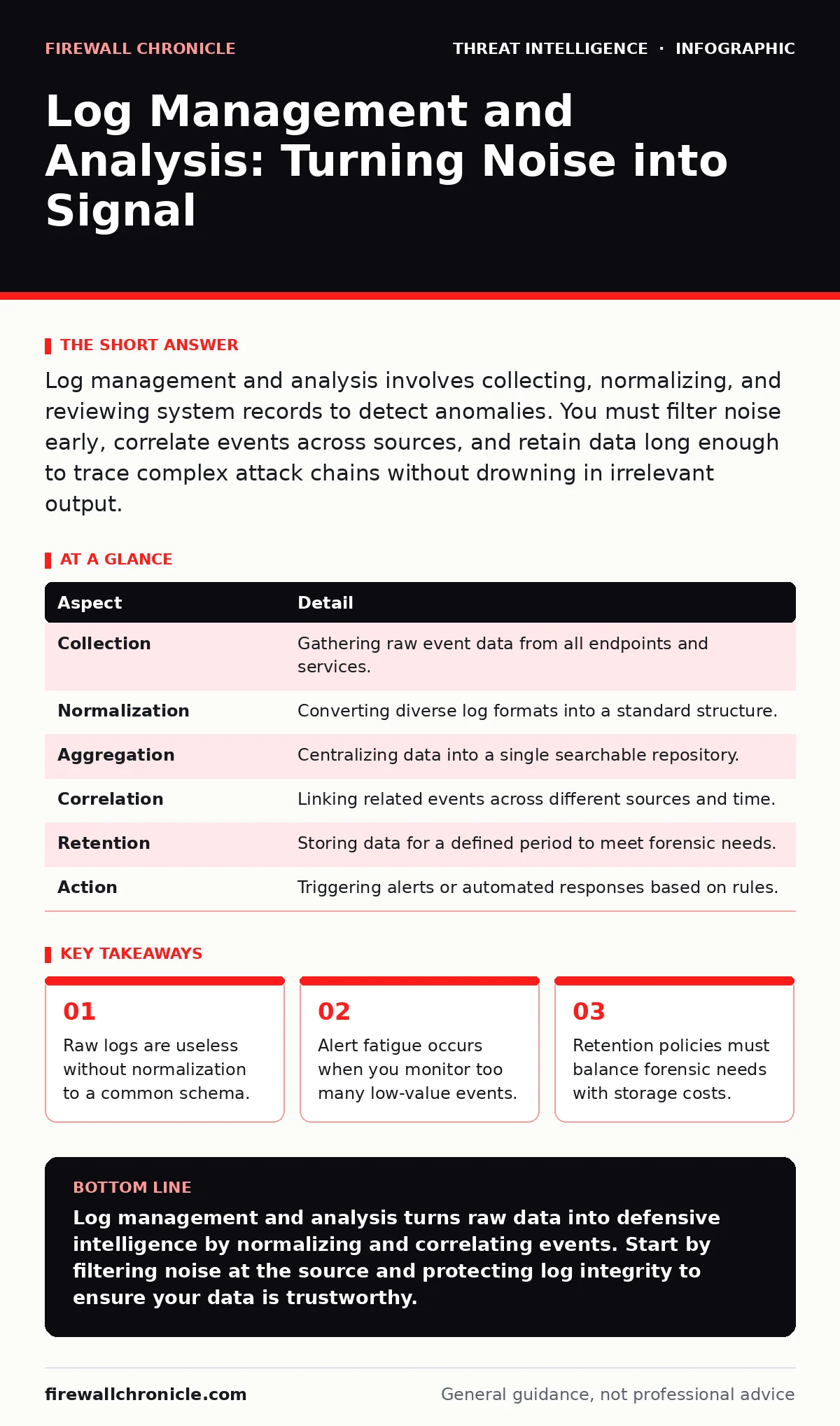
Log management and analysis involves collecting, normalizing, and reviewing system records to detect anomalies. You must filter noise early, correlate events across sources, and retain data long enough to trace complex attack chains without drowning in irrelevant output.
The Value of Digital Footprints
Imagine a busy airport security checkpoint. Every passenger leaves a trace: a boarding pass scan, a metal detector beep, and a bag X-ray. Individually, these data points seem random. A beep might just be a belt buckle. A bag might contain a laptop. But when you combine the boarding pass time, the specific lane used, and the X-ray image, patterns emerge. A person who scanned a ticket but never entered the gate is an anomaly.
Log management and analysis works the same way for your infrastructure. Every server, application, and network device generates records of activity. These records are the digital equivalent of boarding passes. Without a system to collect and correlate them, you are looking at isolated noise. With proper analysis, you see the full journey of a user or an attacker. This process transforms raw data into actionable intelligence.
At a Glance
| Aspect | Detail |
|---|---|
| Collection | Gathering raw event data from all endpoints and services. |
| Normalization | Converting diverse log formats into a standard structure. |
| Aggregation | Centralizing data into a single searchable repository. |
| Correlation | Linking related events across different sources and time. |
| Retention | Storing data for a defined period to meet forensic needs. |
| Action | Triggering alerts or automated responses based on rules. |
How Log Management and Analysis Works
The process begins with collection. You must capture events from operating systems, databases, firewalls, and applications. Each source produces logs in a different format. Windows Event Logs differ from Linux syslog entries. Cloud providers use JSON structures. If you leave them as-is, you cannot search them efficiently.
Normalization is the critical next step. You map fields from each source to a common schema. For example, you might map "src_ip" from a firewall log to "source_address" in your central index. This allows you to query all sources using the same terminology. Without normalization, you must write separate queries for every device type.
Aggregation brings these normalized logs into a central platform. This platform must handle high volume and provide fast search capabilities. Once aggregated, you apply correlation rules. These rules look for sequences of events that indicate a problem. A single failed login is normal. Five failed logins from different countries in one minute is not.
Finally, you analyze the results. This involves reviewing alerts, investigating false positives, and refining your rules. The goal is to reduce the time between an incident starting and you detecting it. This cycle continues as your environment changes. New applications introduce new log sources. New threats require new correlation rules.
Who It Affects and Why It Matters
Every organization with digital infrastructure is affected by poor log management. If you cannot prove what happened, you cannot defend yourself. Legal teams need logs for compliance audits. Security teams need them for incident response. Development teams need them for debugging application errors.
Suppose a developer pushes code that introduces a SQL injection vulnerability. An attacker exploits it to access a database. Without logs, you might only notice when data disappears. With proper log management and analysis, you see the malicious query, the source IP, and the time of execution. You can stop the attack before significant damage occurs.
This capability also affects your ability to understand normal behavior. Baseline activity helps you spot anomalies. If a server usually sends 100 megabytes of data per hour, a sudden spike to 10 gigabytes is suspicious. You need historical data to establish this baseline. Retaining logs for only 24 hours prevents you from seeing long-term trends.
What People Usually Get Wrong
Many teams treat log management as a storage problem. They collect everything and hope to find something useful later. This approach fails because volume increases exponentially. You will run out of disk space or budget before you find the needle in the haystack. You must filter at the source. Drop debug logs that are never used. Keep only events that have security or operational value.
Another common mistake is ignoring log integrity. Attackers know you will look at logs first. They often disable logging or overwrite entries to cover their tracks. If your logging system is not protected, your data is untrusted. You must ensure logs are sent to a remote, write-once storage immediately. Local logs alone are insufficient for forensic investigations.
Teams also fail to normalize data properly. They rely on vendor-specific formats or custom scripts. This creates technical debt. When a vendor changes their log format, your entire analysis pipeline breaks. Using open standards for log structure prevents this fragility. It also makes it easier to switch tools in the future.
See also: Port Scan Response: Containment, Recovery, and Prevention Steps · Sysmon Event ID 11: Decoding Process Access for Defense
Common Pitfalls in Analysis
Alert fatigue is the silent killer of security operations. If your system generates 1,000 alerts a day, analysts will ignore them. You must tune your rules to reduce noise. Start with high-fidelity alerts that require immediate action. Gradually add more complex rules as your team matures.
Context is often missing from alerts. An alert saying "failed login" is useless. An alert saying "failed login from a known malicious IP followed by a successful login from the same IP" is actionable. You must enrich logs with external data. Threat intelligence feeds can label IPs as malicious. User directory services can tell you if an account is disabled.
Integrating with Broader Security
Log management does not exist in a vacuum. It feeds into other security practices. For instance, SIEM platforms rely on normalized logs to function effectively. Without good data, a SIEM is just an expensive search engine. You should also consider how logs support breach and attack simulation. These tests generate specific log patterns that you can use to validate your detection rules.
When investigating an incident, you often look for signs of attacker reconnaissance. Port scanning attempts leave traces in firewall logs. Failed authentication attempts appear in system logs. Correlating these events helps you identify the early stages of an attack. This is critical for stopping threats before they escalate to golden ticket attacks or other advanced techniques.
You might also see logs related to AS-REP roasting attempts. These are specific authentication attacks that leave distinct signatures in domain controller logs. If your analysis pipeline can detect these patterns, you can respond quickly. This integration shows that log management is the foundation of a mature security program. It supports everything from daily monitoring to complex threat hunting.
What To Do About It
Start by identifying your critical assets. Not all systems are equal. Focus your collection efforts on servers, databases, and network devices that hold sensitive data. Define what success looks like. Do you need to detect brute force attacks? Do you need to track data exfiltration? Build your rules around these specific goals.
Implement a retention policy that balances cost and need. Keep raw logs for a shorter period. Keep aggregated and anonymized data for longer. This reduces storage costs while preserving forensic value. Ensure your logs are immutable. Use write-once-read-many storage to prevent tampering.
Regularly review and update your correlation rules. Threats evolve, and so should your defenses. Test your rules against known attack patterns. Use security metrics to measure your effectiveness. Track mean time to detect and mean time to respond. These metrics help you justify investments and identify gaps.
Key takeaways
- Raw logs are useless without normalization to a common schema.
- Alert fatigue occurs when you monitor too many low-value events.
- Retention policies must balance forensic needs with storage costs.
Log management and analysis turns raw data into defensive intelligence by normalizing and correlating events. Start by filtering noise at the source and protecting log integrity to ensure your data is trustworthy.
Frequently asked questions
How long should I keep my logs?
Keep raw logs for 90 to 365 days depending on compliance needs. Store aggregated, anonymized data for several years to support long-term trend analysis and forensic investigations.
Do I need a SIEM for log management?
You do not strictly need a commercial SIEM. You can use open-source tools or custom pipelines. However, a SIEM provides built-in correlation and alerting features that simplify the process.
How do I handle log volume?
Filter logs at the source to drop low-value events. Use sampling for high-volume, low-risk data. Archive old data to cheaper storage tiers to manage costs.
What is log normalization?
Log normalization converts diverse log formats into a common structure. This allows you to search and analyze data from different sources using consistent field names and formats.
How this guide was produced: written by the Firewall Chronicle editorial team with AI assistance, checked against the public references listed below, and reviewed when the facts change. See our editorial policy or report an error.