SOC vs NOC: Operational Differences and Security Impact
Security operations centers detect threats while network operations centers maintain uptime, creating distinct priorities that often conflict during active incidents.
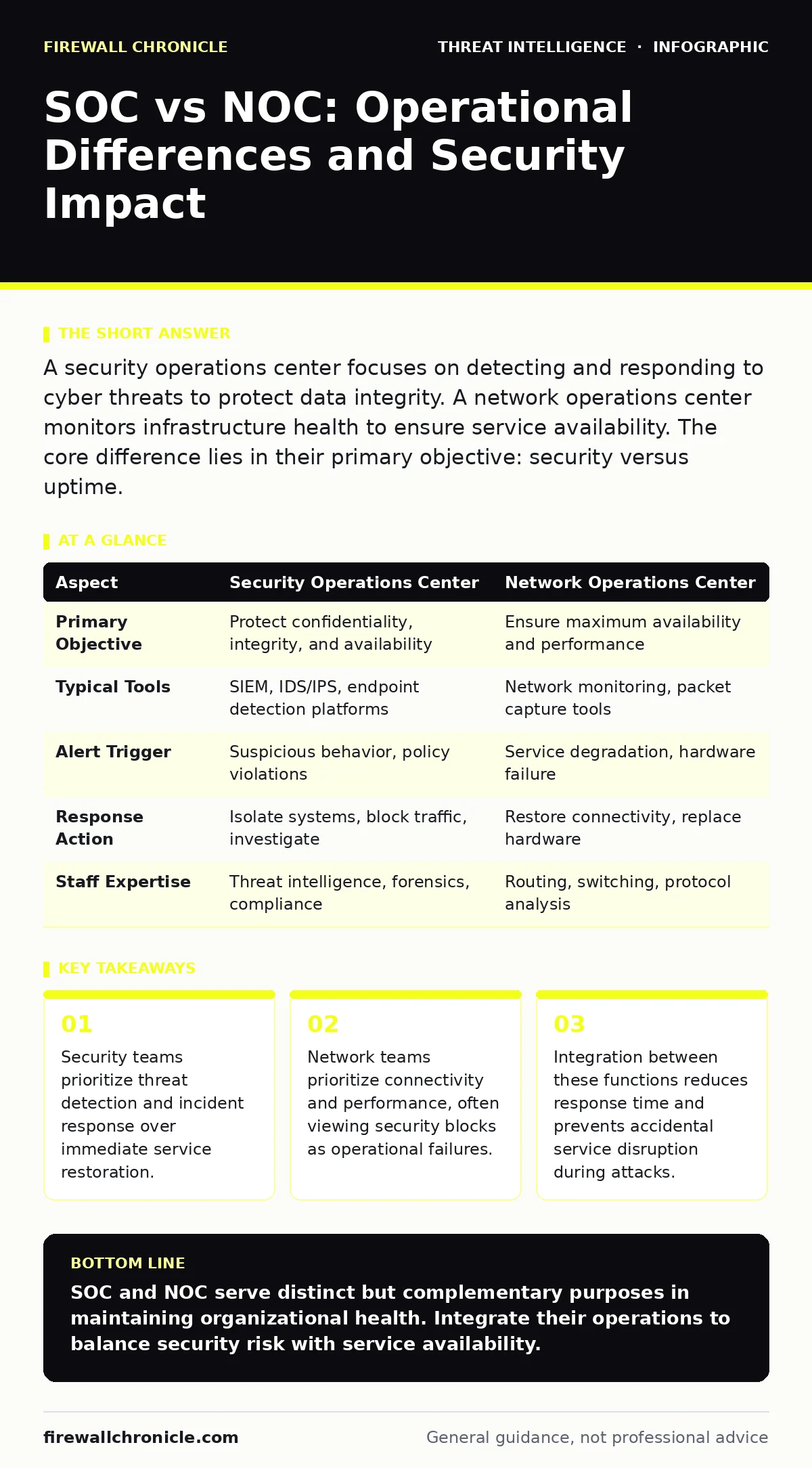
A security operations center focuses on detecting and responding to cyber threats to protect data integrity. A network operations center monitors infrastructure health to ensure service availability. The core difference lies in their primary objective: security versus uptime.
Defining the Core Functions
A security operations center (SOC) is a centralized function within an organization that employs people, processes, and technology to continuously monitor and analyze an organization's security posture. The primary goal is to detect, investigate, and respond to cybersecurity incidents. Analysts in this environment look for anomalies that indicate malicious activity, such as unauthorized access attempts or data exfiltration.
A network operations center (NOC) is a centralized location where IT operations are monitored and maintained. The primary goal is to ensure the health, performance, and availability of network infrastructure. Technicians in this environment focus on uptime, latency, and packet loss. They respond to outages, hardware failures, and configuration errors that disrupt service delivery.
The fundamental distinction is intent. Security teams seek to block suspicious activity, even if it causes temporary friction for users. Network teams seek to keep data flowing, often viewing security controls as potential points of failure that require careful management.
Comparative Analysis of Roles
| Aspect | Security Operations Center | Network Operations Center |
|---|---|---|
| Primary Objective | Protect confidentiality, integrity, and availability | Ensure maximum availability and performance |
| Typical Tools | SIEM, IDS/IPS, endpoint detection platforms | Network monitoring, packet capture tools |
| Alert Trigger | Suspicious behavior, policy violations | Service degradation, hardware failure |
| Response Action | Isolate systems, block traffic, investigate | Restore connectivity, replace hardware |
| Staff Expertise | Threat intelligence, forensics, compliance | Routing, switching, protocol analysis |
Operational Priorities and Trade-offs
Imagine a sudden spike in outbound traffic from a server. A NOC technician sees a bandwidth utilization alert. Their instinct is to check for a misconfigured application causing a loop or a legitimate traffic surge. They may increase bandwidth or restart the service to stabilize performance.
A SOC analyst sees the same spike but interprets it as potential data exfiltration. Their instinct is to isolate the host to prevent data loss. They may block the traffic entirely, causing a service outage. This creates immediate tension. The NOC views the block as a disruption to business continuity. The SOC views the outage as necessary damage control.
This conflict highlights a hidden cost of siloed operations. When teams operate independently, resolution time increases. The NOC may restore service before the SOC completes its investigation, inadvertently allowing the threat to persist. The SOC may keep systems isolated longer than necessary, impacting business operations unnecessarily.
Where Functions Overlap
Modern infrastructure blurs the lines between these functions. Both teams rely on telemetry data. Both respond to alerts in real time. Both impact user experience. The overlap occurs in the detection layer. Network flow data helps the SOC identify lateral movement. Security logs help the NOC identify compromised devices causing network instability.
Effective organizations integrate these functions through shared platforms. A Security Information and Event Management (SIEM) system can ingest network performance data. This allows security analysts to correlate performance degradation with security events. For example, a sudden drop in throughput might indicate a Distributed Denial of Service attack rather than simple congestion.
This integration supports blue team operations by providing a holistic view. It allows responders to distinguish between a performance issue and a security incident quickly. It reduces the risk of misclassification. It ensures that response actions consider both security risk and operational impact.
Choosing the Right Focus
Choose the SOC focus when:
- Your primary risk is data breach or regulatory non-compliance.
- You operate in a high-threat environment with frequent targeted attacks.
- You need detailed forensic capabilities for incident response.
- Your industry requires strict audit trails and compliance reporting.
Choose the NOC focus when:
- Your primary risk is service downtime or customer churn.
- You operate critical infrastructure where availability is paramount.
- You manage complex network topologies requiring constant tuning.
- Your users report frequent connectivity or performance issues.
See also: Incident Communication Plans: 9 FAQs on Strategy and Execution · Port Scan Response: Containment, Recovery, and Prevention Steps
Integrating for Resilience
Silos create blind spots. A NOC may miss a slow-moving threat because it does not cause immediate performance degradation. A SOC may miss a network configuration error that exposes vulnerabilities. Integration requires shared processes and communication channels.
Regular joint exercises help align priorities. These exercises simulate scenarios where security and network issues intersect. They reveal gaps in detection and response. They build trust between teams. They ensure that both groups understand each other's constraints and goals.
Consider the impact of port scanning on both teams. The NOC sees increased connection attempts and may adjust firewall rules to mitigate load. The SOC sees the scan as reconnaissance and investigates the source. If they do not communicate, the NOC may open ports to relieve load, while the SOC blocks them, causing confusion.
Measuring Success
Security metrics differ from network metrics. Mean time to detect (MTTD) measures how quickly the SOC identifies a threat. Mean time to respond (MTTR) measures how quickly they contain it. These metrics focus on security efficacy.
Network metrics focus on reliability. Uptime percentages and latency measurements indicate performance. These metrics focus on service quality. Both sets of metrics are necessary for a complete picture. Ignoring one leads to an incomplete understanding of organizational health.
Organizations that track both can identify correlations. A rise in security incidents may correlate with a drop in network performance. This correlation can indicate that security controls are impacting performance. It can also indicate that attacks are degrading performance. Understanding this relationship allows for better tuning of controls.
Key takeaways
- Security teams prioritize threat detection and incident response over immediate service restoration.
- Network teams prioritize connectivity and performance, often viewing security blocks as operational failures.
- Integration between these functions reduces response time and prevents accidental service disruption during attacks.
SOC and NOC serve distinct but complementary purposes in maintaining organizational health. Integrate their operations to balance security risk with service availability.
Frequently asked questions
Can one team perform both SOC and NOC functions?
Small organizations often combine these roles, but this creates conflicts of interest. As threats grow more sophisticated, separation becomes necessary for effective response.
How do security metrics differ from network metrics?
Security metrics focus on threat detection and response times. Network metrics focus on uptime, latency, and throughput. Both are needed for a full operational view.
What is the biggest risk of siloed operations?
Siloed operations lead to delayed response and misclassified incidents. Teams may work at cross-purposes, exacerbating the impact of an incident.
Do AS-REP roasting attacks affect NOC operations?
AS-REP roasting is a security attack targeting authentication protocols. It typically does not cause immediate network performance issues, so NOC tools may miss it entirely.
How this guide was produced: written by the Firewall Chronicle editorial team with AI assistance, checked against the public references listed below, and reviewed when the facts change. See our editorial policy or report an error.