
Golden Ticket Attacks: How Kerberoasting Bypasses Normal Defenses
Golden ticket attacks exploit the trust model of directory services, allowing attackers to generate valid credentials that standard log monitoring often misses entirely.
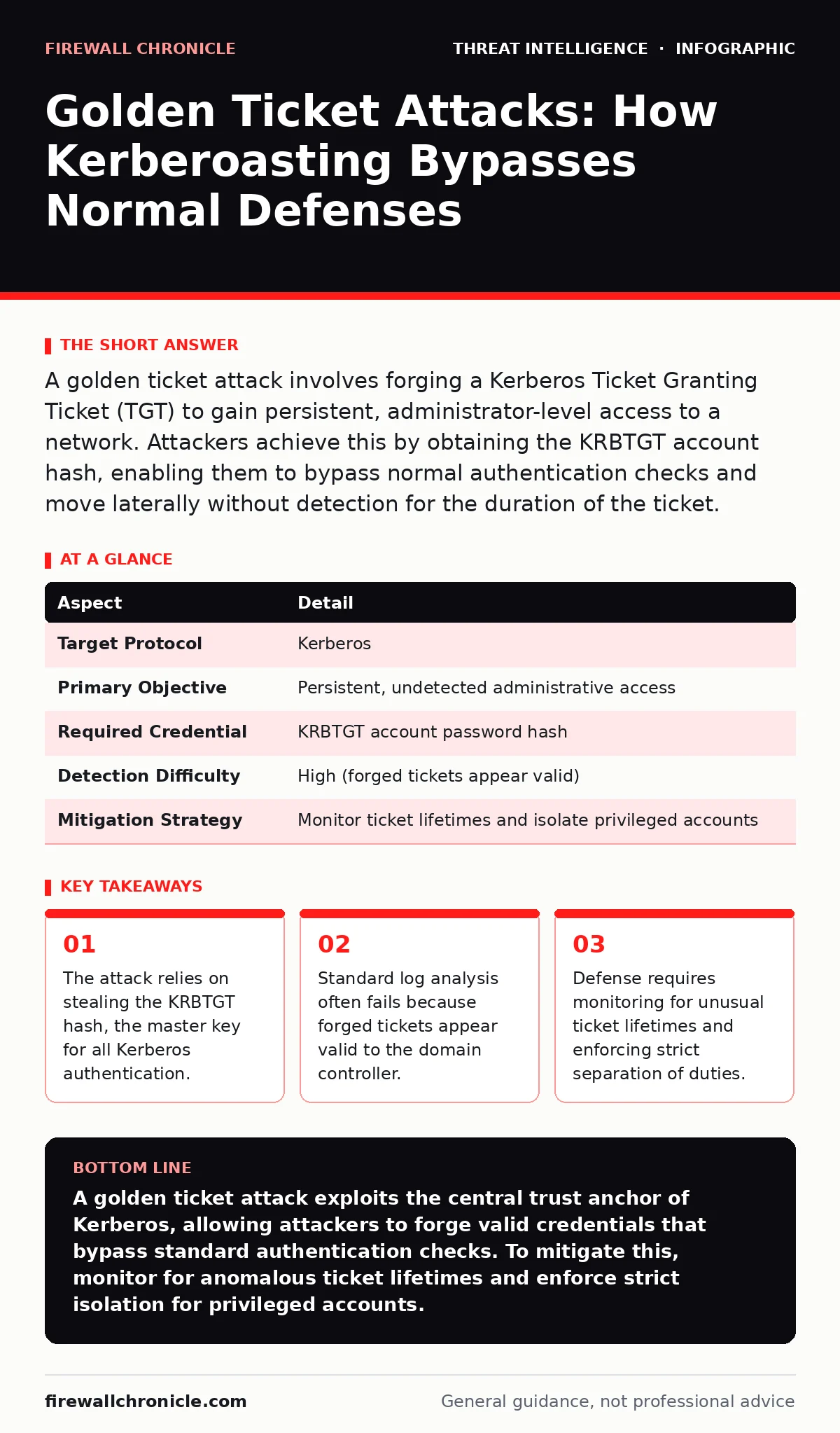
A golden ticket attack involves forging a Kerberos Ticket Granting Ticket (TGT) to gain persistent, administrator-level access to a network. Attackers achieve this by obtaining the KRBTGT account hash, enabling them to bypass normal authentication checks and move laterally without detection for the duration of the ticket.
The Master Key Analogy
Imagine a large corporate building where every employee carries a badge. This badge grants access to specific floors based on their role. Now imagine a master key card that opens every door in the building, including the server room and executive offices. If an attacker steals the design specifications for this master key, they can print their own copy. Security guards at the doors will scan the badge, see it matches the central system’s expectations, and let the attacker in. They have no reason to suspect the badge is counterfeit because it was created using the same cryptographic rules as the legitimate ones.
This is the core mechanic of a golden ticket attack. It does not involve guessing passwords or cracking encryption on a remote server. Instead, it involves replicating the trust anchor of the entire identity system.
At a Glance
| Aspect | Detail |
|---|---|
| Target Protocol | Kerberos |
| Primary Objective | Persistent, undetected administrative access |
| Required Credential | KRBTGT account password hash |
| Detection Difficulty | High (forged tickets appear valid) |
| Mitigation Strategy | Monitor ticket lifetimes and isolate privileged accounts |
How the Forgery Works
Kerberos is an authentication protocol that uses tickets to verify user identity without sending passwords over the network. The process relies on a trusted third party, the Key Distribution Center (KDC). When you log in, the KDC issues a Ticket Granting Ticket (TGT). You then use this TGT to request access to specific services.
The security of this system rests on one account: KRBTGT. This account issues and signs every TGT in the domain. Its password hash acts as the private key for the entire authentication scheme. If an attacker obtains this hash, they can sign their own tickets. The domain controller receives these forged tickets, verifies the signature against the known KRBTGT hash, and accepts them as legitimate.
The attacker does not need to compromise your actual user account. They create a new identity with the permissions they desire. Because the signature is cryptographically valid, the system cannot distinguish between a ticket issued by the real KDC and one forged by the attacker.
Common Forms and Variations
While the classic golden ticket targets the TGT, the concept extends to other parts of the Kerberos ecosystem. A silver ticket attack is a related technique. Instead of forging a TGT, the attacker forges a service ticket for a specific service, such as a file server or SQL database.
This variation has a distinct trade-off. A silver ticket allows access to one specific service but cannot be used to request other services. It also does not require the KRBTGT hash. Instead, it requires the service account password hash for that specific service. This makes silver tickets harder to detect in some contexts because they do not trigger the same high-level authentication events as TGT issuance.
Another variation involves the pre-authentication bypass. Some older systems allowed users to request a TGT without proving they knew their password. Attackers exploit this to request tickets for accounts with pre-authentication disabled, allowing them to offline-crack the resulting ticket or request service tickets directly.
Who Gets Hit and Why
These attacks primarily affect organizations using Windows Active Directory environments. Any network that relies on Kerberos for internal authentication is theoretically vulnerable. The risk is highest in environments where privilege separation is weak.
Attackers target this vector because it provides persistence. Once they have the KRBTGT hash, they can return to the network at any time, even if you change all user passwords. Changing user passwords does not invalidate a forged TGT because the ticket’s validity depends on the KRBTGT hash, not the user’s password.
The impact is severe. Attackers gain the ability to move laterally across the entire domain. They can access sensitive data, install backdoors, and exfiltrate information without triggering standard password-based alerts.
See also: Dark Web Monitoring Services: How They Work and What They Miss
What People Usually Get Wrong
Many defenders believe that strong password policies protect against golden tickets. This is incorrect. Password complexity does not protect the KRBTGT hash once it is compromised. The attack is post-compromise. It assumes the attacker already has some level of access.
Another common misconception is that disabling legacy protocols stops this attack. While modernizing authentication helps, the Kerberos protocol itself remains widely used and necessary for many enterprise functions. Disabling it is not a practical solution for most organizations.
Defenders also often miss the initial foothold. The KRBTGT hash is rarely stolen directly. It is usually extracted from memory after an attacker has escalated privileges. Focusing solely on the ticket forgery ignores the earlier stages of attacker reconnaissance and privilege escalation.
Reducing the Risk
Mitigating this risk requires a shift from perimeter defense to internal monitoring. You must assume that the KRBTGT hash could be compromised. The goal is to detect the abuse of that hash quickly.
- Monitor Ticket Lifetimes: Standard TGTs have a default lifetime, often 10 hours. Attackers often extend this lifetime to days or weeks to ensure persistence. Configure your Windows event log monitoring to alert on TGTs with unusually long durations.
- Isolate Privileged Accounts: Use a separate, isolated domain or administrative tier for managing the KRBTGT account. This limits the attack surface. If an attacker compromises a standard user account, they should not have access to the tools or paths needed to extract the KRBTGT hash.
- Enforce Ticket Encryption: Ensure that all Kerberos traffic uses strong encryption standards. Weak encryption allows attackers to capture and analyze ticket traffic, potentially aiding in the extraction of hashes.
- Review Service Accounts: Regularly audit service accounts with high privileges. Ensure they do not have more rights than necessary. This reduces the value of any single compromised account.
Integrating these checks into your log management strategy is critical. You need to correlate authentication events across multiple systems. A single login might look normal, but a login from a new user identity with admin rights at an unusual time is a red flag.
The Hidden Cost of Trust
The underlying issue in golden ticket attacks is the concentration of trust. The KRBTGT account is a single point of failure. Its compromise breaks the trust model for the entire domain. This highlights a broader challenge in cybersecurity: centralized identity systems offer convenience but create high-value targets.
You must balance ease of access with security. Every service account with domain admin rights increases the risk. Every workstation that can dump memory increases the attack surface. The defense is not just technical; it is architectural. You must design your network so that compromising one part does not grant access to the whole.
Consider how lateral movement techniques complement this attack. Attackers do not just steal the hash; they use the forged tickets to move quietly between systems. Detecting this movement requires visibility into internal traffic, not just endpoint logs.
Final Considerations
Protecting against golden tickets is about limiting the damage of an inevitable breach. You cannot prevent the theft of memory from every endpoint. But you can make the stolen credentials useless by detecting their misuse.
The key is anomaly detection. Look for the unusual. A new user account appearing with high privileges. A ticket lasting longer than expected. A login from a geographic location that does not match the user’s history. These are the signals that matter.
Incorporating breach and attack simulation into your testing routine can help verify that your detection rules work. You can simulate the creation of a golden ticket in a safe environment to see if your alerts trigger. This ensures your defenses are active, not just theoretical.
Remember, no single control is sufficient. You need a layered approach. Combine strong endpoint security, strict privilege management, and continuous monitoring. The goal is not to make the KRBTGT hash unstealable, but to make its use visible and costly for the attacker.
Key takeaways
- The attack relies on stealing the KRBTGT hash, the master key for all Kerberos authentication.
- Standard log analysis often fails because forged tickets appear valid to the domain controller.
- Defense requires monitoring for unusual ticket lifetimes and enforcing strict separation of duties.
A golden ticket attack exploits the central trust anchor of Kerberos, allowing attackers to forge valid credentials that bypass standard authentication checks. To mitigate this, monitor for anomalous ticket lifetimes and enforce strict isolation for privileged accounts.
Frequently asked questions
Can a golden ticket attack be used to access non-Windows systems?
Generally, no. Golden tickets are specific to the Kerberos protocol as implemented in Windows Active Directory. However, if a non-Windows system trusts the Active Directory domain for authentication, it may be indirectly affected.
Does changing the KRBTGT password fix a golden ticket attack?
Yes, changing the KRBTGT password invalidates all existing TGTs, including forged ones. Users must re-authenticate to receive new tickets signed with the new hash. This is disruptive but effective.
How long is a golden ticket valid?
The validity depends on the lifetime set by the attacker. They can set it to match the domain’s maximum ticket lifetime, which can be days or even years if misconfigured. Monitoring for unusually long lifetimes is key.
Is there a way to detect golden tickets without endpoint agents?
Detection is difficult without endpoint visibility, as the tickets appear valid to the domain controller. However, network-level monitoring for unusual Kerberos traffic patterns and analyzing directory service logs for unexpected admin logins can provide indicators.
How this guide was produced: written by the Firewall Chronicle editorial team with AI assistance, checked against the public references listed below, and reviewed when the facts change. See our editorial policy or report an error.