Penetration Testing for Small Businesses: Low-Cost Security Validation
Small teams reduce breach risk by combining automated scanning with targeted manual reviews, avoiding the high cost of full-scale enterprise assessments.
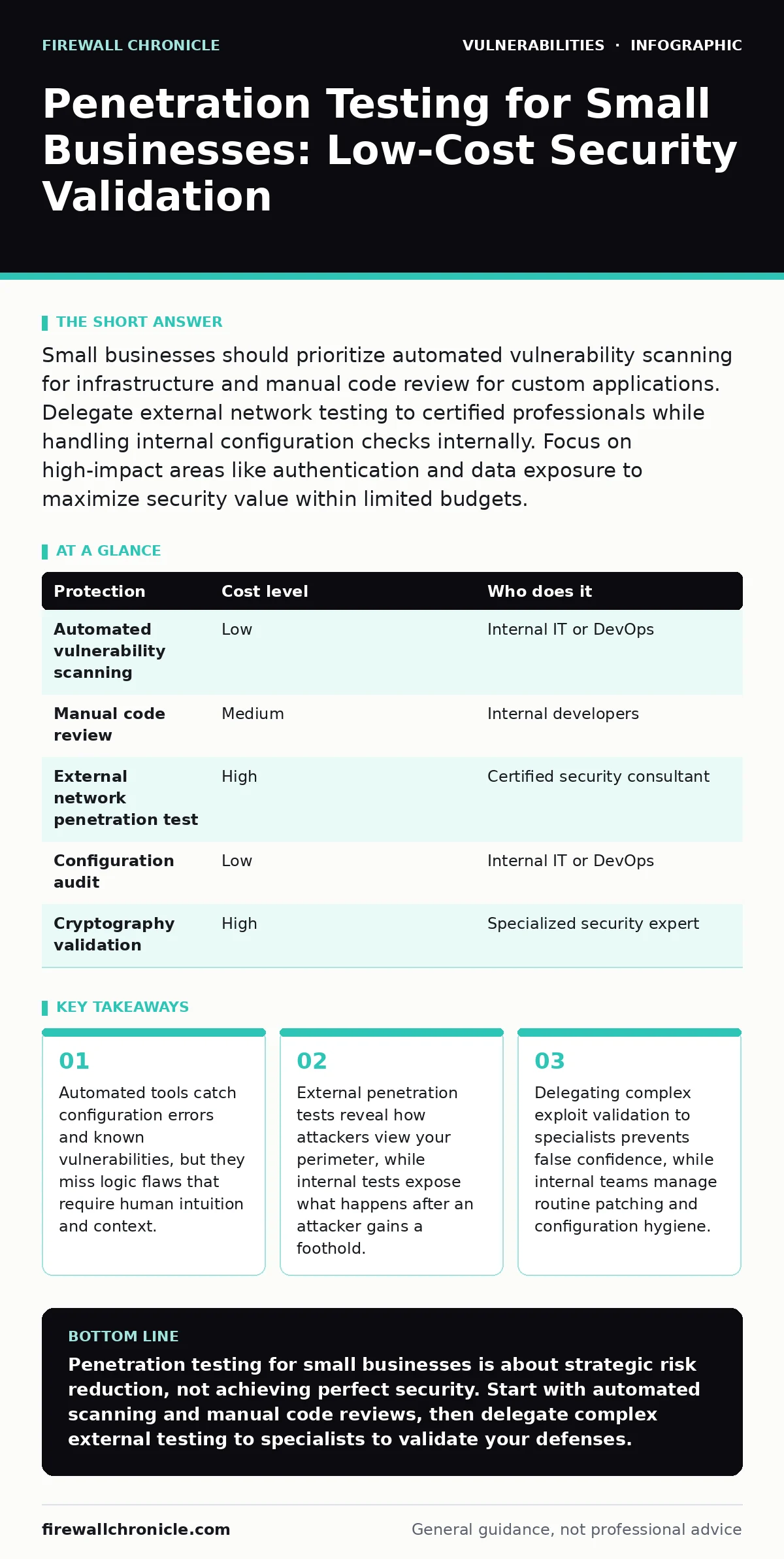
Small businesses should prioritize automated vulnerability scanning for infrastructure and manual code review for custom applications. Delegate external network testing to certified professionals while handling internal configuration checks internally. Focus on high-impact areas like authentication and data exposure to maximize security value within limited budgets.
The Small Team Security Paradox
Small organizations often believe that security is a luxury reserved for large enterprises with deep pockets. This belief is dangerous. Attackers do not care about company size; they care about value. A small business with weak defenses is an easier target than a hardened corporation. The goal of penetration testing for these teams is not to achieve perfect security, which is impossible, but to identify the most critical weaknesses before an attacker does.
The paradox is that small teams have fewer resources but often more agility. You can implement fixes faster than a large corporation. The challenge is knowing where to look. Without a structured approach, you might spend weeks fixing low-risk issues while ignoring a critical flaw in your authentication logic. Penetration testing provides that structure. It forces you to view your system through the eyes of an adversary, revealing gaps that routine maintenance misses.
Why Scale Changes the Approach
Large companies conduct penetration tests annually or quarterly as a compliance requirement. Small businesses must be more strategic. You cannot afford to test everything every month. Instead, you must focus on high-value assets and high-risk changes. This means testing after every major release or when new infrastructure is deployed.
The scope of your test should match your risk profile. If you store credit card numbers, the payment processing module needs rigorous testing. If you have a public-facing API, the authentication and authorization mechanisms are prime targets. Ignoring the context of your business leads to wasted effort.
A generic test might check for outdated software versions but miss a business logic error that allows users to access each other’s data. This is where understanding concepts like insecure direct object references (IDOR) becomes relevant. These logic flaws do not show up in standard vulnerability scanners because they require an understanding of how your application is supposed to work versus how it actually works.
Affordable Assessment Strategies
You do not need to hire a large consulting firm to validate your security posture. There are several affordable ways to conduct penetration testing. The first is automated vulnerability scanning. These tools crawl your web applications and infrastructure to identify known weaknesses. They are cheap and fast, but they produce noise. You will get many false positives, requiring time to verify which issues are real.
The second strategy is manual code review. For custom applications, reading the source code is often more effective than black-box testing. Developers can spot logic errors that automated tools miss. This requires discipline and a checklist, but it costs nothing in external fees. You are paying with developer time, which is a resource you already have.
The third strategy is hiring a freelance security consultant for a limited scope engagement. Instead of a full network assessment, you might hire someone to test a single critical feature, such as your file upload function. This targeted approach provides high value at a fraction of the cost of a broad assessment. It focuses resources on the areas most likely to cause significant damage if compromised.
What to Delegate to Specialists
Not every security task is suitable for internal handling. Some areas require specialized knowledge and tools that are not worth acquiring for a one-time use. External network penetration testing is a prime candidate for delegation. Attempting to simulate a sophisticated network attack without proper experience can lead to false confidence or accidental disruption of services.
Specialists bring an external perspective that internal teams lack. They are not biased by the assumption that "we always do it this way." They can identify misconfigurations that seem normal to you but are obvious to an outsider. This is particularly true for security misconfigurations, which are a leading cause of breaches. A specialist can quickly identify open ports, default credentials, or exposed management interfaces that an internal team might overlook due to familiarity.
You should also delegate the validation of complex cryptographic implementations. If you are rolling your own encryption or using obscure algorithms, a specialist can verify that you are not introducing subtle weaknesses. Implementing cryptography correctly is notoriously difficult. A small error can render your entire security model useless. Delegating this review ensures that your data remains confidential even if other defenses fail.
| Protection | Cost level | Who does it |
|---|---|---|
| Automated vulnerability scanning | Low | Internal IT or DevOps |
| Manual code review | Medium | Internal developers |
| External network penetration test | High | Certified security consultant |
| Configuration audit | Low | Internal IT or DevOps |
| Cryptography validation | High | Specialized security expert |
Integrating Testing into Development
Penetration testing should not be a separate, annual event. It should be integrated into your development lifecycle. This is often called "shift-left" security, meaning you move security checks earlier in the process. When developers write code, they should consider security implications immediately. This reduces the cost of fixing vulnerabilities later.
Automated tools can be integrated into your continuous integration pipeline. Every time code is committed, the tools run a quick scan. If a known vulnerability is detected, the build fails. This forces developers to address issues before they reach production. It creates a feedback loop that improves security awareness over time.
However, automation has limits. It cannot understand business logic. You still need manual reviews for complex features. Imagine a feature that allows users to export their data. An automated tool might check for injection flaws, but it might not check if a user can export another user’s data by manipulating the ID parameter. This requires a human to think like an attacker. Combining automated scans with manual logic reviews provides the most comprehensive coverage.
Questions for IT Providers
When you hire an external provider for penetration testing, you need to ensure they are qualified and that their methods align with your needs. Do not just ask for a "pen test." Ask specific questions to gauge their expertise and approach.
- Do you use both automated tools and manual verification to reduce false positives?
- What is your process for validating that a vulnerability is actually exploitable?
- How do you handle sensitive data during the testing process to ensure confidentiality?
- Do you offer remediation support, or do you only provide findings?
These questions help you avoid providers who simply run a scanner and sell you the output. You want a partner who understands your business and can provide actionable insights. The goal is not just a list of vulnerabilities, but a clear path to reducing risk.
Managing the Results
The value of penetration testing lies in what you do with the results. A report full of findings is useless if you do not fix the issues. Prioritize vulnerabilities based on their potential impact. A high-severity issue that is easy to exploit should be fixed immediately. A low-severity issue that requires complex conditions can be scheduled for later.
Use a scoring system to help prioritize. The CVSS score is a common standard for rating the severity of vulnerabilities. It considers factors like the complexity of the attack and the privileges required. However, do not rely on the score alone. Context matters. A vulnerability that exposes customer data is more critical than one that exposes internal server information, even if the technical score is lower.
Track your fixes over time. Repeat tests for the same vulnerabilities to ensure they are truly resolved. Some fixes introduce new issues. Retesting ensures that your security posture is improving, not just shifting. This continuous improvement cycle is the key to maintaining security in a dynamic environment.
The Role of Basic Hygiene
Penetration testing is not a substitute for basic security hygiene. You cannot test your way out of poor practices. Regular updates, strong access controls, and employee training are foundational. If you neglect these basics, penetration testing will only reveal the obvious.
For example, if you do not keep your browser updates current, you leave your development environment vulnerable to known exploits. Similarly, if you do not practice output encoding, your application is susceptible to cross-site scripting (XSS) attacks. These are well-known issues with straightforward fixes. Addressing them reduces the noise in your penetration test results, allowing you to focus on more complex, custom vulnerabilities.
Key takeaways
- Automated tools catch configuration errors and known vulnerabilities, but they miss logic flaws that require human intuition and context.
- External penetration tests reveal how attackers view your perimeter, while internal tests expose what happens after an attacker gains a foothold.
- Delegating complex exploit validation to specialists prevents false confidence, while internal teams manage routine patching and configuration hygiene.
Penetration testing for small businesses is about strategic risk reduction, not achieving perfect security. Start with automated scanning and manual code reviews, then delegate complex external testing to specialists to validate your defenses.
Frequently asked questions
How often should a small business conduct penetration testing?
Conduct automated scans with every major release and hire specialists for a full external assessment at least once a year or after significant infrastructure changes.
Is penetration testing legal?
Yes, as long as you have explicit written permission from the owner of the system. Testing without authorization is illegal and can result in criminal charges.
How this guide was produced: written by the Firewall Chronicle editorial team with AI assistance, checked against the public references listed below, and reviewed when the facts change. See our editorial policy or report an error.