
Fake Event Ticket Websites and How to Block Them
Domain monitoring removes the foundational asset attackers rely on long before a single fraudulent transaction occurs.
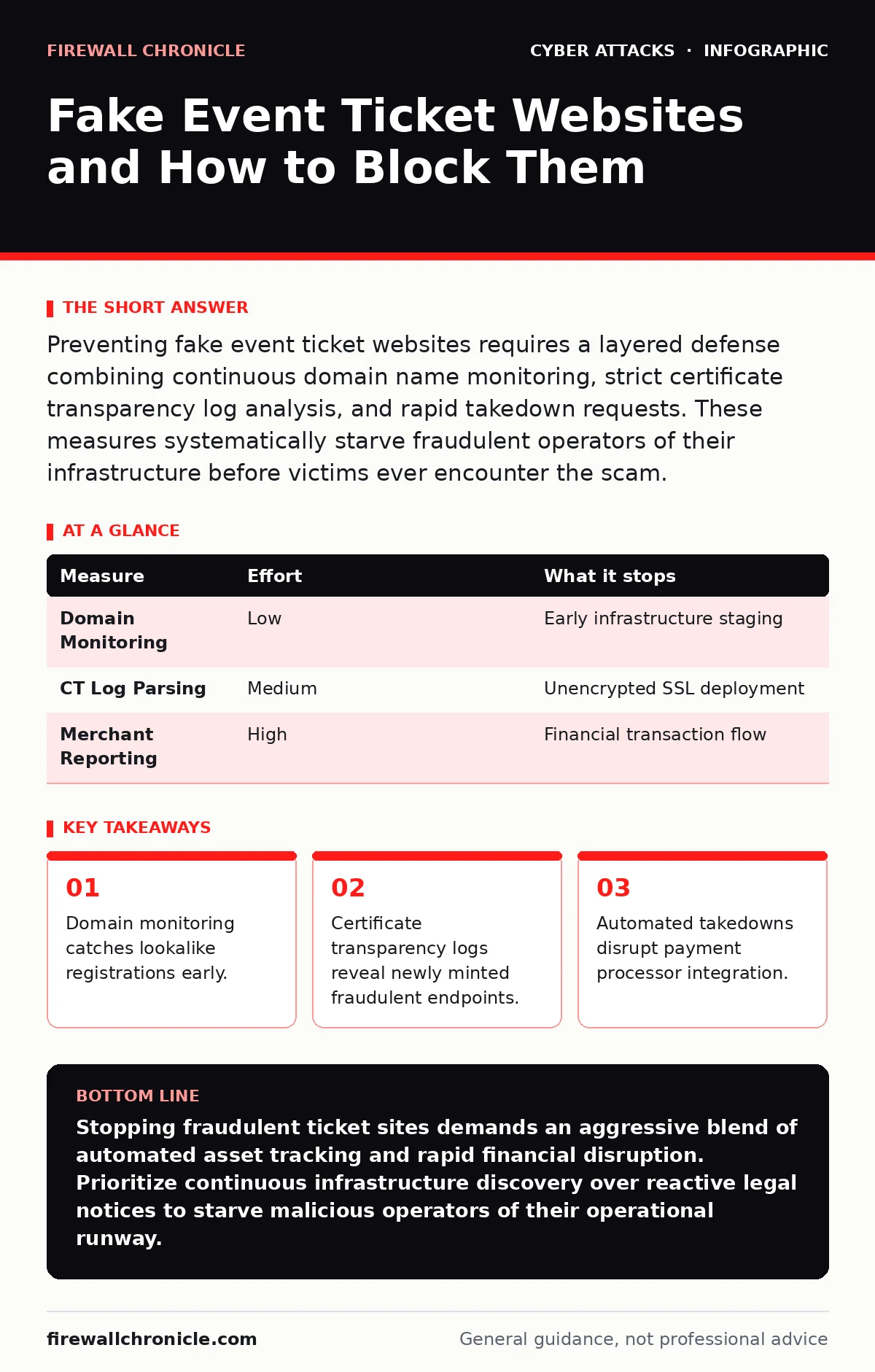
Preventing fake event ticket websites requires a layered defense combining continuous domain name monitoring, strict certificate transparency log analysis, and rapid takedown requests. These measures systematically starve fraudulent operators of their infrastructure before victims ever encounter the scam.
Establishing Continuous Domain Monitoring
Domain monitoring detects unauthorized lookalike registrations by querying public registries for semantic variations of your brand name. Brand protection teams configure keyword alerts to catch typosquatting variants and homoglyph domains before hosting providers spin up servers. Domain name system (DNS) tracking provides the earliest warning signal of an impending campaign, revealing infrastructure setup steps weeks prior to public ticket sales.
Continuous discovery protocols scan newly registered zones hourly to identify suspicious linguistic matches targeting your intellectual property. Security analysts review these newly spawned assets to separate legitimate partner integrations from malicious staging servers. Early detection grants your legal and technical teams the necessary lead time to issue registrar complaints before the fraudulent platform accepts a single customer payment.
Analyzing Certificate Transparency Logs
Certificate transparency logs publish every Transport Layer Security (TLS) certificate issued by public certificate authorities, creating an immutable public ledger. Security systems parse these public streams to find new certificates matching brand keywords issued to unknown entities. Automated scripts query these public feeds continuously, alerting security engineers the moment a fraudulent site acquires cryptographic trust.
Modern browsers refuse to load unencrypted web traffic smoothly, forcing malicious ticket vendors to secure automated TLS certificates immediately after domain registration. Parsing these public logs exposes the hosting provider and deployment timestamp of the malicious infrastructure. Integrating this intelligence feed into internal security operations centers guarantees visibility over emerging threats without waiting for customer complaints.
Disrupting Payment Processor Integration
Payment processor integration relies on merchant accounts that fraudulent ticket sites struggle to maintain under genuine identities. Fraudulent operators frequently rely on stolen credentials or synthetic identities to bypass onboarding checks enforced by financial institutions. Reporting these illicit merchants directly to acquiring banks halts revenue streams faster than technical domain takedowns alone, making the operation economically unviable.
Financial disruption alters the cost-benefit calculation for cyber criminals who rely on automated credit card testing platforms. Payment gateways monitor transaction velocity and chargeback ratios closely to flag anomalous merchant behavior associated with ticket scalping scams. Security personnel must establish direct communication channels with risk operations teams at major financial processors to accelerate merchant account terminations.
Implementing Technical Defense Strategies
Defense measures vary significantly in their capacity to neutralize fraudulent ticket infrastructure. Ranking these interventions correctly ensures security budgets target high-impact structural weaknesses rather than superficial symptoms. Enterprise defenses often intersect with web filtering to block user access to newly flagged malicious destinations automatically.
| Measure | Effort | What it stops |
|---|---|---|
| Domain Monitoring | Low | Early infrastructure staging |
| CT Log Parsing | Medium | Unencrypted SSL deployment |
| Merchant Reporting | High | Financial transaction flow |
Deploying technical controls demands continuous tuning to minimize false positive blocks on legitimate secondary marketplace vendors. Security architects must balance strict blocking rules against the operational reality of authorized ticket-sharing platforms. Automated validation pipelines evaluate domain age, certificate issuer reputation, and hosting provider history before enforcing network-level blocks.
Recognizing Limitations of Domain Takedowns
Domain takedowns remove the primary network address but fail to eliminate underlying operational assets. Attackers simply migrate content to alternative top-level domains within hours of a registrar suspension, rendering traditional legal notices an endless game of whack-a-mole. Furthermore, understanding the broader attack lifecycle helps security teams anticipate when threat actors will pivot to messaging apps rather than hosted web portals.
Legal frameworks governing domain seizures require extensive evidentiary documentation that delays immediate remediation actions. International jurisdictional differences further complicate efforts to compel foreign registrars to suspend malicious domains promptly. Technical countermeasures must therefore operate independently of legal processes to maintain adequate protection levels during high-demand event cycles.
Educating Users Against Social Engineering
User education targets the psychological manipulation techniques driving traffic toward fraudulent ticket portals. Attackers frequently use urgent social engineering during high-demand on-sale events to bypass rational skepticism. Security teams must recognize that technical blocks complement but never fully replace defenses against sophisticated man-in-the-middle attacks that intercept authentication tokens during checkout.
Creating resilient user populations requires simulating deceptive ticketing emails and evaluating employee susceptibility to brand impersonation. Training programs must teach ticket buyers to verify exact URL paths rather than relying on visual brand aesthetics alone. Clear visual indicators inside official applications help users distinguish authentic purchase workflows from deceptive third-party replicas.
Executing Daily Preventive Checklist
Actionable steps taken daily dramatically reduce the window of opportunity for fraudulent ticket vendors. Security engineers must establish rigorous verification routines to protect genuine ticket buyers from falling victim to impersonation.
- Configure automated domain monitoring alerts for brand name variations.
- Subscribe to public certificate transparency log ingestion pipelines.
- Establish direct escalation channels with major payment processors.
Routine verification audits ensure that security telemetry captures evolving evasion techniques utilized by sophisticated scam networks. Maintaining updated blocklists and monitoring registrar compliance metrics keeps defensive postures aligned with shifting threat actor behaviors. Continuous operational readiness remains the single most effective deterrent against large-scale ticket fraud campaigns.
Key takeaways
- Domain monitoring catches lookalike registrations early.
- Certificate transparency logs reveal newly minted fraudulent endpoints.
- Automated takedowns disrupt payment processor integration.
Stopping fraudulent ticket sites demands an aggressive blend of automated asset tracking and rapid financial disruption. Prioritize continuous infrastructure discovery over reactive legal notices to starve malicious operators of their operational runway.
Frequently asked questions
How do fake event ticket websites acquire official-looking branding?
Fraudulent operators scrape high-resolution logos, seat maps, and promotional copy directly from legitimate primary ticketing platforms to construct convincing replicas.
Why do traditional registrar complaints take so long to process?
Registrar complaints require manual verification of trademark ownership and legal compliance reviews across multiple international jurisdictions.
What payment methods do fraudulent ticket sites prefer?
Scammers favor irreversible transfer methods such as cryptocurrency or peer-to-peer payment apps to prevent chargebacks.
Can browser extensions block fake ticket sites effectively?
Browser extensions offer partial protection by maintaining crowdsourced blocklists, but they often lag behind the rapid deployment rate of newly registered fraudulent domains.
How this guide was produced: written by the Firewall Chronicle editorial team with AI assistance, checked against the public references listed below, and reviewed when the facts change. See our editorial policy or report an error.