What Is Supply Chain Risk in Cloud Security?
You inherit every vulnerability in the libraries you import, turning your code into a collection of third-party liabilities you cannot directly control.
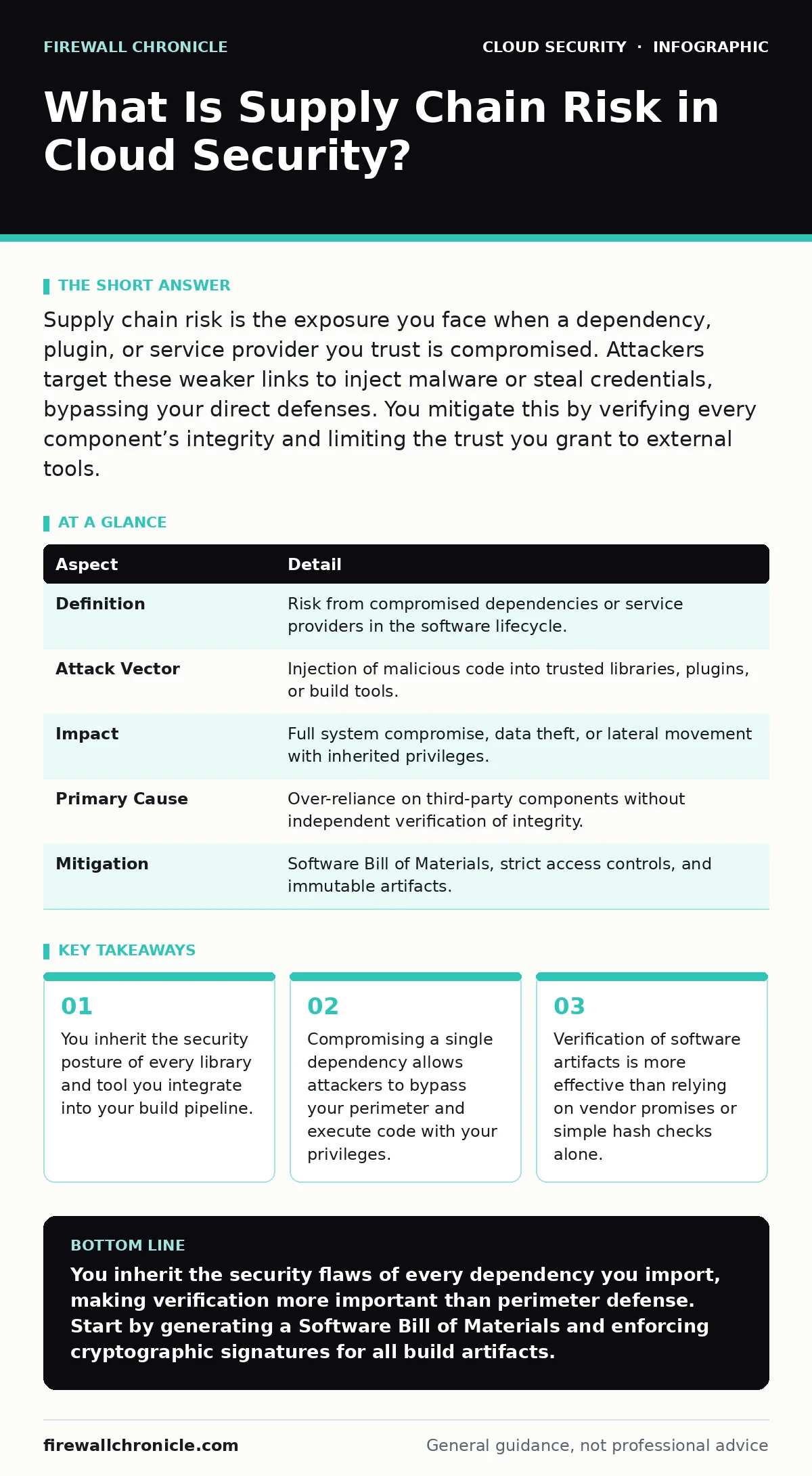
Supply chain risk is the exposure you face when a dependency, plugin, or service provider you trust is compromised. Attackers target these weaker links to inject malware or steal credentials, bypassing your direct defenses. You mitigate this by verifying every component’s integrity and limiting the trust you grant to external tools.
What Is Supply Chain Risk
What is supply chain risk? It is the threat that arises when an attacker compromises a trusted component in your software delivery process rather than attacking your systems directly. This risk exists because modern development relies on thousands of external dependencies. You do not write every line of code you deploy. You import libraries, use pre-built containers, and rely on third-party APIs. Each of these components introduces a potential entry point for an adversary. If a single dependency is poisoned, your entire application becomes vulnerable.
The mechanism is simple. An attacker identifies a widely used library or a critical infrastructure tool. They insert malicious code into that component. When you update or build your software, you pull in the compromised code. Your system then executes the attacker’s payload with the same permissions your application holds. This bypasses traditional perimeter defenses because the traffic looks like legitimate software updates.
Imagine a scenario where a popular logging library receives a routine security patch. An attacker gains write access to the library’s repository and injects a data exfiltration script. Thousands of developers pull this update. Your CI/CD pipeline builds the new version without flagging the script. The next deployment sends user data to an external server you never authorized.
| Aspect | Detail |
|---|---|
| Definition | Risk from compromised dependencies or service providers in the software lifecycle. |
| Attack Vector | Injection of malicious code into trusted libraries, plugins, or build tools. |
| Impact | Full system compromise, data theft, or lateral movement with inherited privileges. |
| Primary Cause | Over-reliance on third-party components without independent verification of integrity. |
| Mitigation | Software Bill of Materials, strict access controls, and immutable artifacts. |
How Supply Chain Attacks Work
Attackers prefer supply chain attacks because they offer high reward for low effort. Targeting a single library can compromise thousands of downstream applications. The process usually begins with reconnaissance. The attacker looks for projects with high download counts but low maintenance activity. These projects are attractive because they are widely used but often lack rigorous security reviews.
Once a target is selected, the attacker seeks access. This might involve stealing credentials from a maintainer, exploiting a vulnerability in the repository platform, or social engineering a contributor. They do not need to break into your production environment. They only need to change the source code or the build script of the dependency.
The injection is subtle. The malicious code is often hidden in error handling routines or conditional logic that rarely triggers. This allows the package to pass basic testing. When you integrate the update, the code executes in your environment. It may install a backdoor, steal API keys, or modify your configuration files. Because the code came from a trusted source, your security tools may not raise an alarm.
Who Is Affected by These Risks
You are affected if you use any third-party code. This includes almost every software project today. The risk extends beyond the code you write. It covers the tools you use to build, test, and deploy that code. If your build server pulls dependencies from a public registry, you are exposed. If you use a managed service that processes your data, you are exposed.
Developers often think they are safe if they do not use open-source libraries. This is incorrect. Commercial software also has supply chains. Proprietary tools depend on other proprietary tools. A breach in a vendor’s update mechanism can deliver malware to your enterprise. The scope includes container images, infrastructure-as-code templates, and plugins for your IDE. Every external component is a potential vector.
The impact scales with your trust. If you grant a service broad network access, a compromise in that service grants the attacker broad access. If you run containers with root privileges, a compromised container gives the attacker root on the host. The privilege model of your environment determines the severity of the breach.
What People Usually Get Wrong
Many teams believe that scanning for known vulnerabilities is enough. This is a common mistake. Scanners only find flaws that have already been documented. They do not detect newly injected malware or logic bombs. They also do not verify that the code you downloaded matches the code the author intended. A package can be free of known CVEs and still contain fresh, malicious code.
Another misconception is that private repositories are safe. Attackers target the maintainers who publish to these repositories. If a maintainer’s machine is compromised, the attacker can push malicious updates to your private registry. Your internal scan may pass because the artifact looks structurally valid. You must verify the identity of the signer, not just the content of the package.
Teams also often ignore the build environment. If your CI/CD server is compromised, the attacker can modify the build process itself. They can inject secrets into the binary or change the destination of the deployment. Securing the application code is useless if the factory that produces it is under enemy control.
Practical Mitigation Strategies
You must shift from trust to verification. Start by maintaining a Software Bill of Materials (SBOM). This is a list of every component in your software, including versions and licenses. An SBOM allows you to quickly identify which systems are affected when a dependency is compromised. You cannot protect what you do not know you have.
Implement strict access controls for your repositories. Use multi-factor authentication and require code reviews for all changes. Limit who can publish packages. Separate the roles of development and deployment. The person who writes the code should not have the ability to push updates to production. This reduces the risk of insider threats and credential theft.
Use signed artifacts. Cryptographic signatures prove that the code has not been altered since it was built. Verify these signatures during the build process. Reject any package that lacks a valid signature from a trusted key. This adds a layer of integrity checking that simple hash comparisons cannot provide.
See also: Mutable vs Immutable Infrastructure: Why State Changes Break Security · Multi Cloud Security Challenges: How to Stop Config Drift
Securing the Build Pipeline
Your build pipeline is the factory of your software. It must be as secure as the production environment. Use immutable infrastructure principles for your build servers. Do not allow stateful changes to the build agents. Each build should run in a fresh, isolated environment. This prevents persistent malware from surviving between builds.
Limit the network access of your build agents. They should only be able to pull from approved registries and push to approved destinations. Block outbound traffic to unknown servers. This prevents the build process from phoning home to command-and-control servers. Implement cloud network segmentation to isolate the build environment from your production databases and user traffic.
Monitor the build logs for anomalies. Look for unexpected network connections, unusual file modifications, or changes to the dependency list. Alert on any deviation from the expected build pattern. Early detection can stop a compromised build from reaching production.
Managing Third-Party Dependencies
You cannot eliminate dependencies, but you can manage them. Regularly audit your libraries. Remove unused dependencies. Each unused library is an unnecessary attack surface. Keep your dependencies updated, but do not automate updates without testing. Automated updates can introduce breaking changes or new vulnerabilities.
Prefer static binaries over dynamic links where possible. Static binaries include all their dependencies within the executable. This reduces the risk of library hijacking at runtime. However, this increases the binary size and may complicate updates. Weigh the trade-offs based on your security requirements.
For container images, use minimal base images. These contain fewer packages and thus fewer potential vulnerabilities. Scan the base images regularly. Do not use root users in containers. Run containers with the least privilege necessary. Refer to Kubernetes security basics for detailed guidance on hardening container environments. Proper network policies can further limit the blast radius of a compromised container. See Kubernetes network policies to learn how to restrict traffic between pods.
Verification and Monitoring
Continuous verification is key. Static checks are not enough. You need runtime protection as well. Monitor your applications for unexpected behavior. Look for new network connections, file changes, or process executions that deviate from the norm. This helps detect supply chain attacks that bypass static analysis.
Implement cloud backup strategies for your critical data. If a supply chain attack leads to encryption or deletion, backups allow you to restore your systems. Ensure your backups are immutable and isolated from the production network. This prevents attackers from encrypting or deleting your backups as part of the attack. See cloud backup for methods to protect data against ransomware.
Regularly review your cloud misconfigurations. Misconfigured storage or permissions can amplify the impact of a supply chain breach. An attacker with access to a compromised application may use misconfigured permissions to access other resources. See cloud misconfigurations for common pitfalls to avoid. Exposed storage buckets are a frequent result of poor configuration and can leak sensitive data. See exposed storage buckets for remediation steps.
If a breach occurs, having an incident response plan is vital. But prevention is better. By securing your supply chain, you reduce the likelihood of a breach. See cloud ransomware for how supply chain attacks can lead to widespread encryption. Immutable infrastructure can help you recover quickly by allowing you to discard compromised instances and rebuild from known-good templates. See immutable infrastructure for implementation details.
Key takeaways
- You inherit the security posture of every library and tool you integrate into your build pipeline.
- Compromising a single dependency allows attackers to bypass your perimeter and execute code with your privileges.
- Verification of software artifacts is more effective than relying on vendor promises or simple hash checks alone.
You inherit the security flaws of every dependency you import, making verification more important than perimeter defense. Start by generating a Software Bill of Materials and enforcing cryptographic signatures for all build artifacts.
Frequently asked questions
How do I know if my dependencies are safe?
You cannot know with certainty. You must verify the source, check for signatures, and monitor for anomalous behavior after deployment.
Is using a private registry enough to secure my supply chain?
No. Attackers can compromise the maintainers who publish to private registries. You must still verify artifacts and restrict access.
What is the difference between a vulnerability and a supply chain risk?
A vulnerability is a flaw in the code. A supply chain risk is the exposure caused by trusting a third-party component that may contain that flaw or malicious code.
Should I stop using open-source libraries?
No. Open source is fundamental to modern development. You must manage the risk through verification, minimal dependencies, and strict access controls.
How this guide was produced: written by the Firewall Chronicle editorial team with AI assistance, checked against the public references listed below, and reviewed when the facts change. See our editorial policy or report an error.