Cloud Network Segmentation: Isolate Workloads to Stop Lateral Movement
Proper segmentation forces attackers to breach multiple independent control planes, turning a single compromise into a contained incident rather than a total collapse.
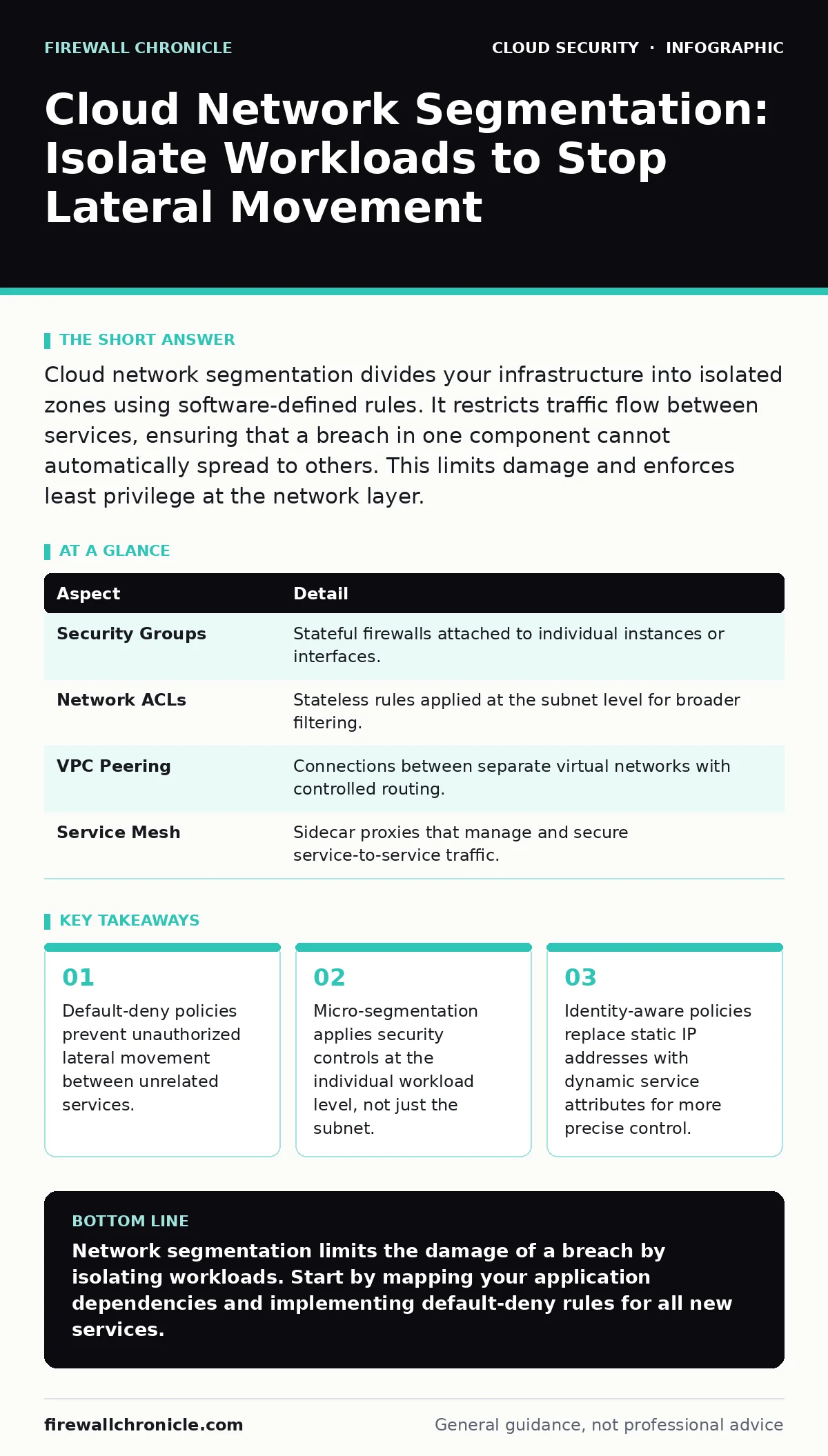
Cloud network segmentation divides your infrastructure into isolated zones using software-defined rules. It restricts traffic flow between services, ensuring that a breach in one component cannot automatically spread to others. This limits damage and enforces least privilege at the network layer.
The Library Analogy for Network Isolation
Imagine a vast library where every book is placed on a single, endless shelf. If a fire starts in one section, the entire collection burns. Now imagine the same library divided into separate rooms with fireproof doors. A fire in the biography section stays there. The rest of the library remains safe. Cloud network segmentation works exactly like those fireproof doors. It creates logical barriers between your applications, databases, and user interfaces.
In a traditional data center, physical cables and separate routers provided these barriers. In the cloud, everything is virtual. You must explicitly define where the walls go. Without these boundaries, your environment behaves like that single endless shelf. A vulnerability in a public-facing web server becomes a direct path to your private database. Segmentation breaks that path.
Why Flat Networks Fail in the Cloud
Many organizations migrate to the cloud by replicating their on-premise network structure. They create large subnets and allow broad traffic flow to maintain compatibility. This approach creates a flat network. A flat network allows any device to communicate with any other device unless explicitly blocked. This is dangerous because it assumes all traffic is trusted by default.
The problem is that trust is rarely static. A developer’s laptop, a third-party API, and a production database all exist in the same space. If an attacker compromises the developer’s laptop, they can scan the entire network. They can probe for open ports and weak services. Segmentation solves this by enforcing the principle of least privilege. Each component only receives the traffic it strictly needs to function. Everything else is rejected.
Core Components of Segmentation
To implement effective segmentation, you need to understand the mechanisms that enforce the rules. These components work together to create a layered defense.
| Aspect | Detail |
|---|---|
| Security Groups | Stateful firewalls attached to individual instances or interfaces. |
| Network ACLs | Stateless rules applied at the subnet level for broader filtering. |
| VPC Peering | Connections between separate virtual networks with controlled routing. |
| Service Mesh | Sidecar proxies that manage and secure service-to-service traffic. |
Security groups act as the first line of defense. They are attached directly to your virtual machines or containers. They inspect traffic entering and leaving that specific resource. Network Access Control Lists operate at a higher level. They apply to entire subnets. They are stateless, meaning they do not remember previous connections. This makes them useful for blocking broad categories of traffic but less precise for complex application logic.
Micro-Segmentation vs Traditional Methods
Traditional segmentation relies on IP addresses and subnets. This works well when your infrastructure is static. However, cloud environments are dynamic. Containers spin up and down. Serverless functions execute and disappear. IP addresses change constantly. Relying on static IPs leads to broken rules or overly permissive access.
Micro-segmentation solves this by using tags and identities instead of IP addresses. You define rules based on the role of the service, such as "frontend" or "database." The security platform translates these tags into enforcement rules in real time. If a container moves, the rules move with it. This approach is critical for modern architectures. It ensures that security policies remain consistent regardless of where the workload runs.
Where Segmentation Fits in Your Defense
Segmentation is not a standalone solution. It is part of a broader security strategy. It works best when combined with other controls. For instance, Kubernetes RBAC manages who can deploy changes to your containers. Segmentation manages how those containers talk to each other. Both are necessary. One prevents unauthorized configuration changes. The other limits the impact of a misconfigured container.
You should also consider secure access service edge (SASE) for remote access. SASE combines networking and security functions into a cloud service. It provides secure connectivity for users and devices anywhere. When paired with internal segmentation, it ensures that external access does not bypass internal controls. This creates a zero-trust model where no user or device is trusted by default, regardless of their location.
See also: Mutable vs Immutable Infrastructure: Why State Changes Break Security
Common Mistakes in Implementation
Many teams make the same errors when implementing segmentation. The most common mistake is relying solely on perimeter security. They assume that if the firewall is strong, the inside is safe. This ignores the reality of insider threats and compromised credentials. An attacker who gains valid credentials can move freely through a flat network.
Another error is creating overly complex rules. When rules become too complicated, they become unmanageable. Administrators may disable them to restore connectivity. This defeats the purpose of segmentation. Keep rules simple and aligned with business logic. Regularly audit and clean up unused rules. This reduces noise and makes it easier to detect anomalies.
The Hidden Cost of Poor Segmentation
The cost of poor segmentation is not just a breach. It is the operational chaos that follows. When an incident occurs, a flat network forces you to shut down entire systems to contain the threat. This causes downtime and revenue loss. With proper segmentation, you can isolate only the affected component. The rest of the system continues to operate.
This also impacts compliance. Many regulations require strict access controls and data isolation. Segmentation provides the technical evidence needed for audits. It shows that you have implemented controls to protect sensitive data. Without it, you may fail audits or face legal penalties.
Integrating with Backup and Recovery
Segmentation also affects how you handle data recovery. Cloud backup strategies must account for segmented environments. If your backup systems cannot reach the segmented workloads, you cannot restore them. You must create specific exceptions for backup traffic. These exceptions should be tightly controlled. They should only allow read access from the backup service to the source data.
This integration is vital for resilience. Cloud ransomware attacks often target backups to prevent recovery. By segmenting your backup storage from the production network, you protect your recovery copies. Even if the production environment is encrypted, your backups remain intact and accessible. This ensures you can restore services quickly and securely.
Key takeaways
- Default-deny policies prevent unauthorized lateral movement between unrelated services.
- Micro-segmentation applies security controls at the individual workload level, not just the subnet.
- Identity-aware policies replace static IP addresses with dynamic service attributes for more precise control.
- Segmentation reduces the blast radius of misconfigurations and credential theft.
Network segmentation limits the damage of a breach by isolating workloads. Start by mapping your application dependencies and implementing default-deny rules for all new services.
Frequently asked questions
Does segmentation slow down application performance?
Modern cloud networks handle segmentation rules in software with minimal latency. The overhead is negligible for most applications.
Can I segment serverless functions?
Yes, using service meshes or API gateways. You can define policies based on function identity and destination.
How do I handle cross-region traffic?
Use private endpoints or VPC peering with strict
How this guide was produced: written by the Firewall Chronicle editorial team with AI assistance, checked against the public references listed below, and reviewed when the facts change. See our editorial policy or report an error.