Cloud Native Security: Protecting Dynamic Infrastructure
Static perimeter defenses fail against cloud-native architectures because the attack surface shifts with every container deployment and microservice interaction.
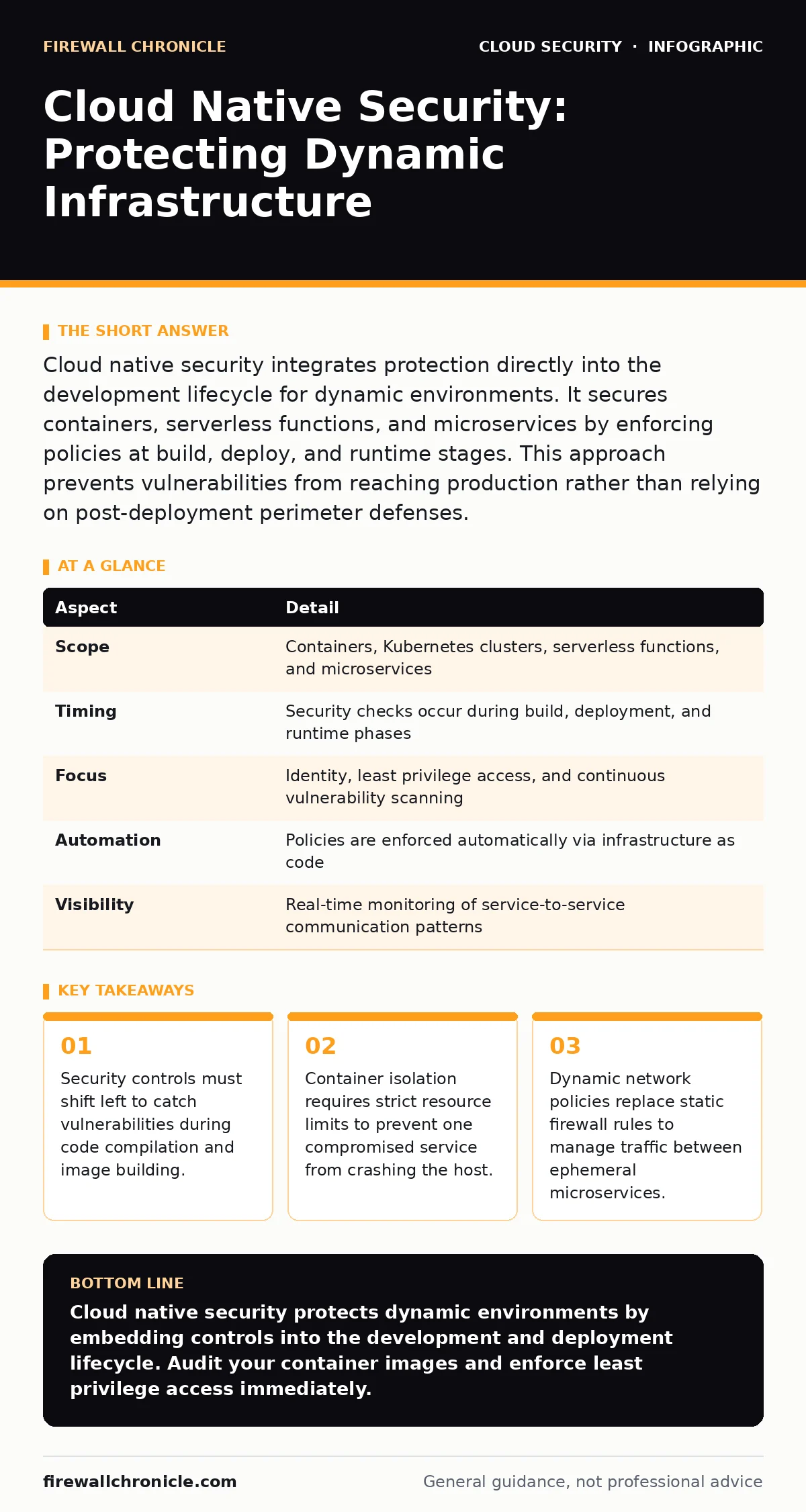
Cloud native security integrates protection directly into the development lifecycle for dynamic environments. It secures containers, serverless functions, and microservices by enforcing policies at build, deploy, and runtime stages. This approach prevents vulnerabilities from reaching production rather than relying on post-deployment perimeter defenses.
Understanding Cloud Native Security Fundamentals
Imagine a traditional office building with a single guarded gate. Security checks everyone at the entrance, assuming the interior is safe. Cloud native security operates differently. It resembles a city where every building has its own locks, guards, and access logs, and citizens move freely between them. The perimeter is no longer a single line but a distributed set of controls.
This model applies to infrastructure built for the cloud from the start. It uses containers, microservices, and serverless computing. These components are ephemeral, meaning they start and stop frequently. Traditional security tools struggle to monitor resources that exist for minutes or seconds. You must protect the code, the container image, the runtime environment, and the network connections between services.
| Aspect | Detail |
|---|---|
| Scope | Containers, Kubernetes clusters, serverless functions, and microservices |
| Timing | Security checks occur during build, deployment, and runtime phases |
| Focus | Identity, least privilege access, and continuous vulnerability scanning |
| Automation | Policies are enforced automatically via infrastructure as code |
| Visibility | Real-time monitoring of service-to-service communication patterns |
How Cloud Native Security Works in Practice
The mechanism relies on embedding security checks into the continuous integration and continuous delivery pipeline. When you write code, static analysis tools scan for common vulnerabilities. When you build the container image, scanners check for known flaws in the base operating system and libraries. This process ensures that only verified artifacts reach the production environment.
At runtime, the system enforces policies on how services interact. A web frontend should not talk directly to a database. Cloud native security blocks this unauthorized connection even if the firewall allows it. It uses identity-based controls rather than IP-based rules. Since containers change IP addresses constantly, relying on IPs is ineffective. Instead, the system verifies the identity of the service requesting access.
Who Cloud Native Security Affects
This approach impacts every role involved in software delivery. Developers must write secure code and manage dependencies. Operations teams must configure cluster policies and monitor runtime behavior. Security engineers design the guardrails that allow rapid deployment without compromising safety.
The cloud provider shares responsibility with you. They secure the underlying hardware and hypervisor. You secure the guest operating system, the container runtime, and your application logic. Misunderstanding this division leads to gaps. If you assume the provider protects your data in storage buckets, you remain vulnerable. See our guide on exposed storage buckets to understand how to secure object storage.
What to Do About It
Start by inventorying your cloud resources. You cannot protect what you cannot see. Use infrastructure as code to define your security posture. This ensures that every new environment is created with the same security controls. Manual configurations drift over time and introduce inconsistencies.
Implement least privilege access for all services. Each microservice should have only the permissions it needs to function. If a service is compromised, the attacker gains limited access. Regularly scan container images for vulnerabilities. Update base images frequently to patch known flaws. Monitor network traffic for anomalies that indicate lateral movement.
Common Misconceptions About Cloud Native Security
Many teams believe that encrypting data at rest solves security problems. Encryption protects data if the storage is stolen. It does not stop an attacker from executing malicious code within a running container. You need runtime protection to detect and stop active attacks.
Another error is treating the cloud like a traditional data center. You cannot use static IP addresses for access control. Containers are ephemeral and move across nodes. Network policies must be dynamic and identity-aware. See our guide on Kubernetes network policies to learn how to define these rules effectively.
See also: Mutable vs Immutable Infrastructure: Why State Changes Break Security · Multi Cloud Security Challenges: How to Stop Config Drift
Integrating With Broader Security Strategies
Cloud native security does not exist in isolation. It connects with identity management and network segmentation. Zero trust network access ensures that every request is verified, regardless of origin. This complements cloud-native controls by adding an extra layer of authentication. See our guide on zero trust network access for implementation details.
Multi-cloud security adds complexity. If you use multiple providers, you must ensure consistent policies across all environments. A vulnerability in one cloud may not be present in another. Standardizing on open security frameworks helps maintain consistency. See our guide on multi-cloud security to manage cross-provider risks.
Advanced Considerations For Developers
Developers often focus on application logic and ignore infrastructure configuration. This creates hidden risks. A misconfigured database can expose sensitive data. A container running as root has full access to the host system. Always run containers with non-root users. Set resource limits to prevent denial of service attacks.
Secrets management is critical. Never hardcode credentials in your source code. Use dedicated secrets management tools. These tools rotate credentials automatically and limit access. See our guide on SaaS account takeover to understand how leaked credentials can compromise entire systems.
Conclusion Of Cloud Native Security Practices
Cloud native security requires a shift in mindset. You move from protecting a perimeter to protecting every component. Automation is key. Manual checks cannot keep pace with dynamic deployments. Integrate security into your development workflow. Test, scan, and enforce policies at every stage.
Continuous monitoring reveals threats that static scans miss. Analyze logs and network traffic for unusual patterns. Respond quickly to anomalies. Security is not a one-time setup but an ongoing process. Adapt your controls as your infrastructure evolves. See our guide on cloud misconfigurations to audit your current setup for common errors.
Key takeaways
- Security controls must shift left to catch vulnerabilities during code compilation and image building.
- Container isolation requires strict resource limits to prevent one compromised service from crashing the host.
- Dynamic network policies replace static firewall rules to manage traffic between ephemeral microservices.
Cloud native security protects dynamic environments by embedding controls into the development and deployment lifecycle. Audit your container images and enforce least privilege access immediately.
Frequently asked questions
Does cloud native security replace traditional firewalls?
It complements them. Traditional firewalls protect network boundaries. Cloud native security protects individual services and containers within the cloud environment.
How do I secure serverless functions?
Apply least privilege permissions. Manage secrets securely. Monitor execution logs for anomalies. Ensure the function code itself is free of vulnerabilities.
What is the biggest risk in cloud native environments?
Misconfiguration is the primary risk. Incorrect settings expose services and data. Automated policy enforcement reduces this risk significantly.
Can I use cloud native security for on-premise servers?
Yes. The principles of container security and least privilege apply regardless of where the infrastructure runs. The tools may differ, but the concepts remain valid.
How this guide was produced: written by the Firewall Chronicle editorial team with AI assistance, checked against the public references listed below, and reviewed when the facts change. See our editorial policy or report an error.