Broken Object Level Authorization Prevention Checklist for APIs
Most API breaches occur because servers verify user identity but forget to verify object ownership, leaving data exposed to anyone with a predictable ID.
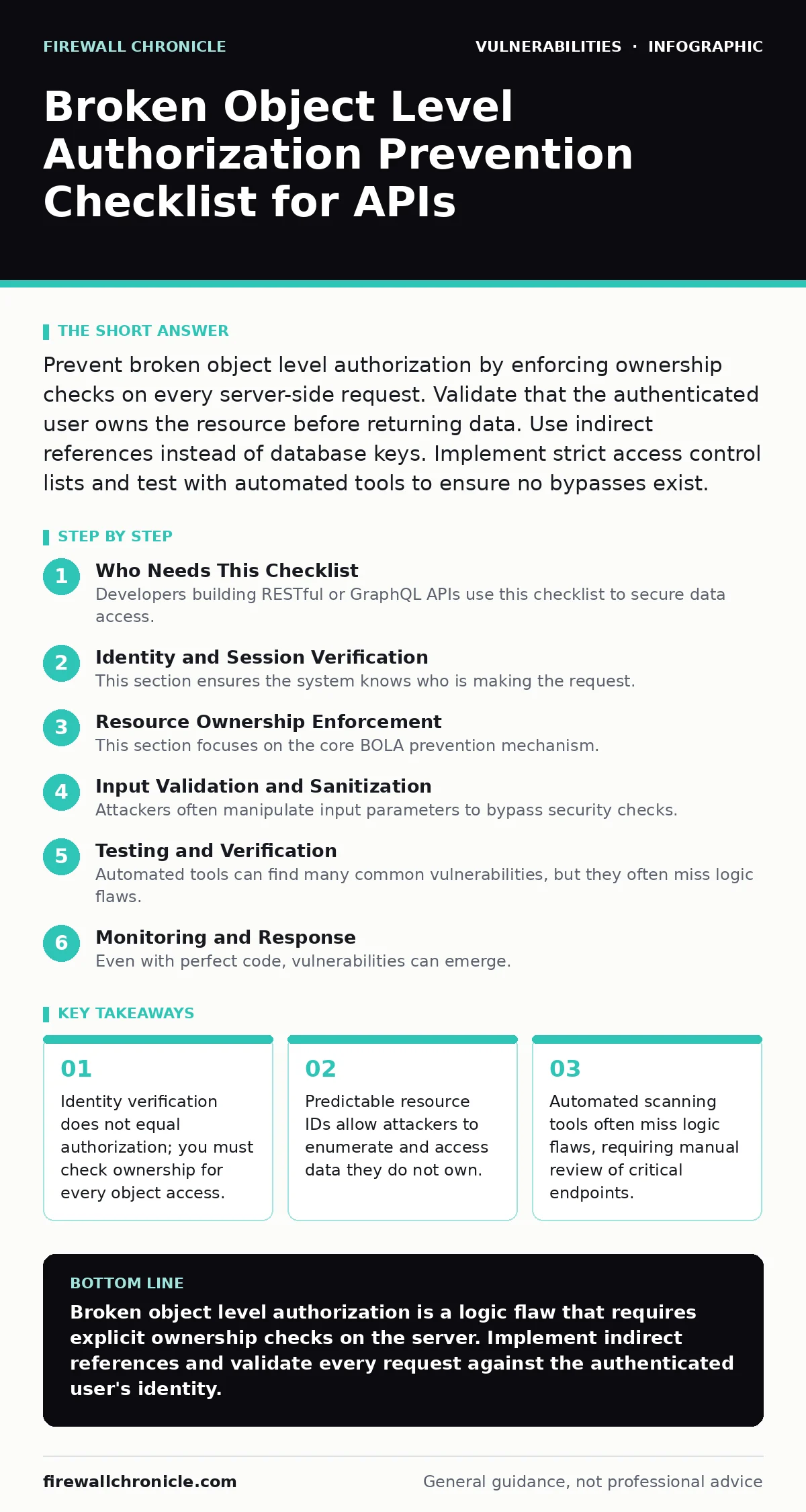
Prevent broken object level authorization by enforcing ownership checks on every server-side request. Validate that the authenticated user owns the resource before returning data. Use indirect references instead of database keys. Implement strict access control lists and test with automated tools to ensure no bypasses exist.
Who Needs This Checklist
Developers building RESTful or GraphQL APIs use this checklist to secure data access. Broken object level authorization, often called BOLA, occurs when an API endpoint exposes data without verifying that the requester owns it. You might authenticate a user correctly, but if you fail to check if they own the specific record, you create a vulnerability. Use this list during code reviews and before deployment.
Identity and Session Verification
This section ensures the system knows who is making the request. Authentication confirms identity, while authorization confirms permission. You must separate these concerns clearly.
- Validate session tokens on every request: Expired or forged tokens should be rejected immediately to prevent unauthorized access.
- Verify user roles against required permissions: A standard user should not access admin-level resources even with a valid session.
- Check for token tampering or reuse: Replaying old tokens can allow access after a user has been logged out or disabled.
- Enforce short token expiration times: Short-lived tokens reduce the window of opportunity for attackers to steal and use credentials.
Authentication proves who you are. Authorization proves what you can do. Many developers assume that because a user is logged in, they can access any resource associated with their account. This assumption fails when the server uses the same token to fetch different types of data. You must check permissions for each specific action.
Resource Ownership Enforcement
This section focuses on the core BOLA prevention mechanism. You must prove the user owns the data they request. Database primary keys are often sequential and predictable. Attackers guess these IDs to access other users' data.
- Compare resource owner ID with session user ID: The server must verify the record belongs to the authenticated user before returning it.
- Use indirect object references: Map public-facing IDs to internal database keys to prevent enumeration attacks.
- Reject requests for non-existent resources with generic errors: Specific error messages can reveal if an ID exists, aiding attackers.
- Implement strict access control lists: Define explicit rules for who can read, write, or delete each type of object.
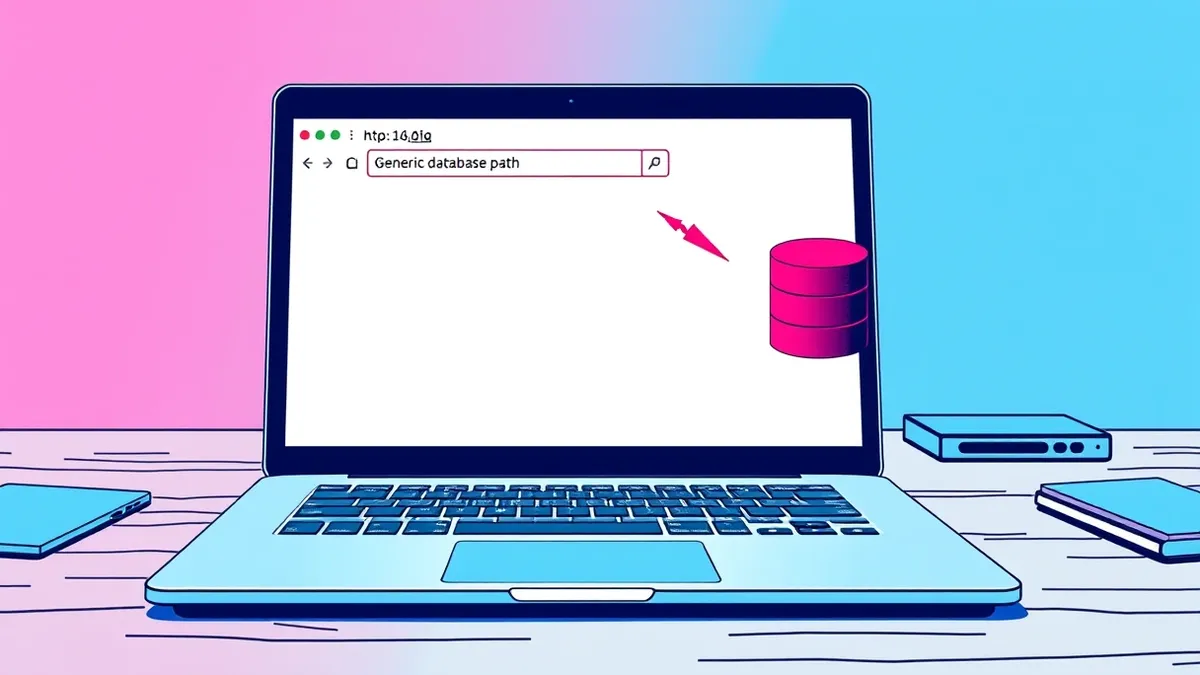
Imagine an API endpoint /api/users/123/profile. If you only check if the user is logged in, any logged-in user can change the ID to 124 and view another person's profile. This is BOLA. To prevent it, the server must look up the profile ID 123, find the owner, and compare that owner to the current user's ID. If they do not match, the server returns a 403 Forbidden error.
Input Validation and Sanitization
Attackers often manipulate input parameters to bypass security checks. You must validate all inputs strictly. This prevents injection attacks and ensures data integrity.
- Validate input types and formats: Ensure IDs are integers or UUIDs, not strings that could contain injection payloads.
- Sanitize user-supplied data before processing: Remove or escape characters that could alter the intended query or command.
- Limit input length and complexity: Excessively long or complex inputs can cause buffer overflows or denial of service.
- Use parameterized queries for database access: This prevents SQL injection, which can bypass authorization checks entirely.
Parameterized queries are a standard defense against SQL injection. They ensure that user input is treated as data, not as part of the command structure. This separation is critical because an attacker might try to inject a condition like OR 1=1 into an ID field. If your code uses string concatenation, this injection could return all records. Parameterized queries prevent this by binding the input as a literal value. See our guide on parameterized queries for implementation details.
Testing and Verification
Automated tools can find many common vulnerabilities, but they often miss logic flaws. BOLA is a logic flaw. You need a mix of automated and manual testing.
- Run automated security scans regularly: Tools can identify missing authentication headers or exposed endpoints.
- Perform manual penetration testing: Human testers can think creatively to find bypasses that scripts miss.
- Test with different user roles: Verify that a low-privilege user cannot access high-privilege resources.
- Review error handling logic: Ensure errors do not leak sensitive information about the application structure.
Penetration testing involves simulating real-world attacks to find weaknesses. While automated scanners check for known patterns, human testers explore the application's logic. They might try to swap user IDs in API calls to see if the server checks ownership. This manual process is vital because BOLA depends on the specific business logic of your application. See our guide on penetration testing for methodology.
Monitoring and Response
Even with perfect code, vulnerabilities can emerge. Continuous monitoring helps detect unauthorized access attempts.
- Log all authorization failures: Track failed attempts to access resources by users who do not own them.
- Alert on unusual access patterns: Sudden spikes in access to different user profiles may indicate an attack.
- Review logs for potential BOLA attempts: Look for sequences of requests with incrementing IDs from a single source.
- Implement rate limiting on sensitive endpoints: This slows down automated attacks that try to enumerate user IDs.
Monitoring provides visibility into your system's behavior. If you see a user trying to access hundreds of different profiles in a short time, it is likely an attack. Rate limiting prevents the attacker from trying every possible ID quickly. This does not stop the attack, but it buys time for your security team to respond.
Common Misconceptions
Many developers believe that certain practices protect against BOLA. They do not.
- Hiding API endpoints does not secure them: Attackers can discover endpoints through documentation or traffic analysis.
- Using HTTPS does not prevent BOLA: Encryption protects data in transit, but does not verify object ownership.
- Trusting client-side state is dangerous: Any data sent from the client can be modified by the user.
Security through obscurity fails. If an endpoint exists, assume attackers know about it. Your defense must be in the server-side logic, not in hiding the URL. This principle applies to all web applications. See our guide on host header injection for another example of where hidden assumptions fail.
Key takeaways
- Identity verification does not equal authorization; you must check ownership for every object access.
- Predictable resource IDs allow attackers to enumerate and access data they do not own.
- Automated scanning tools often miss logic flaws, requiring manual review of critical endpoints.
Broken object level authorization is a logic flaw that requires explicit ownership checks on the server. Implement indirect references and validate every request against the authenticated user's identity.
Frequently asked questions
How do I detect BOLA in my existing application?
Review your API endpoints to see if they check resource ownership. Use automated tools and manual testing to verify that users cannot access data they do not own.
Is BOLA only a problem for REST APIs?
No, BOLA can affect any API that exposes resources via identifiers. GraphQL and SOAP APIs are also vulnerable if they do not enforce strict access controls.
Can a WAF prevent BOLA attacks?
Web application firewalls can block some common attack patterns, but they cannot understand business logic. You must implement server-side checks to prevent BOLA.
What is the difference between BOLA and BFLA?
Broken object level authorization affects individual records, while broken function level authorization affects entire functions or features. Both require strict access controls.
How this guide was produced: written by the Firewall Chronicle editorial team with AI assistance, checked against the public references listed below, and reviewed when the facts change. See our editorial policy or report an error.