
Cryptojacking Myths: Why Your Antivirus Isn't Enough
Most cryptojacking operates within legitimate browser sessions and containerized environments, rendering traditional signature-based detection nearly useless against resource theft.
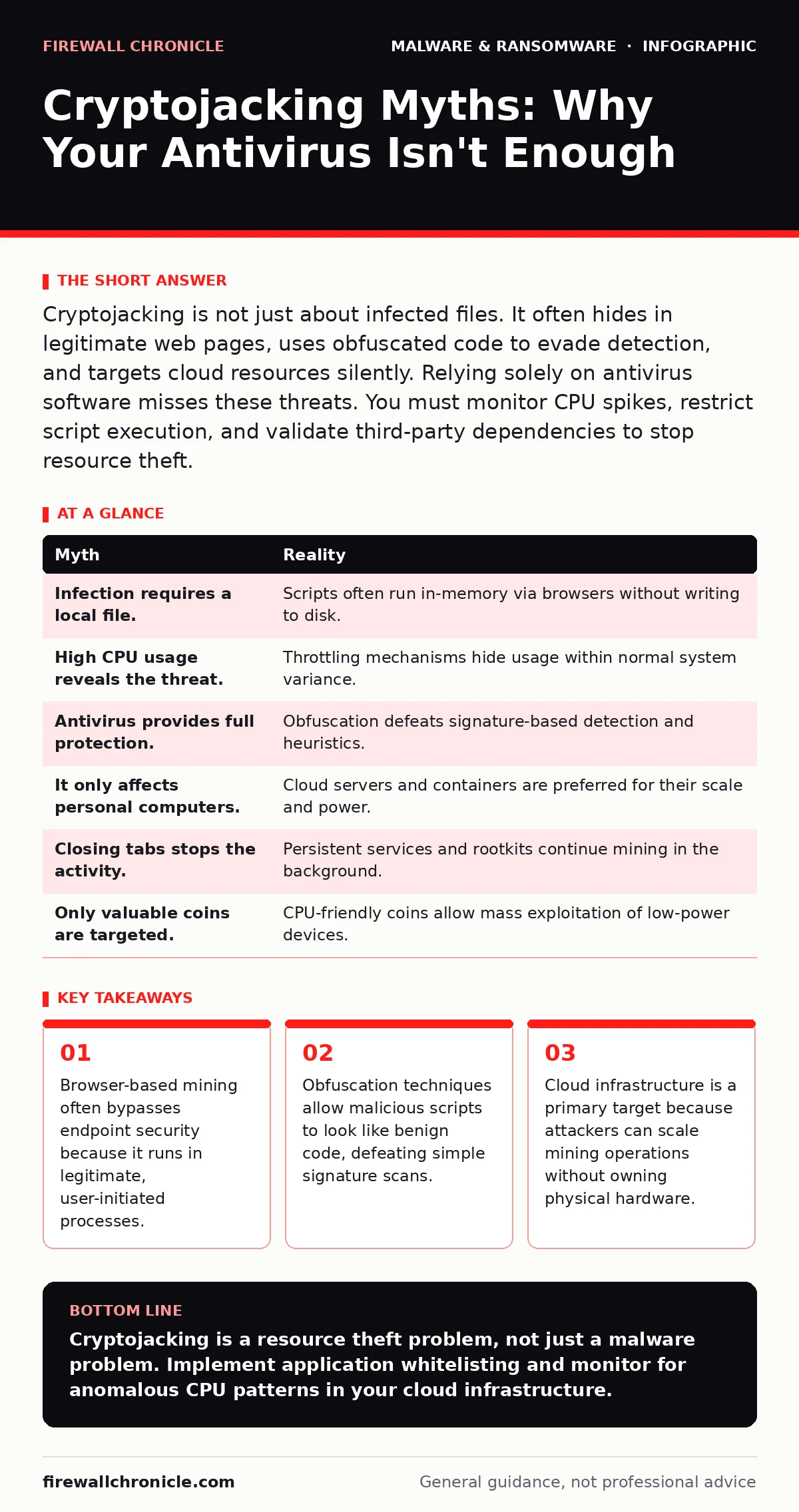
Cryptojacking is not just about infected files. It often hides in legitimate web pages, uses obfuscated code to evade detection, and targets cloud resources silently. Relying solely on antivirus software misses these threats. You must monitor CPU spikes, restrict script execution, and validate third-party dependencies to stop resource theft.
Myth: Cryptojacking Only Infects Local Files on Windows Machines
Reality: This belief assumes that malware must reside as a static executable on your hard drive to cause harm. In modern environments, the most common entry point is the web browser itself. Attackers embed JavaScript mining scripts directly into legitimate websites or compromised ad networks. When you visit the site, the code executes in memory within the browser process. It never writes a file to disk.
Traditional endpoint detection tools scan for known file hashes or suspicious registry changes. They miss in-memory execution entirely. The threat lives and dies with the browser tab. If you close the tab, the mining stops, but the damage to your CPU cycle has already occurred. This vector is particularly dangerous because it relies on social engineering and trust in popular web properties rather than technical exploits.
Myth: High CPU Usage Is an Unmistakable Sign of Infection
Reality: Modern cryptojacking is designed to be stealthy by design. Attackers know that sustained high CPU usage triggers alerts and user complaints. Consequently, they implement throttling mechanisms. These scripts monitor system load and pause mining operations when the user interacts with the mouse or keyboard. On a powerful workstation or a multi-core server, this usage is indistinguishable from normal background tasks.
You might not notice the fan spinning up or the system slowing down. The financial gain for the attacker is slower, but the longevity of the infection is higher. This trade-off favors persistence over immediate yield. Without deep packet inspection or behavioral analysis, you will likely attribute minor performance dips to software updates or heavy applications.
Myth: Next-Generation Antivirus Can Stop All Cryptojacking
Reality: While next-generation antivirus solutions offer better heuristic analysis than legacy tools, they struggle with polymorphic code. Cryptojacking scripts are frequently obfuscated. Obfuscation transforms readable code into a complex, unreadable format that functions identically but looks different to scanners. Attackers use tools to randomize variable names, inject junk code, and encode strings. Each time the script loads, it may present a unique signature.
Signature-based detection fails here because it has never seen that specific variant. Even behavioral heuristics can be fooled if the script mimics legitimate high-computation tasks, such as video rendering or scientific simulations. The antivirus sees a process using CPU cycles but cannot definitively prove it is malicious without false positives. You need application control policies, not just virus scanning, to restrict which processes are allowed to execute scripts.
Myth: Cryptojacking Is Primarily a Consumer Problem
Reality: Enterprise environments and cloud infrastructure are far more lucrative targets. Consumer devices have limited processing power and are often disconnected or low-spec. Servers, however, offer high-performance CPUs and GPUs that can mine cryptocurrency at scale. Attackers target containerized environments and virtual machines because they can compromise one instance and replicate the payload across hundreds of others. This is known as lateral movement.
In cloud environments, the cost of the mining operation is often passed to the victim in the form of increased cloud compute bills. The attacker extracts value without paying for the electricity or hardware. This economic shift makes cloud cryptojacking highly sustainable for threat actors. They exploit misconfigured permissions and unpatched containers to gain access. The impact is not just lost compute time, but direct financial theft via inflated utility costs.
Myth: Closing Browser Tabs Immediately Stops the Mining
Reality: This is true for simple, client-side scripts that run only while the page is active. However, more sophisticated attacks persist beyond the session. If the initial script downloads a secondary payload, that payload may install itself as a background service. On Windows, this could be a scheduled task; on Linux, a systemd service. These services start automatically upon reboot. They run independently of the browser.
Closing the tab does nothing to stop the background process. Furthermore, some attacks exploit vulnerabilities in the browser engine itself to achieve persistence. They may modify system files or install rootkits. A rootkit is a collection of software tools that enables unauthorized access to a computer while actively hiding its presence. Once installed, the mining continues even if you clear your cache and cookies. You must inspect running processes and startup items, not just browser history.
See also: Configuration Drift: How Small Teams Lose Cloud Control · Mutable vs Immutable Infrastructure: Why State Changes Break Security
Myth: Only Cryptocurrencies With High Market Value Are Worth Mining
Reality: Attackers choose cryptocurrencies based on the difficulty of the mining algorithm and the hardware requirements, not just market price. Some coins are designed to be mineable on CPUs rather than specialized hardware like ASICs or GPUs. This lowers the barrier to entry for attackers. They can use the existing CPU power of compromised devices to mine these specific coins.
Even if the coin has a low value, the sheer volume of compromised devices can generate significant revenue. This is an economy of scale. The attacker does not need one powerful machine; they need thousands of weak ones. This distributed approach, often called a botnet, allows them to mine coins that would be unprofitable on a single workstation. The choice of coin is a strategic decision to maximize compatibility with the stolen resources.
| Myth | Reality |
|---|---|
| Infection requires a local file. | Scripts often run in-memory via browsers without writing to disk. |
| High CPU usage reveals the threat. | Throttling mechanisms hide usage within normal system variance. |
| Antivirus provides full protection. | Obfuscation defeats signature-based detection and heuristics. |
| It only affects personal computers. | Cloud servers and containers are preferred for their scale and power. |
| Closing tabs stops the activity. | Persistent services and rootkits continue mining in the background. |
| Only valuable coins are targeted. | CPU-friendly coins allow mass exploitation of low-power devices. |
Key takeaways
- Browser-based mining often bypasses endpoint security because it runs in legitimate, user-initiated processes.
- Obfuscation techniques allow malicious scripts to look like benign code, defeating simple signature scans.
- Cloud infrastructure is a primary target because attackers can scale mining operations without owning physical hardware.
Cryptojacking is a resource theft problem, not just a malware problem. Implement application whitelisting and monitor for anomalous CPU patterns in your cloud infrastructure.
Frequently asked questions
How do I detect browser-based cryptojacking?
Use browser extensions specifically designed to block mining scripts and monitor for unexpected CPU spikes when idle. Check for unknown extensions that you did not install.
Can I remove cryptojacking myself?
If it is browser-based, clearing cache and removing suspicious extensions helps. For persistent infections, you must inspect startup items, scheduled tasks, and running processes for unfamiliar entries.
Does disabling JavaScript stop cryptojacking?
It stops client-side browser mining, but it breaks many modern websites. It does not stop malware that has already installed itself on the operating system.
Are Linux servers immune to cryptojacking?
No. Linux servers are heavily targeted due to their power. Attackers exploit vulnerabilities in web applications and container runtimes to deploy mining daemons.
How this guide was produced: written by the Firewall Chronicle editorial team with AI assistance, checked against the public references listed below, and reviewed when the facts change. See our editorial policy or report an error.